
Water parameters
Overview
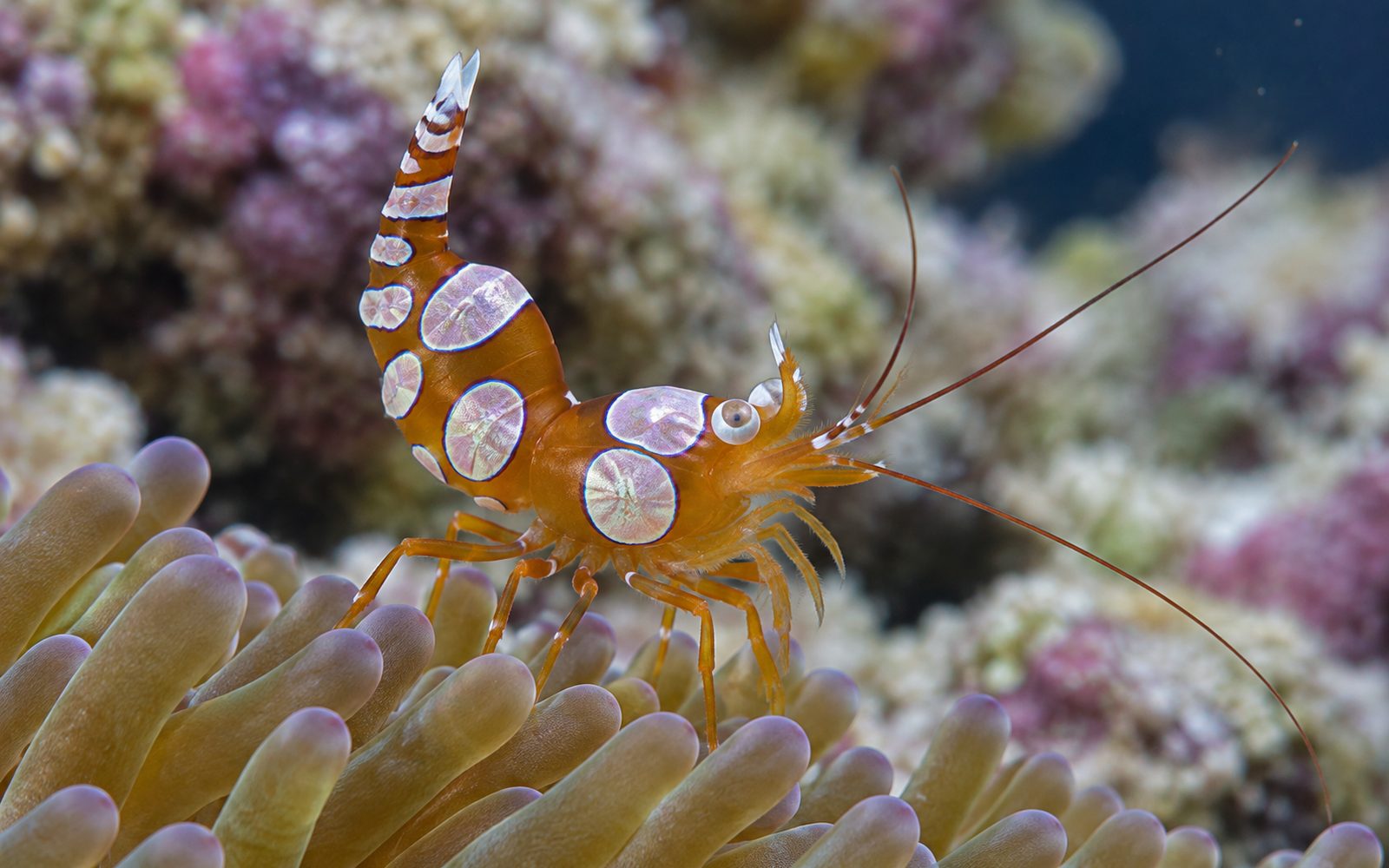
The sexy shrimp gets its name from constantly wiggling its abdomen, which it holds raised over its back. The blue-edged white spots on its brown-orange body sparkle in the light. Because it does not exceed 1.5–2 cm, it is one of the favorite animals for 20–60 liter nano reefs, and it is much more visible when kept in a group.
In the wild it lives in symbiosis with anemones and some corals; in the aquarium an anemone is not essential, and it is also comfortable among rocks and corals. Specimens in the trade are wild-collected.
Natural Habitat
It lives in small groups on the shallow tropical reefs of the Indo-Pacific and Western Atlantic, among the tentacles of anemones and around mushroom corals and other corals. The host's stinging tentacles protect it from predatory fish; the shrimp is resistant to these tentacles.
Tank Setup
- Volume: a mature nano reef of 20 liters or more for 3–5 individuals.
- Water: salinity 1.023–1.026 specific gravity, pH 8.1–8.4, temperature 24–27°C.
- Reef compatibility: Reef-safe with caution. Most individuals are harmless, but some are reported to pick at zoanthids and mushroom corals and to eat the mucus of their host anemone.
- Filter: because of its tiny size, filter and pump intakes should be protected with sponges.
- Acclimation and medication: Acclimate by the drip method for at least 1 hour. Copper-based medications are lethal.
Diet
Omnivorous; it feeds on leftover food, detritus and small particles around corals. In the aquarium it can be given finely ground granules, frozen copepods, brine shrimp and chopped mysis. In aquariums with large, fast fish it struggles to reach the food; in nano reefs fine food a few times a week is enough.
Behavior and Compatibility
Peaceful and calm; it gets along well with its own kind. It is visible during the day as well, but when startled it darts in among the rocks. If there is a host such as a bubble tip anemone, they mostly gather around it.
Good companions: small gobies, dwarf blennies, clownfish, cardinalfish; snails, small hermit crabs, bubble tip anemone.
Avoid: hawkfish, wrasses, dottybacks (Pseudochromis), triggerfish, lionfish; boxer shrimp and large crabs.
Group and Colony Structure
Since it lives in small groups in the wild, it is best to start with 3–5 individuals. This number is enough for nano aquariums; above 100 liters, 5–8 individuals can be kept. A larger group behaves more boldly and stays visible all day. A single individual also survives but hides more.
Breeding
The female carries her eggs under her abdomen; the larvae are released into the water and go through a planktonic stage. Although egg-carrying females are often seen in the aquarium, the larvae do not survive in home conditions; breeding is rare outside specialized larval rearing setups.
Health and Common Problems
- Molting: it sheds its shell at short intervals; it hides during molting.
- Sudden deaths: copper, rapid acclimation, sudden salinity changes.
- Losses: most "disappearances" are actually getting sucked into the filter or being hunted by a fish.
Sexing
The female is noticeably larger (about 2 cm) with a fuller abdomen. Males are smaller and slimmer. An individual carrying eggs is female.
Tank mates
This list is calculated automatically from the species profile and grows as new species are added to the catalog. Try it in the planner for a definite answer.
Should not be kept together



Hobbyist notes
Things you won't find in books, learned by trial and error. The most helpful ones are on top.
Change history and contributors
- Page created · October 16, 2026