
Water parameters
Overview
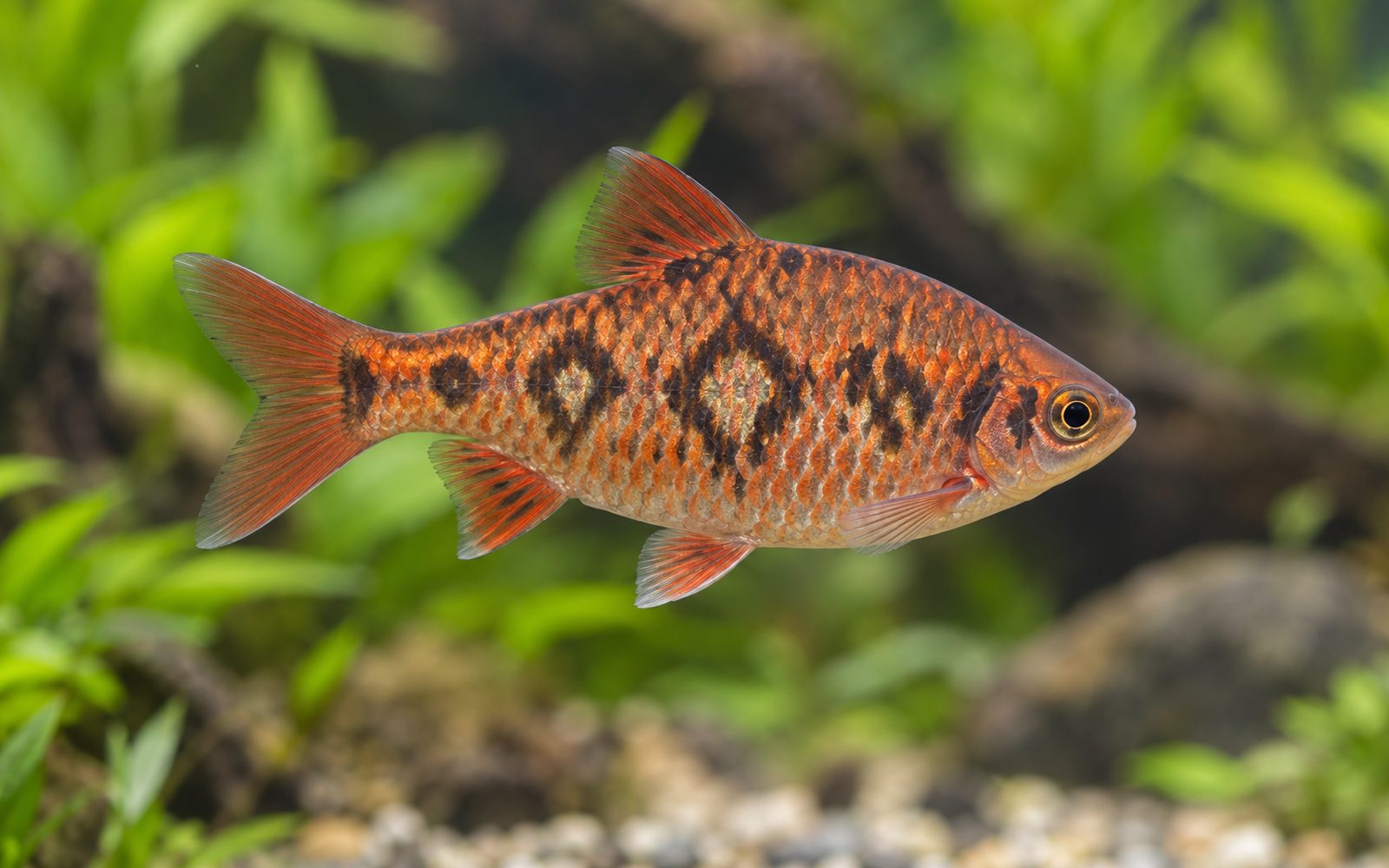
The snakeskin barb is a small barb endemic to the blackwaters of Borneo. The dark blotches on its body take the form of rings or rhombuses with light centers; this pattern resembles snakeskin, which gives it its name. Its body color changes from orange-red to brownish depending on its surroundings and mood.
It is a peaceful, calm species. Because it is sensitive to water quality, it needs a mature tank with soft water.
Natural Habitat
It lives in slow-flowing blackwaters in the peat swamp forests of Kalimantan. The water is tea-colored from tannins, very soft and acidic; the bottom is covered with fallen leaves and twigs.
Tank Setup
- Volume: at least 60 liters and 60 cm in length for a group of 8–10.
- Water: 24–27°C; soft, acidic water (pH 5.5–6.5 is ideal). Stable parameters are important.
- Decor: dark substrate, roots, dried leaves, dense planting and dim light with floating plants.
- Flow: gentle; break up a strong filter outlet with plants or a sponge.
- Maintenance: a 20–25% weekly water change; make parameter changes slowly. It should not be added to a newly set-up tank.
Diet
Omnivorous. It accepts small granules and flakes; vary the diet with frozen brine shrimp, daphnia, cyclops and small bloodworms. Live foods improve color and condition.
Behavior and Compatibility
Peaceful and somewhat shy. It behaves more boldly in a large group and in a planted, dimly lit setting; males occasionally display to each other.
Good companions: harlequin rasboras, small tetras, pencilfish, five-banded barbs, corydoras, otocinclus, dwarf shrimp.
Avoid: large, fast and dominant fish; aggressive cichlids.
Group and Colony Structure
Keep at least 8, ideally 10 or more. The group forms a loose school; when kept in small numbers, the fish hide and lose their color.
Breeding
An egg scatterer; it deposits its eggs on fine-leaved plants or moss and provides no parental care. Fish conditioned with soft, acidic water and live food may spawn in a separate breeding tank; since the parents eat the eggs, they should be separated afterwards.
Health and Common Problems
It becomes stressed in hard water and fluctuating parameters; white spot and bacterial infections may occur. Quarantine new arrivals and acclimate them to the water slowly. Move fish that were kept in hard water at the store gradually to soft, acidic water over a few days. Farm-bred fish are somewhat more flexible, but even so their color fades noticeably above pH 7.
Sexing
Males are slimmer and redder, especially while displaying. Females have a fuller belly and paler tones.
Tank mates
This list is calculated automatically from the species profile and grows as new species are added to the catalog. Try it in the planner for a definite answer.
Usually compatible
 Flame Tetra
 Blackfin Corydoras
 Polystictus Corydoras
 Emerald Cory
 Porthole Catfish
 Keyhole Cichlid
 Cupid Cichlid
 Geophagus altifrons
 Geophagus surinamensis
 Cryptocoryne Parva
Should not be kept together






Hobbyist notes
Things you won't find in books, learned by trial and error. The most helpful ones are on top.
Change history and contributors
- Page created · October 16, 2026