
Water parameters
Overview
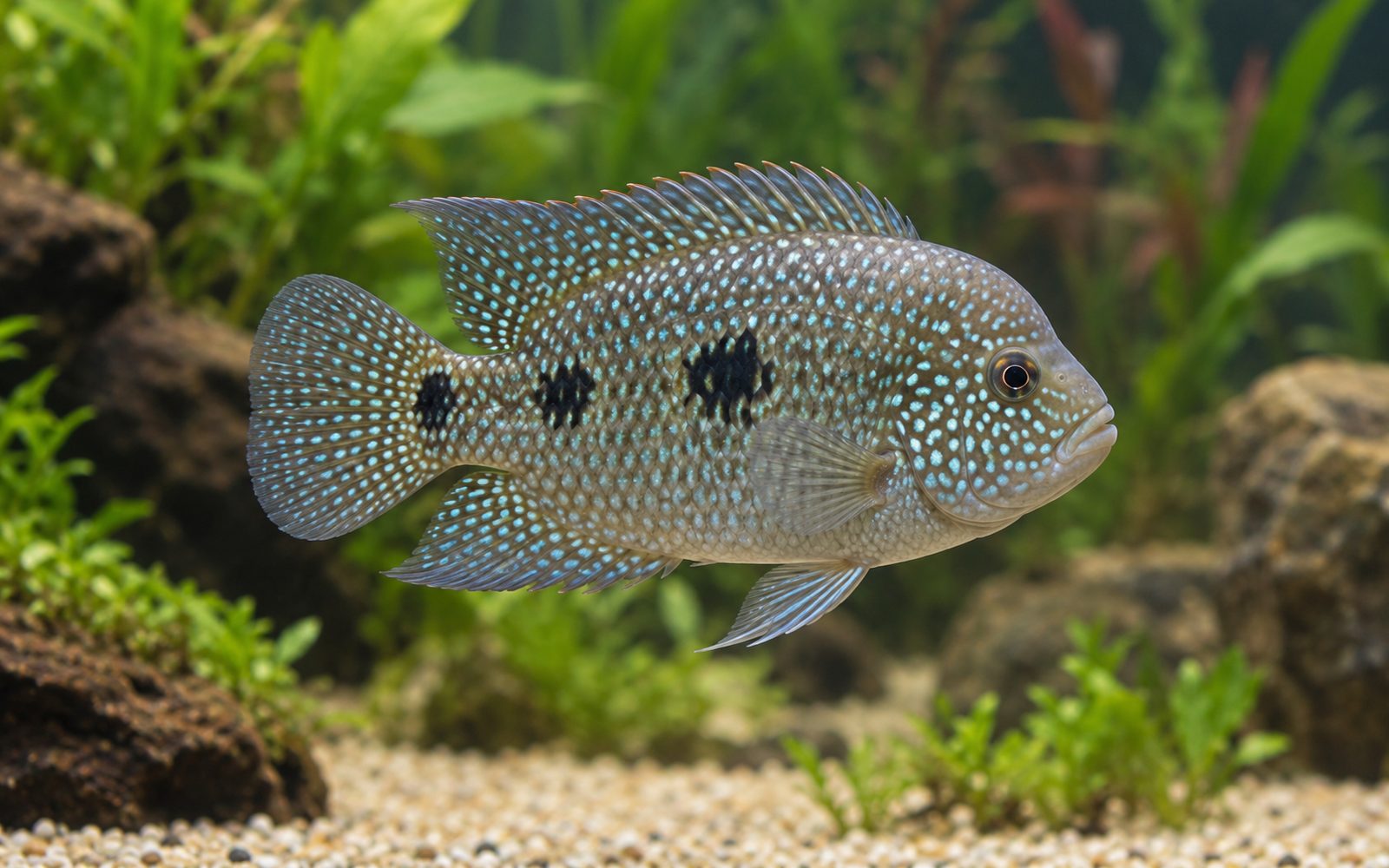
The Texas cichlid is the only cichlid species that lives naturally in the United States. Its gray–green body is covered in pearly white or light blue spots that shine on every scale; there are dark blotches in the middle of the body and on the caudal peduncle. Mature males develop a nuchal hump on the forehead.
It is a long-lived, hardy fish with personality, but it reaches 25–30 cm and fiercely defends its territory. The colorful fish sold in the trade under names like "red Texas" are hybrids of this species with other cichlids; they are not the pure species.
Natural Habitat
It lives in rivers, spring pools and canals of the Rio Grande (Río Bravo) basin in northeastern Mexico and southern Texas. In this region the water cools noticeably in winter, which is why the species tolerates cooler water than many tropical cichlids. It has introduced populations in other parts of Texas and in states such as Florida and Louisiana; aquarium fish must never be released into the wild.
Tank Setup
- Volume: at least 300 liters and 150 cm of length for a single adult or a pair.
- Decor: large rocks and roots; it digs deep into the substrate and knocks over light decor. Keeping plants is difficult.
- Water: moderately hard, slightly alkaline water; 22–26°C is ideal. A 30% water change weekly.
- Equipment: a powerful canister filter and a guarded heater.
Diet
Omnivorous. Make large cichlid granules the staple; vary them with frozen shrimp, mysis, bloodworms and vegetables such as peas and spinach. One meal a day is enough for adults.
Behavior and Compatibility
Relatively docile when young; it becomes territorial and aggressive as it matures. During breeding it claims most of the aquarium.
Good companions: robust cichlids of similar size (Jack Dempsey, green terror, Vieja species) in a very large aquarium; large plecos; silver dollars.
Avoid: small community fish, shrimp, snails, calm species such as angelfish and discus, planted layouts.
Group and Colony Structure
It can be kept alone. A pair forms when juveniles are raised together; a male and female put together later may fight. A bonded pair becomes severely aggressive toward other individuals.
Breeding
During breeding the pair takes on a striking coloration typical of Herichthys species: the front half of the body turns white and the rear half turns deep black. A few hundred to over a thousand eggs are laid on a cleaned stone; the larvae are moved into dug pits. Both parents guard the fry for weeks.
Health and Common Problems
- Hole-in-the-head disease (HLLE): in poor water quality.
- Injuries: from fights and decor.
- Excessive temperature: immunity weakens in water constantly above 28°C.
Sexing
The male is larger, with a prominent nuchal hump and longer fins. The female is smaller and rounder. Sexing is confirmed by the papilla.
Tank mates
This list is calculated automatically from the species profile and grows as new species are added to the catalog. Try it in the planner for a definite answer.
Usually compatible
 Banded Jewel Cichlid
 Spotted Tilapia
 Flowerhorn
 Jack Dempsey
 Jaguar Cichlid
 Red Devil Cichlid
 Red Terror Cichlid
 Convict Cichlid
 Cryptocoryne Parva
 Wolf Cichlid
Should not be kept together








Hobbyist notes
Things you won't find in books, learned by trial and error. The most helpful ones are on top.
Change history and contributors
- Page created · October 16, 2026