
Water parameters
Overview
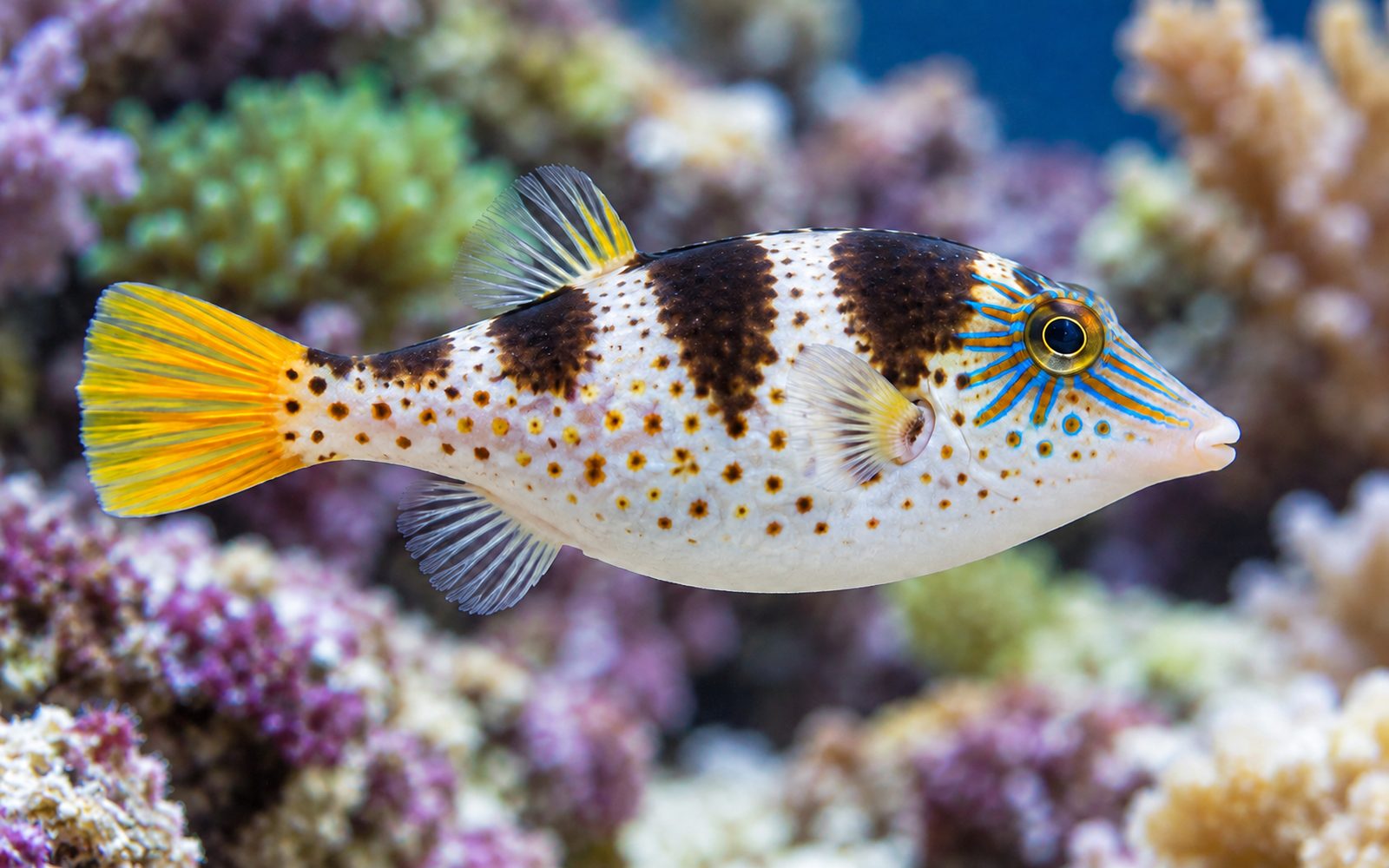
The Valentini puffer is the best-known species of the small sharp-nosed pufferfish (Canthigaster, "toby"). Its white body has four dark saddles on the back, orange–brown spots on the sides and blue lines around the eyes. Because of the toxic secretion in its skin, predators avoid eating it; for this reason a non-toxic filefish (Paraluteres prionurus) mimics its appearance.
Toxin warning: Like all pufferfish it carries tetrodotoxin; it must not be eaten. Substances it releases under stress can affect other fish in a small aquarium. Do not take the fish out of the water; inflating by swallowing air is harmful.
Specimens are wild-collected; the species is generally robust and switches easily to prepared food.
Natural Habitat
It lives among corals and rocks in the lagoons and on the reef flats of the Indo-Pacific. In the wild it forms harems made up of one male and several females; it feeds on algae, small crustaceans, worms and coral polyps.
Tank Setup
- Volume: At least 120 liters.
- Water: Salinity specific gravity 1.023–1.026, pH 8.1–8.4, temperature 24–27°C.
- Decor: Rockwork and open swimming space.
- Maintenance: A 10–15% water change weekly. Protect equipment such as heaters and hoses, since it may bite them.
- Reef compatibility: Reef-safe with caution. Some specimens bite soft and LPS corals, tube worms and the mantle of Tridacna clams; small shrimp, snails and hermit crabs may be eaten. It is risky for reefs where the cleanup crew is important.
Diet
Carnivorous. Frozen mysis, krill, chopped mussels and shrimp, small snails and marine fish granules. Shelled foods wear down its beak-like teeth. Small amounts twice a day.
Behavior and Compatibility
Curious and bold; it constantly patrols the aquarium and can hover in place by beating its pectoral fins like a helicopter. When threatened it inflates its body by swallowing water; doing this often is a sign of stress. It may nip the fins of slow-swimming and long-finned fish. It usually gets along with fast fish of its own size.
Good companions: Tangs, dwarf angelfish, damselfish, clownfish, wrasses, cardinalfish.
Avoid: Seahorses and pipefish, slow long-finned fish, small shrimp, other Canthigaster species (in a small aquarium).
Group and Colony Structure
Usually kept as a single specimen in the aquarium. A pair can be tried in a large aquarium; two males fight.
Breeding
In the wild the female lays her eggs among algae on the bottom; the eggs are also thought to be toxic and thus protected from predators. Breeding in the home aquarium is rare.
Health and Common Problems
- Tooth overgrowth: If shelled foods are not offered, the beak grows too long.
- Copper sensitivity: Because of its scaleless skin it is sensitive to copper treatment.
- Marine white spot: It can be prone to it; quarantine is recommended.
Sexing
Males may be slightly larger; they cannot be reliably distinguished externally.
Tank mates
This list is calculated automatically from the species profile and grows as new species are added to the catalog. Try it in the planner for a definite answer.
Should not be kept together


Hobbyist notes
Things you won't find in books, learned by trial and error. The most helpful ones are on top.
Change history and contributors
- Page created · October 16, 2026