
Water parameters
Overview
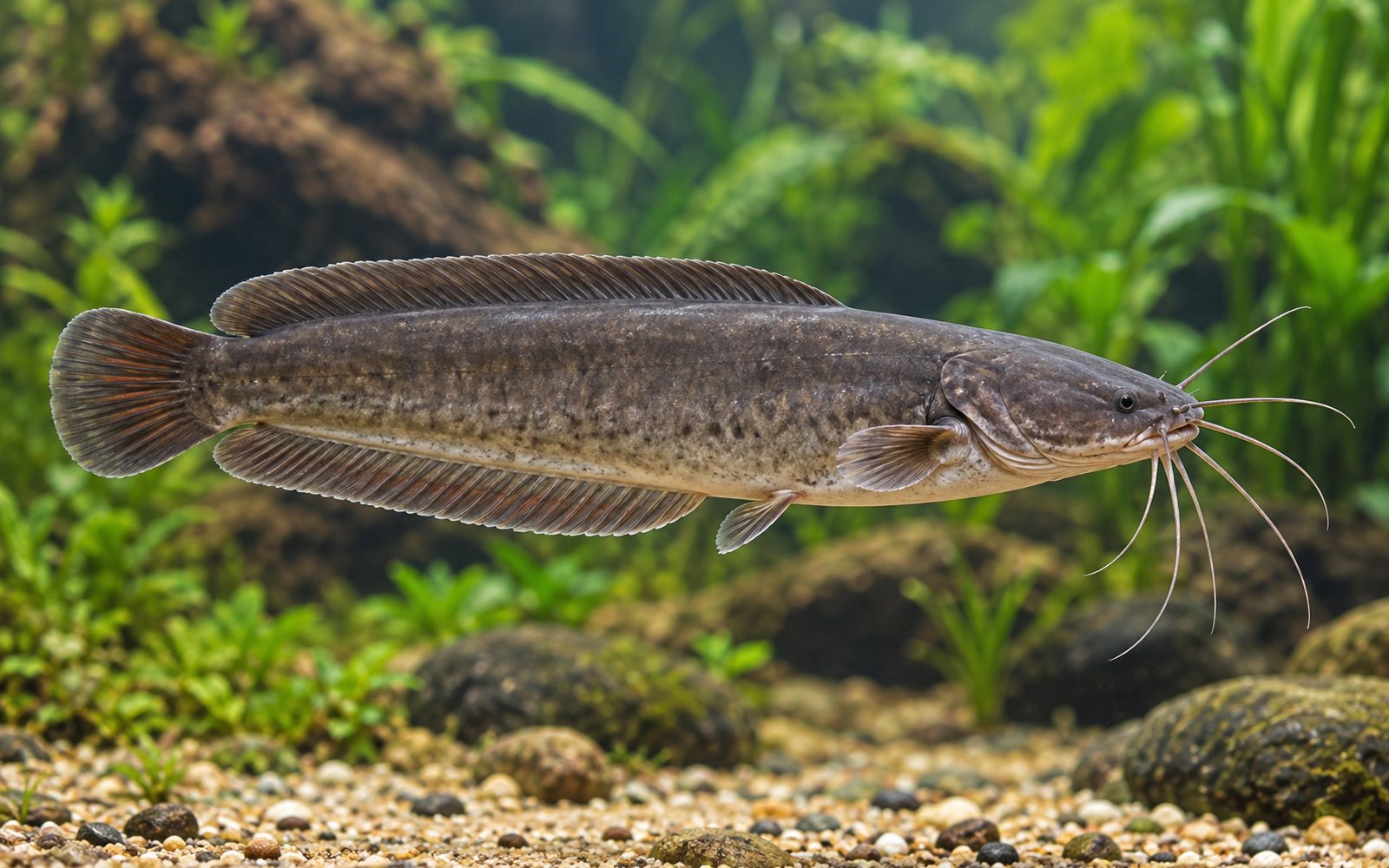
Thanks to the branched accessory breathing organ above its gills, the walking catfish can take oxygen from the air. As long as it stays moist, it can survive out of water for hours, and it covers short distances on land by bracing on its pectoral spines and wriggling its body; it gets its name from this "walking". It is easily recognized by its long, eel-like body, the fins running along its back and belly, and its four pairs of barbels.
Legal and ethical warning: in many areas where it has been released (e.g., the US state of Florida) this species has become invasive and has harmed native fish species; in some countries such as the United States, importing and keeping it is banned. Adults reach 40–45 cm. Never release a grown fish into the wild. The albino form is the one most commonly sold in the trade; some individuals may be other Clarias species or hybrids.
Color and Fin Varieties
- Albino (albino walking catfish): a form with a pinkish-white body and red eyes. It is the form most often seen in the trade; its size and behavior are the same as the normal form.
Natural Habitat
It lives in swamps, ponds, rice paddies, canals and slow-flowing, oxygen-poor waters. In the dry season it survives by burying itself in mud or by crossing land to other pools of water.
Tank Setup
- Volume: at least 400 liters and 150 cm of length for a single adult.
- Lid: a heavy, sturdy lid that leaves no gaps is essential; it can escape through any opening, including holes for hoses. A fish that escapes from the aquarium soon dries out and dies.
- Substrate: sand; the fish digs and uproots plants.
- Decor: sturdy roots, large rocks and pipes; light decor gets knocked over.
- Filter: strong filtration; it eats a lot and produces a lot of waste.
Diet
Carnivorous and opportunistic. Offer fish fillet, shrimp, mussels, worms and large sinking granules. Feeding juveniles once a day and adults every other day is enough. Live feeder fish can carry disease.
Behavior and Compatibility
An aggressive predator. It eats any fish that fits in its mouth and may attack larger fish too. It is also intolerant of its own kind. It is more active at night.
Good companions: it is best kept alone. In very large aquariums, only fish larger and sturdier than itself (large cichlids, big pacus) can be tried.
Avoid: all small and medium-sized fish, shrimp, snails, planted aquariums.
Group and Colony Structure
It is kept as a single individual. Two walking catfish can seriously injure each other.
Breeding
In the wild it breeds during the rainy season in muddy pits or nests in shallow water; the parents are known to guard the eggs. Breeding in home aquariums is rare.
Health and Common Problems
- Escape: the most common cause of death is escaping from the aquarium and drying out.
- It is hardy; insufficient volume and dirty water lead to skin wounds and barbel rot.
- The pectoral spines are hard and sharp; be careful when handling it.
Sexing
Males have a long, pointed genital papilla behind the vent; in females it is shorter and rounded. Mature females are plumper.
Tank mates
This list is calculated automatically from the species profile and grows as new species are added to the catalog. Try it in the planner for a definite answer.
Usually compatible
 Banded Jewel Cichlid
 Spotted Tilapia
 Flowerhorn
 Jack Dempsey
 Jaguar Cichlid
 Red Devil Cichlid
 Red Terror Cichlid
 Cryptocoryne Parva
 Wolf Cichlid
 Zebra Tilapia
Should not be kept together








Hobbyist notes
Things you won't find in books, learned by trial and error. The most helpful ones are on top.
Change history and contributors
- Page created · October 16, 2026