
Water parameters
Overview
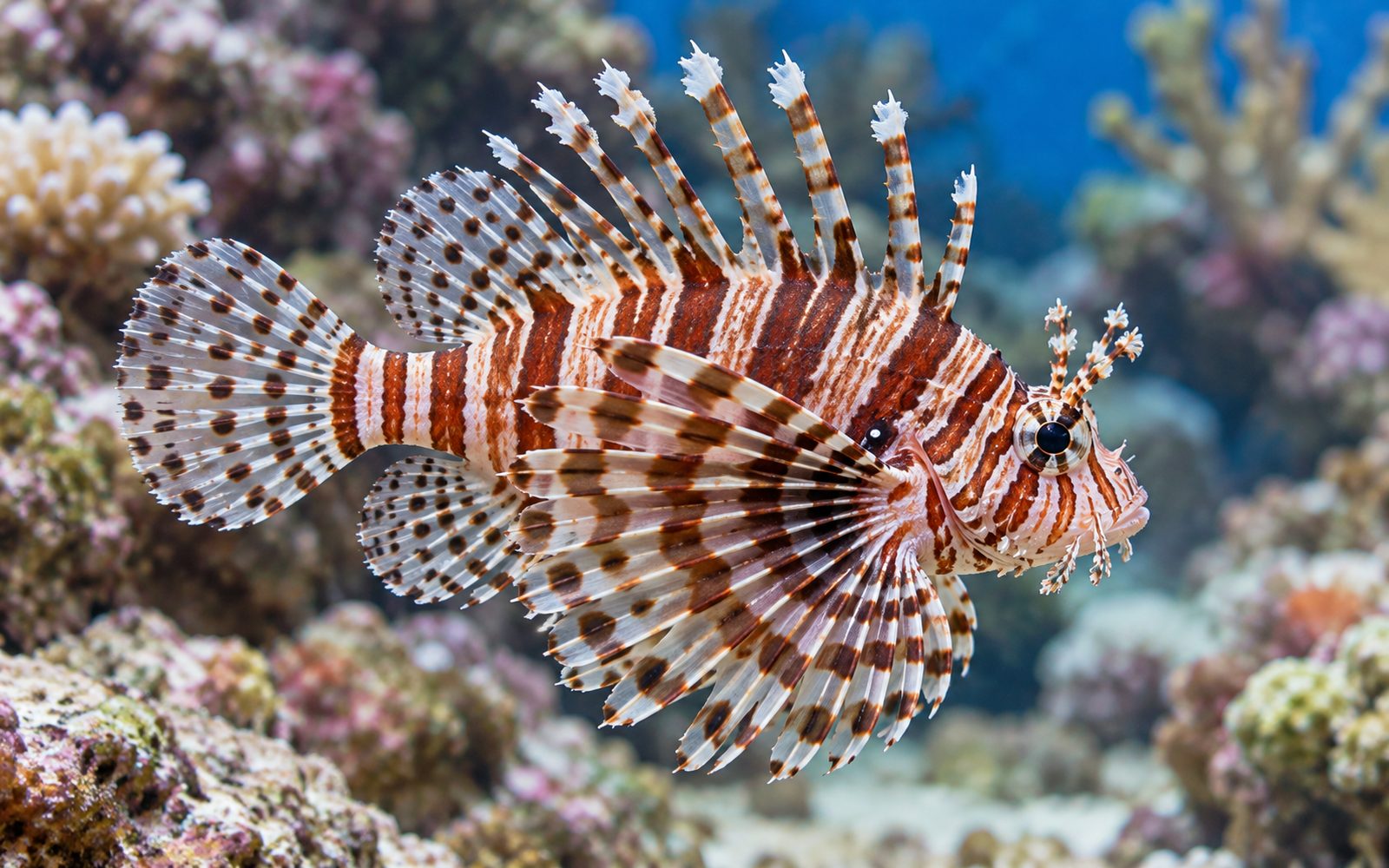
The zebra lionfish is a smaller, stockier relative of the common lionfish (Pterois volitans). Its body is covered with reddish-brown and white bands. The rays of its pectoral fins are not separate as in the larger lionfish, but joined by the membrane between them; that is why its fins open like a fan. In the aquarium it stays around 18–20 cm, which makes it a suitable lionfish for smaller aquariums.
Venomous spine warning: The dorsal, pelvic and anal spines are venomous; a sting is very painful. Wear gloves when working in the aquarium. If stung, immerse the wound in water as hot as can be tolerated (about 45°C, without scalding) for 30–90 minutes and seek medical attention.
Specimens are wild-collected; specimens that adapt to the aquarium can live for many years. Never release it into the wild.
Natural Habitat
On Indo-Pacific reefs and in lagoons it rests under rock overhangs and in caves during the day; at dusk and at night it hunts small crustaceans and fish.
Tank Setup
- Volume: At least 200 liters.
- Water: Salinity specific gravity 1.020–1.025, pH 8.1–8.4, temperature 24–27°C.
- Decor: Caves and overhangs to rest in during the day; a hunting area in front of them.
- Maintenance: A 10–15% water change weekly. Locate the fish before putting your hand into the aquarium; while resting it may blend in with the rock and go unnoticed.
- Reef compatibility: Reef-safe with caution: it leaves corals alone, but eats shrimp, small crabs and fish that fit in its mouth.
Diet
Carnivorous. Live food may be needed in the first days; over time it should be weaned onto thawed mysis, shrimp, fish meat and squid with a feeding stick. Live freshwater feeder fish should not be given. Juveniles are fed once a day, adults 3–4 times a week.
Behavior and Compatibility
Calm and slow; it spends most of its time waiting on the bottom or under an overhang. In the evening, when the lights dim, it becomes more active. It is a predator: anything that fits in its mouth counts as prey.
Good companions: Calm fish too large to fit in its mouth: tangs, dwarf angelfish (larger specimens), foxface, large cardinalfish, moray eels.
Avoid: Small fish (gobies, cardinalfish, anthias), shrimp, seahorses, fin-nipping triggerfish and pufferfish.
Group and Colony Structure
Usually kept as a single specimen. In a large aquarium several dwarf lionfish of similar size can live together.
Breeding
In the wild, courtship and spawning take place at nightfall; as in the larger lionfish, the eggs are released as floating masses enclosed in mucus. It does not breed in the home aquarium.
Health and Common Problems
- Fatty liver: With overfeeding.
- Skin shedding: Shedding its skin like a thin film is normal.
- Copper sensitivity: It is sensitive to copper treatment.
Sexing
Cannot be reliably distinguished externally; males may be slightly larger.
Tank mates
This list is calculated automatically from the species profile and grows as new species are added to the catalog. Try it in the planner for a definite answer.
Should not be kept together


Hobbyist notes
Things you won't find in books, learned by trial and error. The most helpful ones are on top.
Change history and contributors
- Page created · October 16, 2026