
Water parameters
Overview
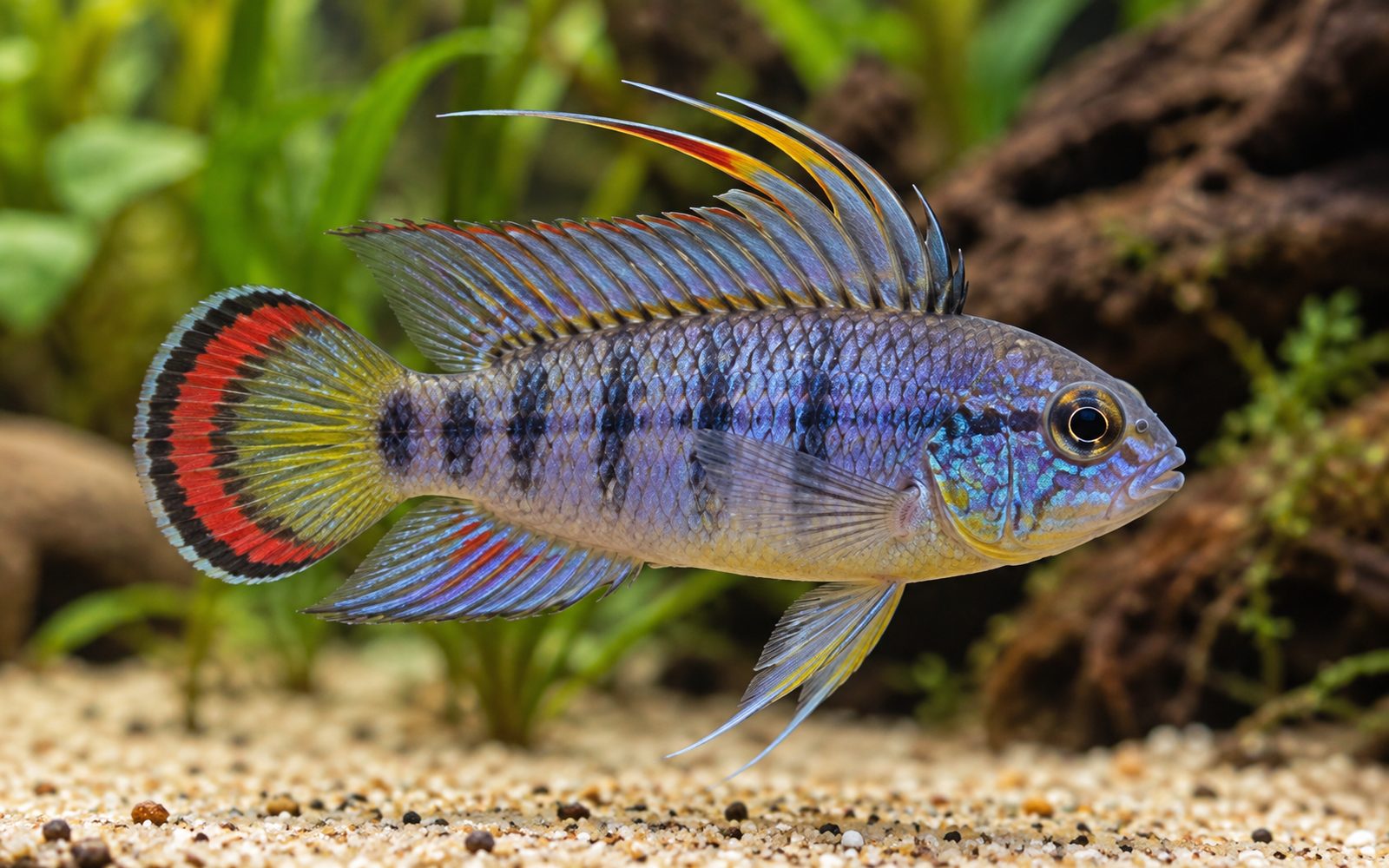
Apistogramma baenschi was scientifically described in 2004 after being sold for many years as "Apistogramma sp. Inca" or "Inka 50." It belongs to the same group of relatives as the panda apisto (A. nijsseni). The male's body is in bluish–purple tones, and its tail carries a black-edged red crescent band on a greenish–yellow base; with age the front membranes of the dorsal fin extend like a flag.
Females look completely different, with bold dark bars on the rear half of the body over a yellow background. Because its natural habitat is cool and very soft, it should be kept at a lower temperature than most Apistogramma.
Natural Habitat
It lives in northern Peru in shallow forest streams flowing into the lower Huallaga River, in the area between Tarapoto and Yurimaguas. The water is tea-colored, very soft and acidic; because of the shady forest canopy it is cooler than the Amazon lowlands.
Tank Setup
- Volume: at least 60 liters for one male and two females.
- Temperature: 22–25°C. Keeping it at 27°C or above for long periods causes stress.
- Water: pH 5–6.5, GH 1–5; with most tap water, RO water is needed. Dried leaves and roots improve both the water and the colors.
- Decor: caves, fine sand, leaf litter, dim light and gentle flow.
Diet
Carnivorous. Small live and frozen foods such as brine shrimp, cyclops, daphnia and fine bloodworms should be the staple. It accepts granules once accustomed to them; live food markedly increases the urge to breed.
Behavior and Compatibility
Males are territorial but more moderate than most Apistogramma. A female guarding fry chases away anything that approaches her cave. It hunts shrimplets; it is not suitable for an aquarium where shrimp are bred.
Good companions: small tetras that tolerate cool, soft water (ember, cardinal), pencilfish, small rasboras, otocinclus.
Avoid: discus and rams, which need warm water, large cichlids, hard-water species, shrimp breeding.
Group and Colony Structure
Males usually form a harem: 1 male and 2 females. Some males prefer to pair with a single female; in that case they can be kept as a pair. A separate cave and visual barriers for each female are essential.
Breeding
The female lays her eggs inside a cave or crevice and takes on their care. Very soft, acidic water is required for the eggs to develop normally; in hard water the eggs turn fungused. The yellow color and dark bars of a female guarding fry become very pronounced. The fry are fed newly hatched brine shrimp.
Health and Common Problems
High temperature, hard water and nitrate buildup are the most common causes of health problems in this species. It is hardy when values are kept stable; new fish should be observed in quarantine.
Sexing
Males reach about 6–7 cm; they have a purple-blue body, a red crescent tail and long dorsal fins. Females are noticeably smaller, with a yellow, barred body, short fins and a plain tail.
Tank mates
This list is calculated automatically from the species profile and grows as new species are added to the catalog. Try it in the planner for a definite answer.
Usually compatible
 Emerald Betta
 Emerald Cory
 Porthole Catfish
 Keyhole Cichlid
 Festivum
 Geophagus surinamensis
 Cryptocoryne Parva
Adonis Pleco
Cryptocoryne Parva
Adonis Pleco
 African Glass Catfish
Should not be kept together





Hobbyist notes
Things you won't find in books, learned by trial and error. The most helpful ones are on top.
Change history and contributors
- Page created · October 16, 2026