
Water parameters
Overview
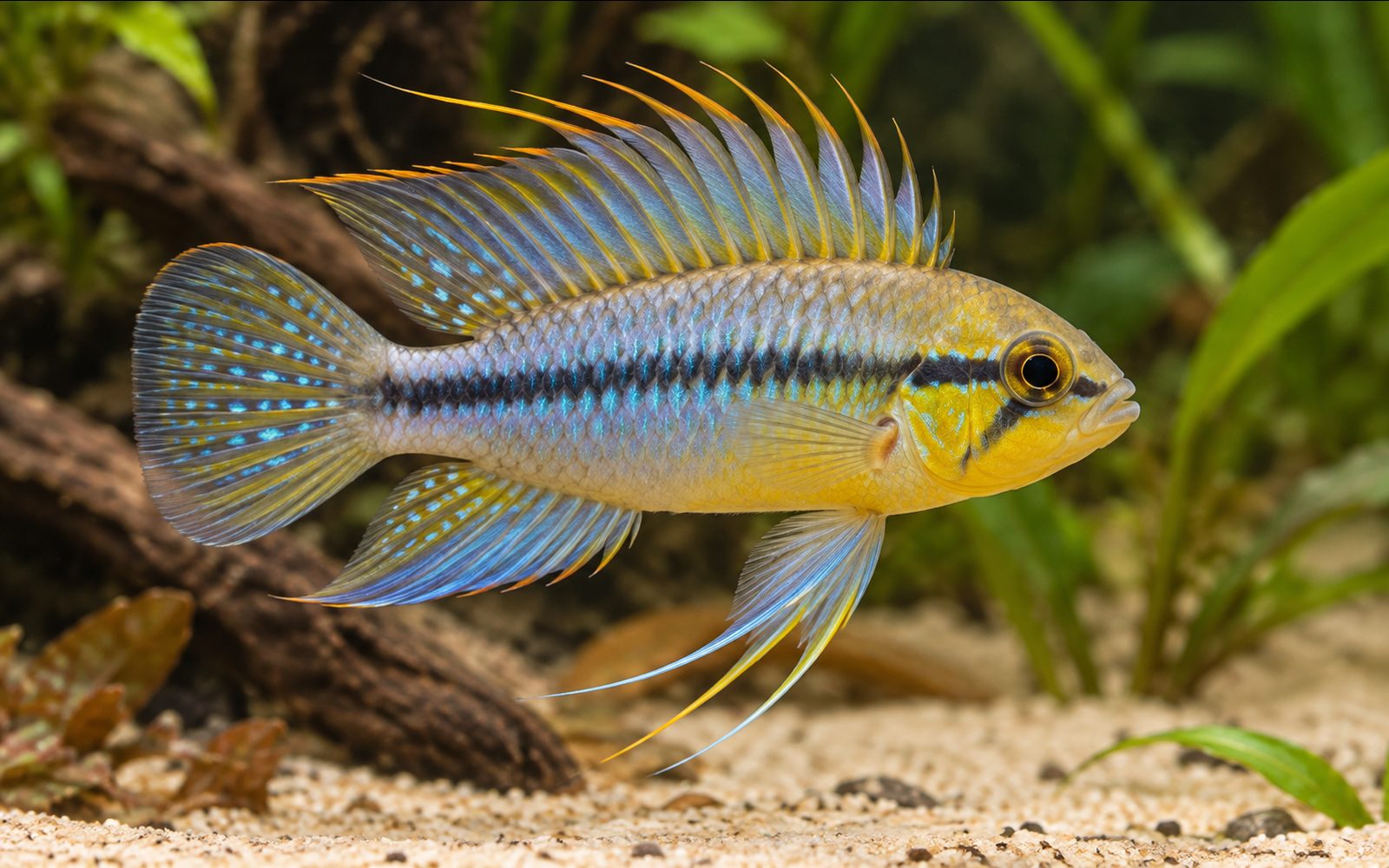
Apistogramma borellii is one of the smallest and most docile species in the genus. The male's dorsal fin opens like a taut sail or umbrella; the head and chest are yellow and the body is in bluish–opal tones. The pelvic fins are long and pointed.
Because its natural range extends to the south of South America, into waters that cool down seasonally, it tolerates lower temperatures and harder water than the Amazon Apistogramma. This makes it a good start for those who want to get to know Apistogramma. In older sources and some stores it also appears under the name Apistogramma reitzigi; today this name is a synonym of borellii.
Color and Fin Varieties
- Opal (Apistogramma sp. 'Opal'): a form with a body in blue tones with an opal shimmer. Because some experts think it may be a separate species, it is recommended not to cross it with other borellii lines.
Natural Habitat
It lives in the streams, swamps and shallow side channels of the Paraguay, Paraná and Uruguay river systems. These waters are wrapped in vegetation, slow-flowing and usually soft. In winter the water temperature drops noticeably; the species has adapted to this fluctuation.
Tank Setup
- Volume: 60 liters is enough for one male and 2–3 females.
- Temperature: 22–25°C is its comfortable range; very warm water is not needed.
- Decor: a cave for each female, fine sand, roots and dense plants. Leave some open space at the front for the male, which displays by spreading its dorsal fin.
- Water: soft to moderately hard, pH 6–7.5. A 25% water change every week.
Diet
Carnivorous. Make small frozen foods (brine shrimp, cyclops, daphnia, fine bloodworms) the staple; it also takes small granules. Its mouth is small, so large tablets are not suitable.
Behavior and Compatibility
It is among the most peaceful Apistogramma; males mostly establish dominance over each other through displays. Even so, a female guarding fry defends her cave determinedly. It hunts shrimplets and may also attack adult shrimp.
Good companions: small tetras (black neon, ember tetra), pencilfish, small rasboras, otocinclus; in a large aquarium, Corydoras species that like cooler water.
Avoid: rams and discus, which need warm water, large cichlids, fast and fin-nipping barbs, shrimp breeding tanks.
Group and Colony Structure
As a harem: 1 male and 2–3 females. Each female claims the area around her own cave. Thanks to its docile nature, two males can also be kept in a well-divided aquarium of 100 liters or more.
Breeding
The female lays a few dozen eggs on the ceiling of the cave and takes on their care alone; the eggs hatch in 2–3 days. A female guarding fry turns lemon yellow, and the black band through her eye and the dark blotch on her body become pronounced. Once the fry are free-swimming they are fed newly hatched brine shrimp and microworms. In a small aquarium, if the female chases the male, the male may need to be removed.
Health and Common Problems
Hardy, but nitrate buildup and dirty substrate lead to bacterial infections. Wild fish can be delicate; new fish should be observed in quarantine.
Sexing
Males reach 6–7 cm and have a yellow head and bluish body; the dorsal fin is very tall and the pelvic fins long. Females are 4–5 cm, yellowish–gray and short-finned. When guarding fry, the female turns bright yellow.
Tank mates
This list is calculated automatically from the species profile and grows as new species are added to the catalog. Try it in the planner for a definite answer.
Usually compatible
 Emerald Betta
 Emerald Cory
 Porthole Catfish
 Keyhole Cichlid
 Firemouth Cichlid
 Buffalohead Cichlid
 Festivum
 Geophagus surinamensis
 Rainbow Cichlid
Should not be kept together





Hobbyist notes
Things you won't find in books, learned by trial and error. The most helpful ones are on top.
Change history and contributors
- Page created · October 16, 2026