
Water parameters
Overview
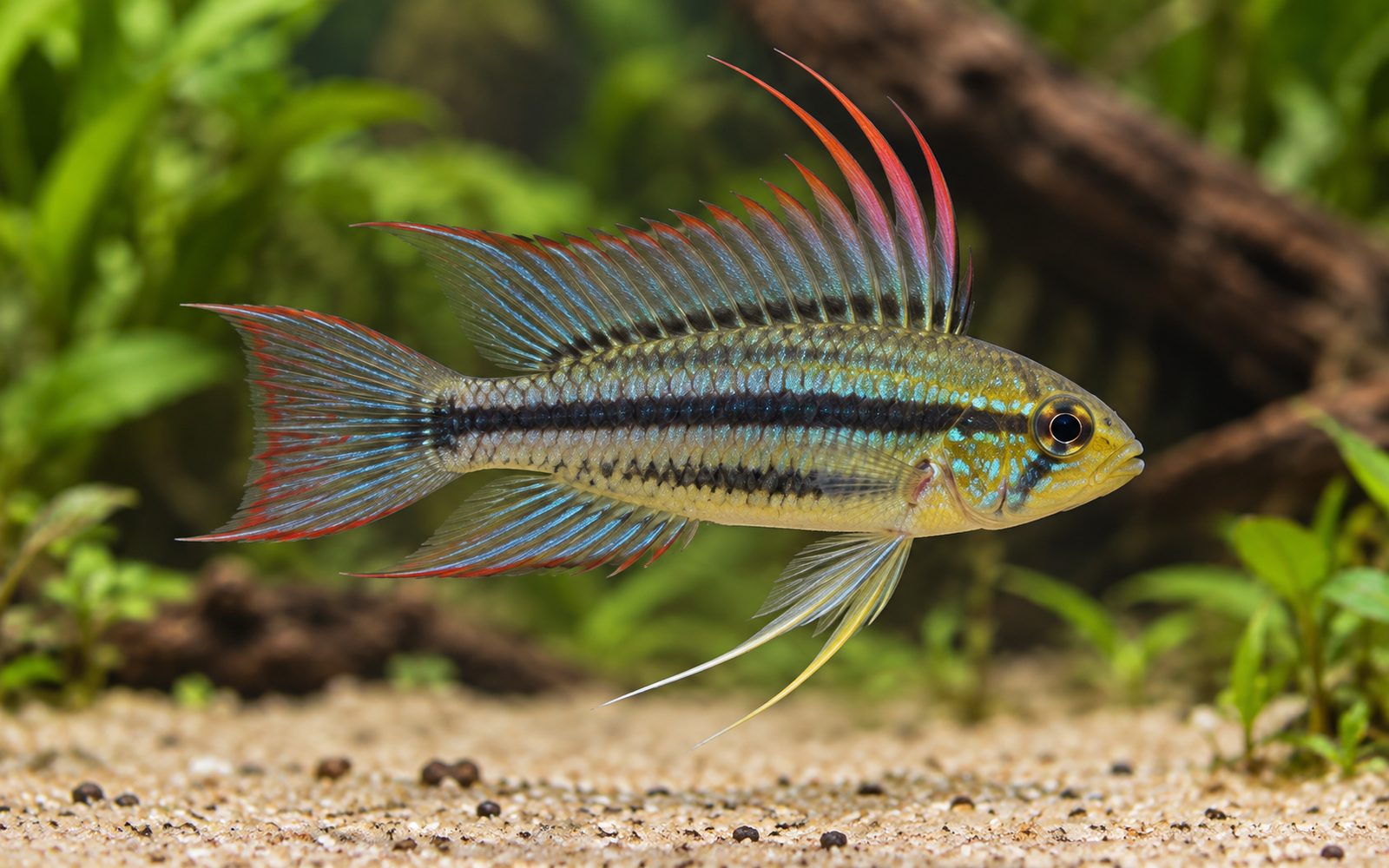
Apistogramma trifasciata takes its name from the dark horizontal stripes on its body: below the main band running from the eye to the tail, there are additional stripes along the belly. The male's body varies from emerald green to steel blue, and its head is yellowish. The front rays of the dorsal fin extend upward like a flag and the fin is partly red-toned; the pelvic fins are also long and pointed.
Despite its small size, it is an active and showy species. It shows its best color in soft water; in a calm planted aquarium, the males' fin-spreading displays are worth watching.
Natural Habitat
It ranges from the Guaporé tributary of the southern Amazon to the Paraguay basin and the middle Paraná. Slow streams covered with leaf litter, small river side channels and planted shallows are its typical habitat. The water is usually soft and slightly acidic.
Tank Setup
- Volume: at least 60 liters for one male and 2–3 females.
- Decor: a small cave for each female, dense plants, roots and dried leaves. An open sand area in the foreground for the displaying male.
- Substrate: fine sand.
- Water: 24–26°C, soft and slightly acidic is ideal; it adapts to moderate hardness in a short time. A 25% water change every week.
Diet
Carnivorous. Small frozen or live foods such as cyclops, daphnia, brine shrimp and fine bloodworms should be the staple. It accepts small granules once accustomed to them; its mouth is small, so watch the food size.
Behavior and Compatibility
Males can be harsh with each other but readily accept several females. It does not bother peaceful midwater fish. It eats shrimplets; it is not suitable for an aquarium where dwarf shrimp are bred.
Good companions: small tetras (black neon, ember, cardinal), pencilfish, small rasboras, otocinclus.
Avoid: crowds of barbs that feed fast, large cichlids, two males in one aquarium (in a small volume), shrimp breeding.
Group and Colony Structure
A harem: 1 male and 2–3 females. Each female sets up a small territory around her cave; the male patrols them all. A single pair also works, but there must be places where the female can hide.
Breeding
The female lays her eggs inside the cave and takes on their care alone. The eggs hatch in 2–3 days, and the fry become free-swimming a few days later. During this period the female turns bright yellow and her black markings become pronounced. The fry are fed newly hatched brine shrimp and microworms. Soft, slightly acidic water supports the healthy development of the eggs.
Health and Common Problems
It is sensitive to dirty water and nitrate buildup; keeping values stable is important. Newly arrived fish should be observed in quarantine; internal parasites can occur in imported fish.
Sexing
Males reach 5–6 cm; their dorsal fins are very tall, their pelvic fins long and their colors blue–green. Females are about 4 cm, yellowish and short-finned; when guarding fry, a black pattern appears on a yellow background.
Tank mates
This list is calculated automatically from the species profile and grows as new species are added to the catalog. Try it in the planner for a definite answer.
Usually compatible
 Emerald Betta
 Emerald Cory
 Porthole Catfish
 Keyhole Cichlid
 Cupid Cichlid
 Buffalohead Cichlid
 Geophagus surinamensis
 Rainbow Cichlid
 Gymnogeophagus balzanii
Should not be kept together






Hobbyist notes
Things you won't find in books, learned by trial and error. The most helpful ones are on top.
Change history and contributors
- Page created · October 16, 2026