
Water parameters
Overview
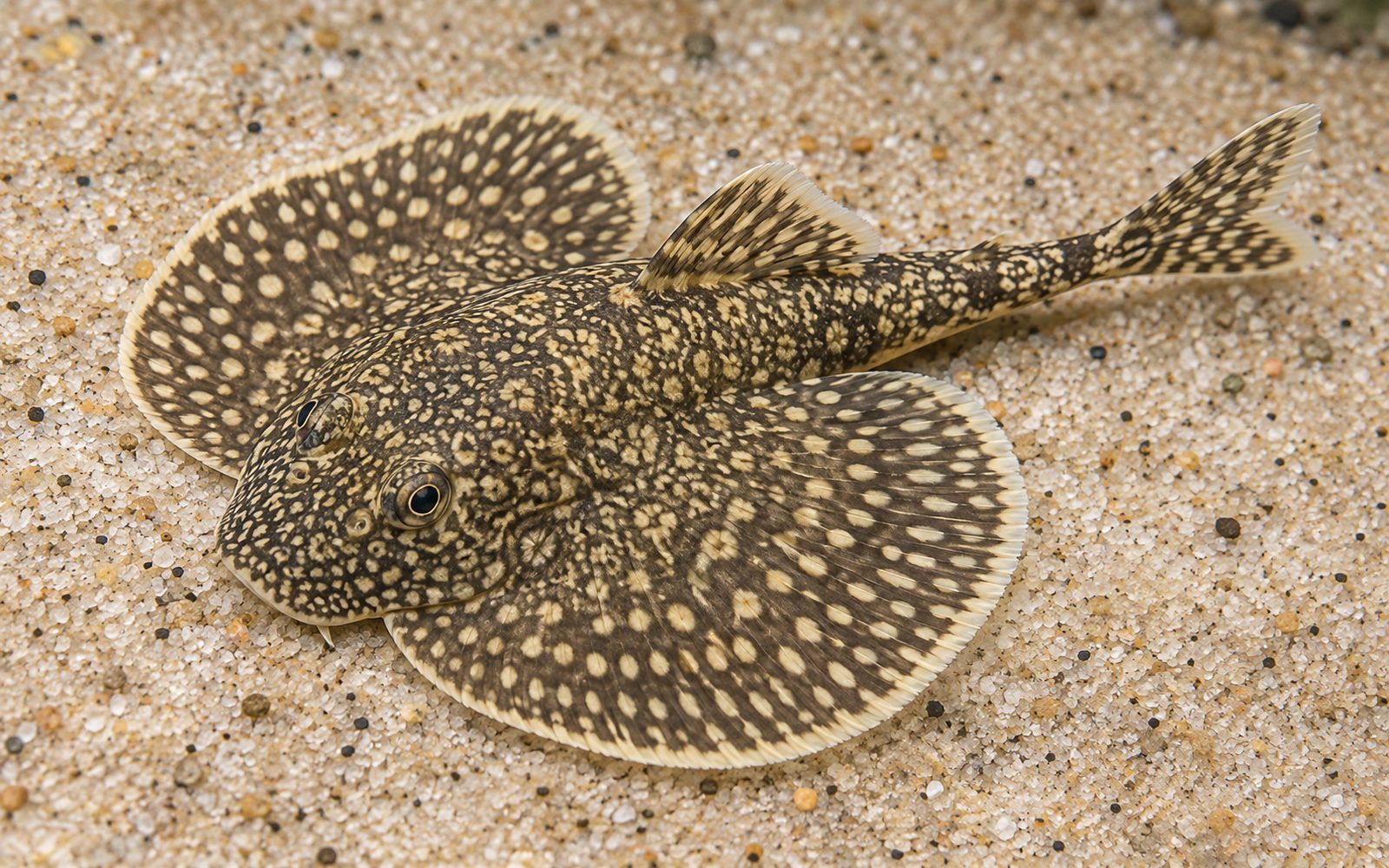
With its very flat body and fins spreading out to both sides like wings, the butterfly loach resembles a small butterfly or a stingray when it clings to the glass. It has light spots and fine veining on a dark olive-gray background. Adults reach 6–7 cm.
It is also sold in the trade as the "Hong Kong pleco" or "butterfly pleco", but it is not a pleco; it is a hillstream loach from the carp order. Because these names are also used for other hillstream loaches, the species should be checked when buying. It is the only species of the genus Beaufortia known in the trade.
Natural Habitat
It lives in mountain streams of the West River system in southern China. In shallow, fast-flowing, rocky stretches it holds its position against the current by clinging to stones. The water is cool, clear and saturated with oxygen.
Tank Setup
- Volume: at least 60 liters and 60 cm of length for a group of 5–6.
- Flow and oxygen: Strong flow is essential; a high-capacity filter, an additional circulation pump and an air stone.
- Water: 18–24°C; a heater is often unnecessary, but the tank needs to be kept cool in summer. pH 6.5–7.5. A 30–50% water change every week.
- Decor: Flat stones, rounded gravel, rocks; anubias and java fern attached to stones. New wood releases tannins, so seasoned wood is preferable.
- Mature aquarium: Algae and biofilm should already have formed on the stones.
- Lid: It can climb the glass and leave the water; the lid must be tight.
Diet
It grazes on algae and biofilm on stones. Algae wafers, spirulina-based food and vegetable gel foods should be the staple, supplemented with quality dry food and small amounts of bloodworms. Too much protein can lead to internal problems.
Behavior and Compatibility
Peaceful. Males are bolder and set up small territories; females gather in the strongest flow. It does not harm other species.
Good companions: small fish that like cool, fast-flowing water: White Cloud Mountain minnows, zebra danios, small devarios, other hillstream loaches.
Avoid: goldfish (their needs for flow, oxygen and waste load do not match), tropical species that need warm water, large and greedy bottom dwellers.
Group and Colony Structure
At least 5–6 individuals are recommended. Two or three individuals, especially if all are female, start to hide and become timid. Within the group the males jostle for space, but serious injuries are not expected.
Breeding
Breeding in the aquarium is rare and there are few detailed records. Most of those in the trade are collected from the wild.
Health and Common Problems
- Oxygen: It is quickly affected by summer heat and by flow stopping.
- Wasting: After long transport it may arrive with a sunken belly; it recovers in a mature aquarium with algae.
- Temperature: It should not be kept above 26°C for long periods.
Sexing
Females have a wider, heavier body; their snout merges almost seamlessly with the pectoral fins. Males are slimmer, have a more angular snout, and their pectoral fins spread out at a right angle to the body.
Tank mates
This list is calculated automatically from the species profile and grows as new species are added to the catalog. Try it in the planner for a definite answer.
Usually compatible
 Flame Tetra
 Blackfin Corydoras
 Polystictus Corydoras
 Emerald Cory
 Emerald Dwarf Rasbora
 Porthole Catfish
 Keyhole Cichlid
 Cryptocoryne Parva
 European Bitterling
 Adolfo's Cory
Should not be kept together






Hobbyist notes
Things you won't find in books, learned by trial and error. The most helpful ones are on top.
Change history and contributors
- Page created · October 16, 2026