
Water parameters
Overview
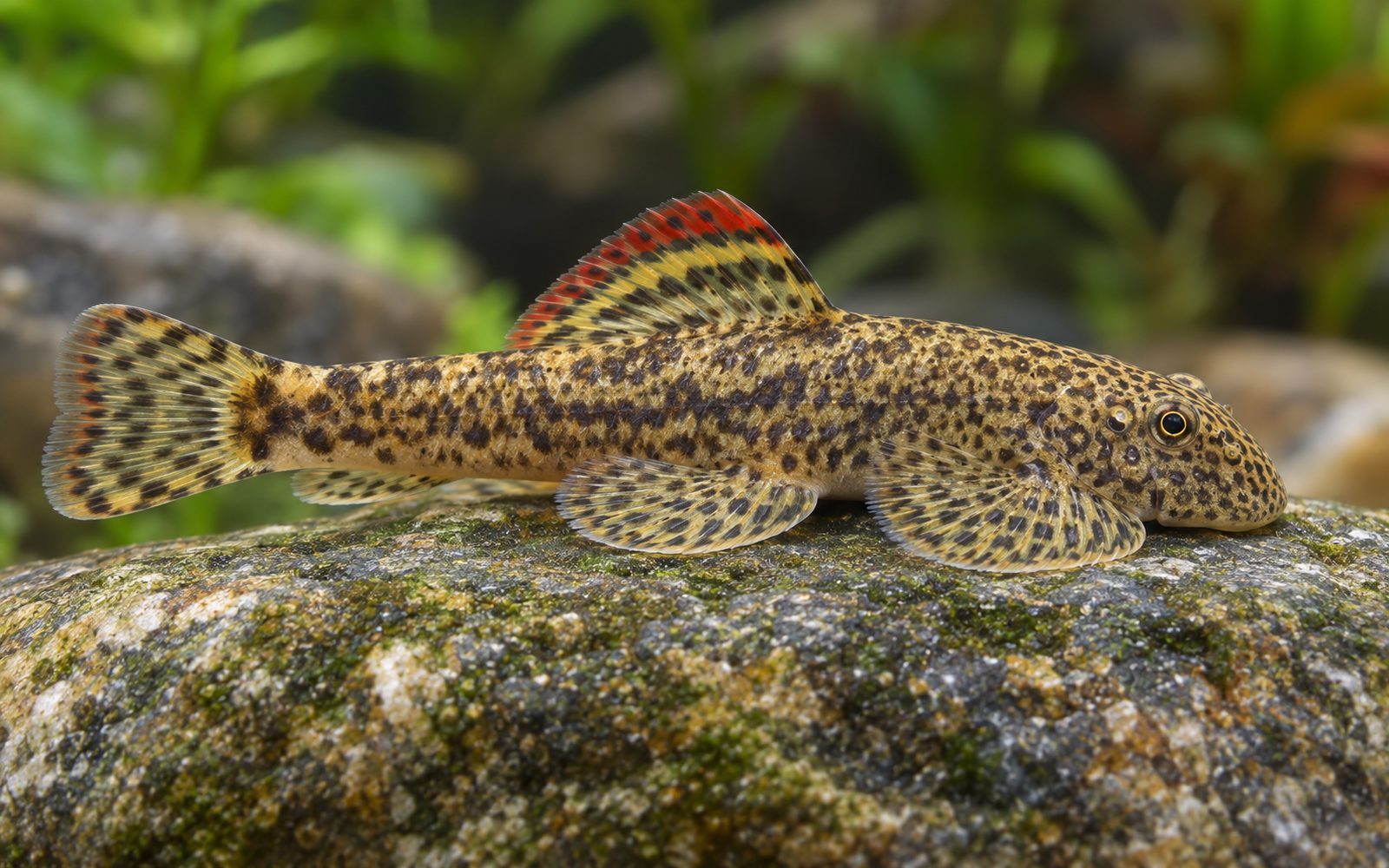
The Chinese hillstream loach is the Pseudogastromyzon species most often found in the hobby. For years it was sold under the name P. cheni, but that species rarely enters the trade; fish whose dorsal fin has a yellow background and a red outer band are considered P. myersi. Adults grow to 5–6 cm.
With its flat body and broad fins, it clings to stones and can hold its position even in a current. Unlike other hillstream loaches, it breeds quite easily in the aquarium, which makes it a good starter species for those who want to set up a hillstream biotope.
Natural Habitat
It lives in mountain streams in the less developed areas of Hong Kong and the neighboring province of Guangdong. It is found in shallow, clear, fast-flowing, rocky water. Those in the trade mostly come from around Guangzhou.
Tank Setup
- Volume: at least 70 liters and 75 cm in length for a group of 5–6.
- Flow and oxygen: strong flow and plenty of oxygen are essential; a circulation pump and an air stone in addition to the filter.
- Water: cool water at 19–24°C; it should not exceed 26°C in summer. pH 6.5–7.5. 30–50% water change weekly.
- Substrate: rounded fine gravel and sand; males dig nests, and the fry hide among the gravel.
- Decor: flat stones, rocks, plants attached to stones.
- Mature aquarium: biofilm should have formed on the stones.
Diet
It grazes biofilm, algae and diatoms on stones and also eats small invertebrates. Besides algae wafers and sinking dry food, frozen daphnia, brine shrimp and bloodworms should be given regularly.
Behavior and Compatibility
Generally peaceful, but it can be harsh toward flat hillstream loaches that resemble it. Males are bolder and establish territories; dominant fish claim the best grazing spots.
Good companions: white cloud mountain minnow, zebra danio, small devarios and rasboras, small barbs that like flowing water.
Avoid: mixing it in a small aquarium with similarly shaped species such as butterfly loaches and Sewellia, goldfish, warm-water species.
Group and Colony Structure
At least 5–6 individuals are recommended. Males make mock attacks on each other and engage in short chases; if there are enough stones and shelters, no serious harm results. Females are more at ease in a group.
Breeding
It has been bred in the aquarium many times. The male digs a shallow pit in the gravel or sand; the female lays her eggs in this nest and the male fertilizes them. There is no parental care. Depending on temperature, the eggs hatch in about 4–14 days. A mature gravel substrate is needed for the fry to hide; in the wild, spawning occurs in early summer.
Health and Common Problems
- Oxygen: it is the first fish affected in hot weather and when the flow stops.
- Wasting: fish weakened after shipping recover in a mature aquarium with plenty of biofilm.
- Temperature: constant temperatures above 25°C damage its health.
Sexing
Mature females are larger and fuller, with paler patterns. Mature males develop small bumps (tubercles) on the head; these are more prominent in dominant males.
Tank mates
This list is calculated automatically from the species profile and grows as new species are added to the catalog. Try it in the planner for a definite answer.
Usually compatible
 Flame Tetra
 Blackfin Corydoras
 Polystictus Corydoras
 Emerald Cory
 Emerald Dwarf Rasbora
 Porthole Catfish
 Keyhole Cichlid
 Cryptocoryne Parva
 European Bitterling
 Adolfo's Cory
Should not be kept together






Hobbyist notes
Things you won't find in books, learned by trial and error. The most helpful ones are on top.
Change history and contributors
- Page created · October 16, 2026