
Water parameters
Overview
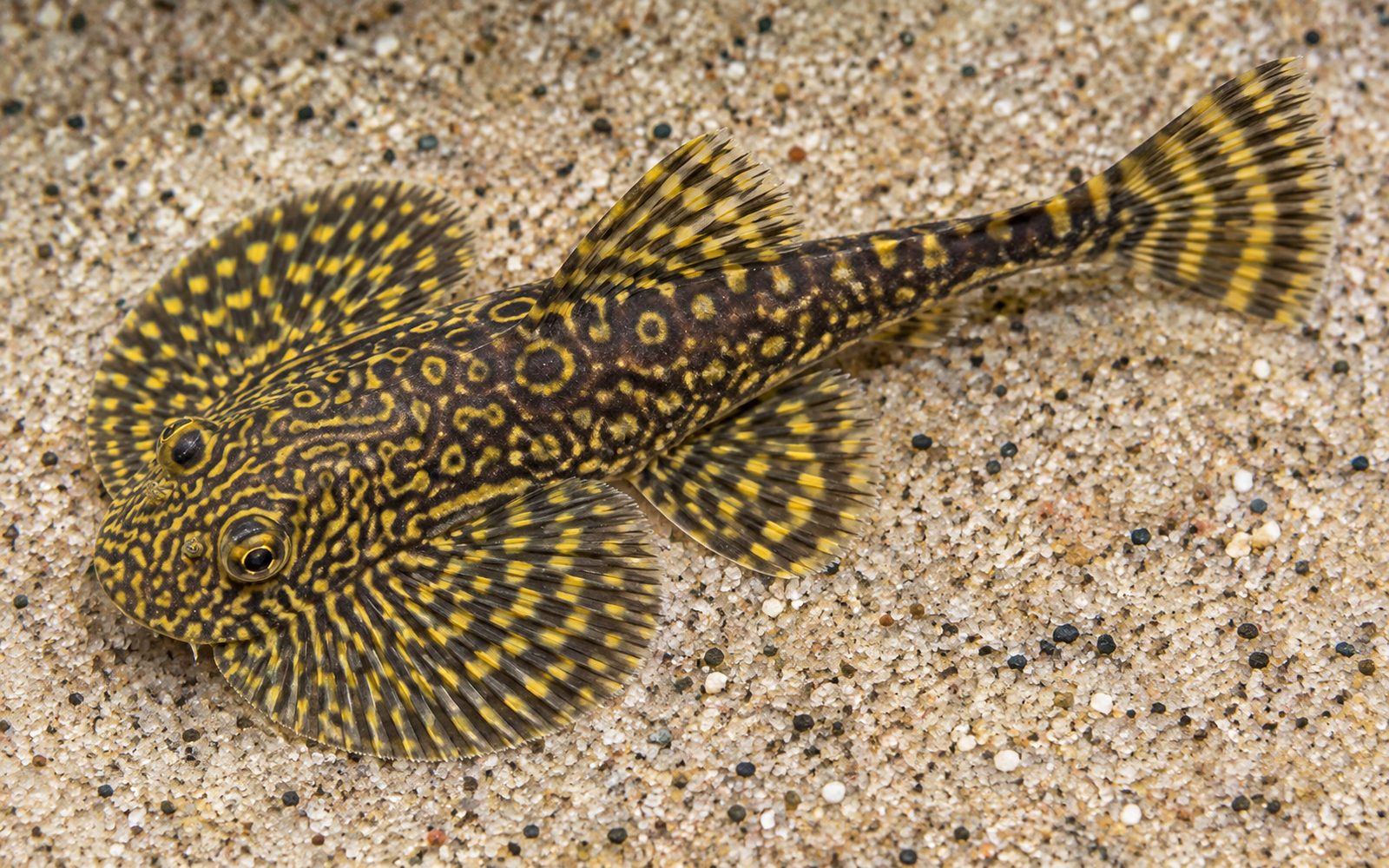
Sewellia lineolata is a loach adapted to fast-flowing streams, with a flat body that looks like a small stingray from above and fins that open like wings. The pectoral and pelvic fins together form a sucker; the fish clings to stones and glass in the current. The golden yellow lines and rings on the dark brown background are different on every individual.
Adults are about 6 cm. Although its appearance invites comparison with plecos, it is not related to them; it is a loach from the carp order. Its care is not difficult once the flow and oxygen requirements are met, but these requirements are non-negotiable.
Natural Habitat
It lives in the shallow, fast-flowing, rocky stretches of rivers that descend from the mountains to the sea in central Vietnam. The water is clear, cool and saturated with oxygen; the surfaces of the rocks are covered in algae and biofilm.
Tank Setup
- Volume: at least 70 liters and 75 cm of length for a group of 5–6; floor area matters, not height.
- Flow and oxygen: Strong flow is essential. The filter should turn over at least 10 times the tank volume per hour; an additional circulation pump and an air stone are recommended.
- Water: Cool water at 20–24°C; it should not exceed 26°C in summer heat. pH 6.5–7.5. A 30–50% water change every week.
- Decor: Rounded gravel, flat stones and rocks; plants that attach to stones such as anubias and java fern.
- Mature aquarium: It should not go into a newly set-up aquarium; biofilm should already have formed on the stones.
- Lid: It climbs the glass and can jump; the lid must be tight.
Diet
Its main food is the algae and biofilm on stones. This is supplemented with spirulina-based algae wafers, vegetable gel foods and small amounts of frozen bloodworms. Too much protein leads to digestive problems. Individuals that arrive thin recover in a mature aquarium where they can find food all the time.
Behavior and Compatibility
Peaceful toward other species. With its own kind, especially between males, it fights over space by pushing belly to belly; these fights are usually harmless.
Good companions: small species that like cool, fast-flowing water: White Cloud Mountain minnows, zebra danios, small devarios, current-loving rasboras, other hillstream loaches.
Avoid: tropical species that need warm water, goldfish, large and greedy bottom dwellers, long-finned species that dislike current.
Group and Colony Structure
Sewellia lives in groups: at least 5–6 individuals are recommended. Males are usually dominant and set up small territories; females gather where the flow is strongest. Two or three individuals, especially if all are female, may become timid.
Breeding
It is one of the easiest loaches to breed in the aquarium. In a mature tank with a gravel substrate, a cool water change following a warm spell can trigger spawning. The eggs are laid among the gravel. The fry are fed infusoria first, then newly hatched brine shrimp and microworms; adults usually leave fry larger than about 5 mm alone.
Health and Common Problems
- Lack of oxygen: It is the first fish affected by summer heat and power cuts; an air stone and a fan are recommended.
- Wasting: Individuals with sunken bellies are often seen for sale; plenty of plant-based food is needed in the first weeks.
- Temperature: Long periods above 26°C weaken the immune system.
Sexing
Females have a wider body and a rounded snout; the snout merges seamlessly with the pectoral fins. Males are slimmer with an angular snout, and their pectoral fins open at almost a right angle to the body; mature males show rows of bumps on the pectoral fin rays.
Tank mates
This list is calculated automatically from the species profile and grows as new species are added to the catalog. Try it in the planner for a definite answer.
Usually compatible
 Flame Tetra
 Blackfin Corydoras
 Polystictus Corydoras
 Emerald Cory
 Emerald Dwarf Rasbora
 Porthole Catfish
 Keyhole Cichlid
 Cryptocoryne Parva
 European Bitterling
 Adolfo's Cory
Should not be kept together






Hobbyist notes
Things you won't find in books, learned by trial and error. The most helpful ones are on top.
Change history and contributors
- Page created · October 16, 2026