
Water parameters
Overview
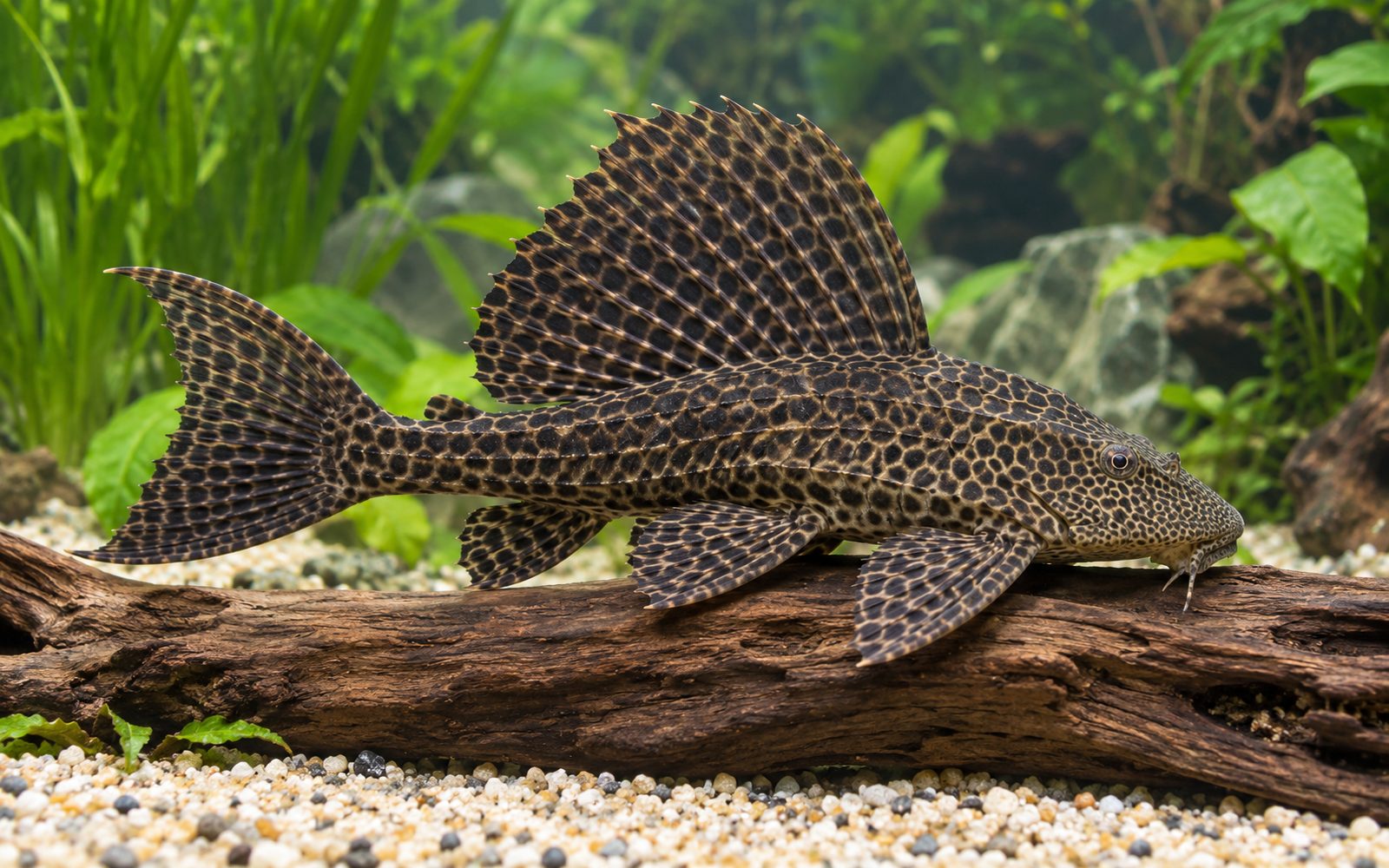
This is the suckermouth catfish most commonly sold in Türkiye as an "algae eater." With its spotted dark body and large, sail-like dorsal fin it looks very cute as a juvenile; it is recommended for every aquarium because "it cleans the algae."
The truth is: It reaches 20–25 cm within the first year and 40–45 cm within a few years, lives 15–20 years and produces a huge amount of waste. For community aquariums, ancistrus (12 cm) is the right choice. Plecos that outgrow their aquarium must not be released into the wild: in many countries where it has been released (USA, Mexico, Southeast Asia), this species has become invasive and harmed local ecosystems.
Natural Habitat
It lives over muddy bottoms in slow-flowing Amazon channels, lakes and swamps; it digs nesting tunnels in the banks.
Tank Setup
- Volume: At least 500 liters and 180 cm in length for one adult.
- Filter: Very powerful filtration (canister filter or sump) and frequent water changes.
- Decor: Large, sturdy roots (it rasps on them for fiber), caves. It uproots and eats plants.
- Water: 24–27°C; it adapts to a wide range of parameters.
Diet
An omnivore with a mainly herbivorous diet. The algae in the aquarium is never enough for an adult common pleco: algae wafers, zucchini, cucumber, potato, spinach, peas and occasionally frozen food should be given. Rasping on wood is necessary for its digestion.
Behavior and Compatibility
It is peaceful toward other species, but as it grows it becomes territorial toward its own kind and other large bottom dwellers. It is known to suck the slime coat of slow, flat-bodied fish (discus, angelfish, goldfish).
Good companions: Large, fast fish: oscars, large barbs, silver dollars, large cichlids (in a very large aquarium).
Avoid: Small aquariums, slow, flat-bodied fish such as goldfish and discus, a second large pleco (in a small aquarium).
Group and Colony Structure
In a home aquarium a single individual is kept. A group is only possible in ponds or very large systems (1000 liters and up).
Breeding
In the wild it breeds in tunnels it digs in the banks; it does not breed in the aquarium. Commercial breeding is done in ponds.
Health and Common Problems
Hardy. The real problem is insufficient space and diet: in a small aquarium growth does not stop, but health deteriorates and water quality collapses.
Sexing
Difficult to tell apart externally; mature males may have thicker, longer pectoral fin spines.
Tank mates
This list is calculated automatically from the species profile and grows as new species are added to the catalog. Try it in the planner for a definite answer.
Usually compatible
 Flame Tetra
Glass Tetra
Flame Tetra
Glass Tetra
 Blackfin Corydoras
 Polystictus Corydoras
 Emerald Betta
 Emerald Cory
 Porthole Catfish
 Keyhole Cichlid
 Firemouth Cichlid
 Cupid Cichlid
Should not be kept together





Hobbyist notes
Things you won't find in books, learned by trial and error. The most helpful ones are on top.
Change history and contributors
- Page created · October 16, 2026