
Water parameters
Overview
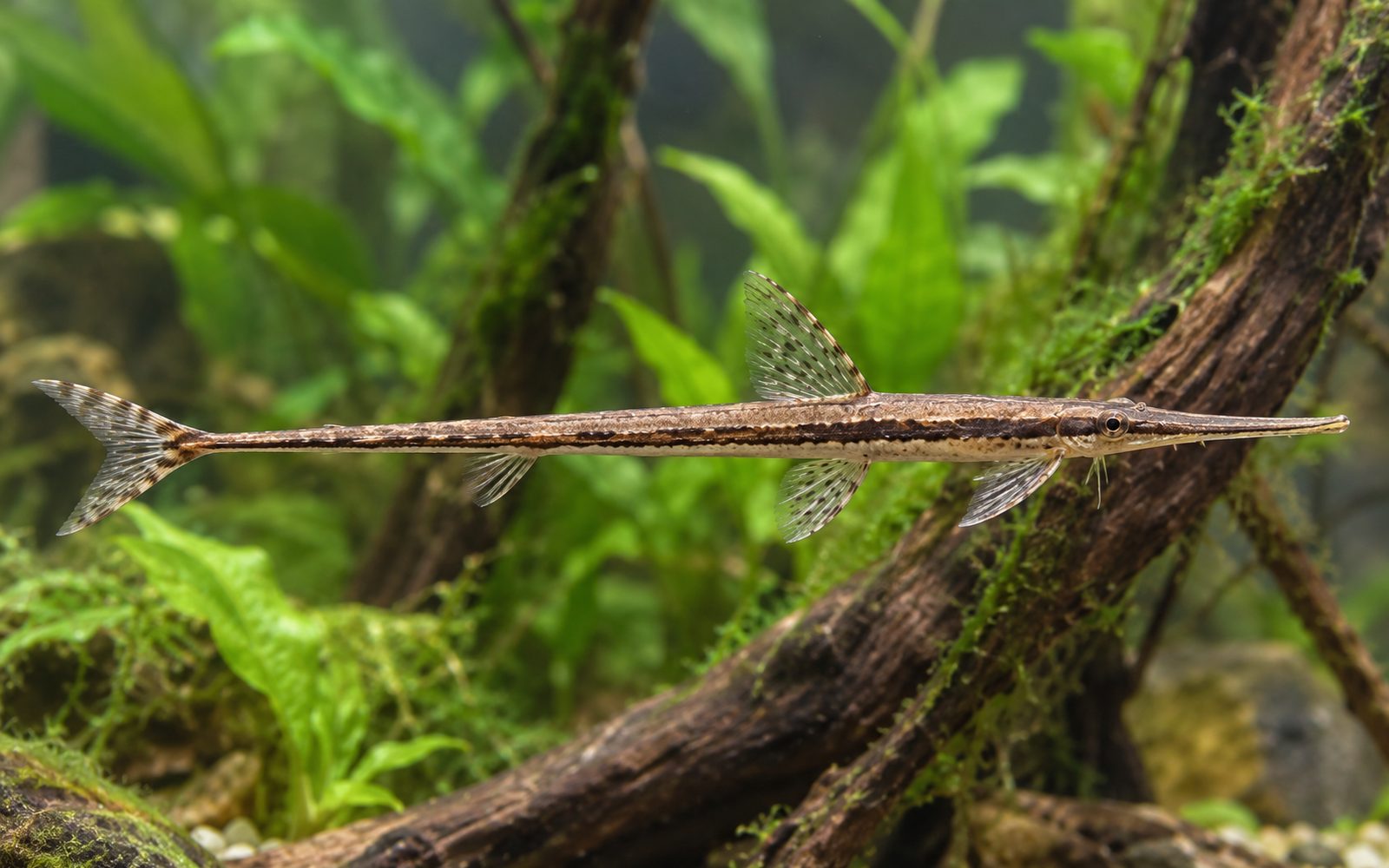
The twig catfish is an interesting-looking suckermouth catfish with a body so thin and long that it cannot be told apart from a piece of twig. Its snout extends forward as a long projection (rostrum), and the dark line along its side completes its camouflage. This makes it nearly invisible among roots and plant stems.
It is not easy to care for: most individuals on sale are wild-caught and arrive hungry. Because it slowly grazes biofilm and algae, it can starve to death in a newly set-up, spotless aquarium. A mature aquarium with plenty of surfaces and algae is the first requirement. It may be sold together with the similar species F. mariaelenae.
Natural Habitat
It lives among bank-side plants, fallen branches and root tangles in slow- to moderately flowing waters of the Orinoco basin. It spends the day clinging to plant stems and branches.
Tank Setup
- Volume: 120 liters for one or two individuals; a long aquarium should be preferred.
- Maturity: An aquarium at least a few months old, with biofilm and fine algae grown on its surfaces.
- Decor: Thin roots, branches, dense plants; an open bottom area.
- Water: 24–26°C, clean and oxygenated water; gentle to moderate flow. A 25% water change every week.
Diet
Herbivorous. The algae and biofilm in the aquarium are its staple food, but they are not enough on their own: spirulina wafers, blanched zucchini, cucumber and spinach should be given regularly. It may occasionally accept small frozen foods (brine shrimp, daphnia). Because it is slow, give food in the evening, in a spot others cannot reach.
Behavior and Compatibility
Extremely peaceful and slow. Fast, greedy fish snatch its food; startling, busy tankmates stress it.
Good companions: Small, calm fish: small tetras, rasboras, otocinclus, corydoras, shrimp.
Avoid: Fin-nippers and fish that snatch food quickly, cichlids, large plecos.
Group and Colony Structure
It can be kept singly; a pair also lives together. Large groups lead to insufficient food. If more than one individual is kept, there should be enough grazing surface and separate resting spots for each.
Breeding
It occasionally breeds in the aquarium. The female lays her eggs on the glass or a flat surface in an area with flow; the male guards the eggs until the fry hatch. The fry are very small and need plenty of biofilm.
Health and Common Problems
The most common problem is starvation; a sunken belly is the first warning sign. It is sensitive to nitrate buildup and low oxygen. It is sensitive to copper.
Sexing
Mature males develop short, dense odontodes on both sides of the snout projection. Females have a smooth snout and slightly thicker bodies.
Tank mates
This list is calculated automatically from the species profile and grows as new species are added to the catalog. Try it in the planner for a definite answer.
Usually compatible
 Flame Tetra
Glass Tetra
Flame Tetra
Glass Tetra
 Blackfin Corydoras
 Polystictus Corydoras
 Emerald Betta
 Emerald Cory
 Porthole Catfish
 Keyhole Cichlid
 Firemouth Cichlid
 Cupid Cichlid
Should not be kept together




Hobbyist notes
Things you won't find in books, learned by trial and error. The most helpful ones are on top.
Change history and contributors
- Page created · October 16, 2026