
Water parameters
Overview
The croaking gourami is named for the sounds it makes: males (and, more faintly, females) produce squeaky sounds resembling a frog's croak by vibrating special tendons in their pectoral fins while displaying to each other. In a quiet room these sounds are easily heard from outside the aquarium.
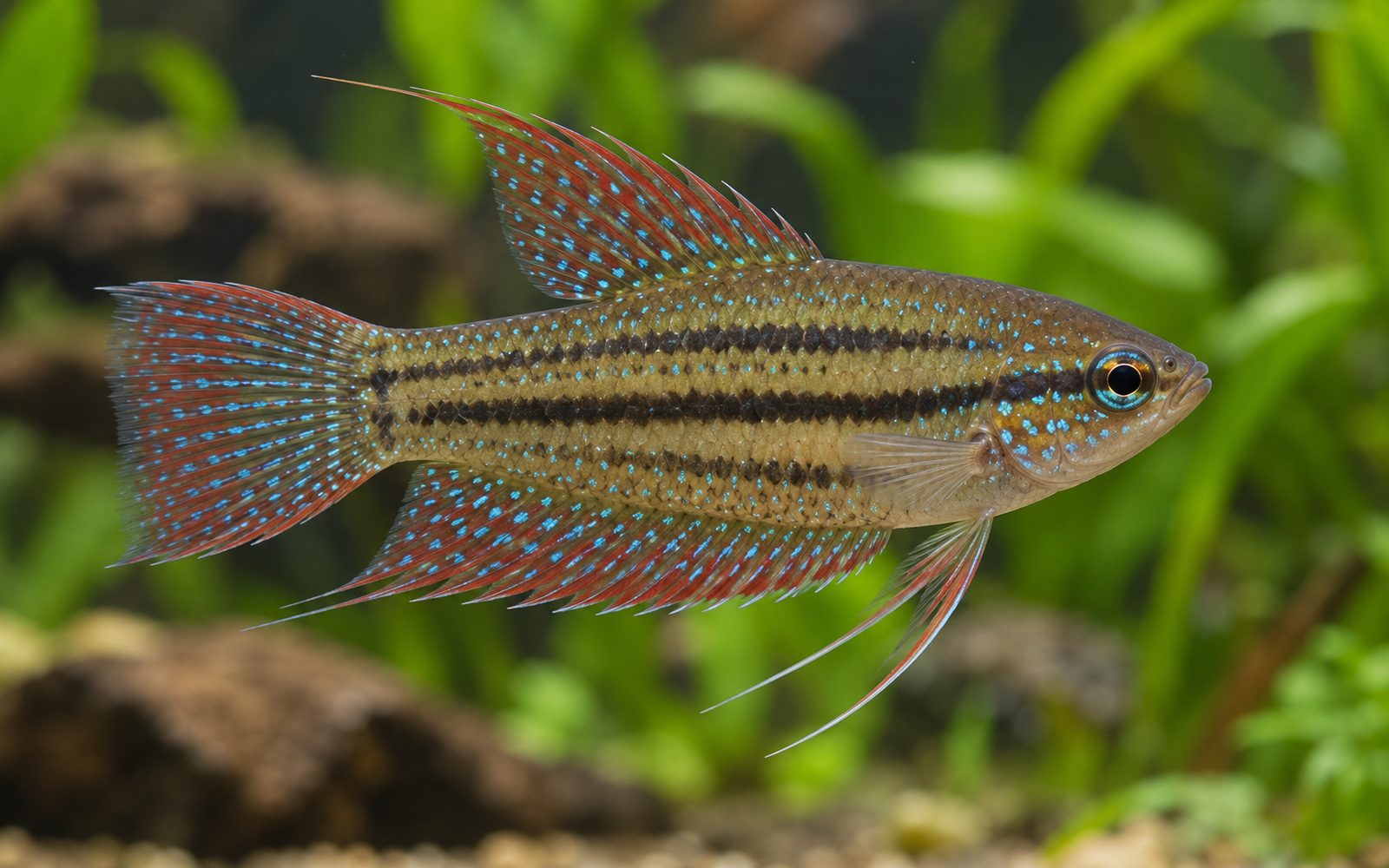
Its slender 6–7 cm body is olive-brown with 3–4 dark horizontal stripes. The blue and red spots on the body and fins shine as they catch the light; the area around the eye is bluish. It is the larger relative of the sparkling gourami.
Natural Habitat
It is spread over a very wide area of Southeast Asia: ditches, rice paddies, swamps, lake shores and slow-flowing canals. These habitats are shallow, vegetated and still; it tolerates low-oxygen water with variable temperatures.
Tank Setup
- Volume: at least 60 liters for a group of 4–6.
- Water: 24–27°C, pH 6–7.5; soft to moderately hard water.
- Plants: dense planting, floating plants and roots; males choose small areas for themselves.
- Flow: weak; a sponge filter or a filter with a softened outlet.
- Lid: use a lid that leaves warm, humid air above the surface.
Diet
Omnivorous but fond of small live foods. Fine flakes and micro granules can be the staple; vary with frozen or live brine shrimp, daphnia, cyclops and chopped bloodworms. Feed small amounts 1–2 times a day.
Behavior and Compatibility
Peaceful; males spread their fins at each other, make sounds and shove briefly, but do no serious harm. It is a shy fish and becomes bolder with calm tankmates. It usually leaves adult dwarf shrimp alone but may eat the young.
Good companions: small tetras, harlequin rasbora, zebra danio, corydoras, kuhli loach, otocinclus, honey gourami.
Avoid: fin nippers, large and boisterous fish, aggressive cichlids, large predators.
Group and Colony Structure
It is best kept as a mixed group of 4–6; having more females than males reduces chasing. Within a group, the males' displays and sounds are observed more often; fish kept singly remain more timid. Dividing the tank with plants reduces tension.
Breeding
The male builds a small bubble nest under floating plants or a broad leaf. Sounds and displays intensify during courtship. More than a hundred small eggs are released during a series of embraces; the male places them in the nest and guards them until the fry are free-swimming. The female can be removed after spawning. The fry start on infusoria and then grow on brine shrimp nauplii. While the labyrinth organ develops, the air above the tank should be kept warm.
Health and Common Problems
Hardy. Cold water and temperature fluctuations set the stage for ich and velvet. Wild-caught fish may carry parasites; a 2-week quarantine is recommended.
Sexing
Sexing is difficult. Males are usually more colorful, with longer, pointed and reddish dorsal and anal fins; they make louder sounds. When you hold the fish up to a light from behind, the ovary is visible in the body cavity of mature females.
Tank mates
This list is calculated automatically from the species profile and grows as new species are added to the catalog. Try it in the planner for a definite answer.
Usually compatible
 Flame Tetra
 Blackfin Corydoras
 Polystictus Corydoras
 Emerald Betta
 Emerald Cory
 Emerald Dwarf Rasbora
 Porthole Catfish
 Keyhole Cichlid
 Cupid Cichlid
 Geophagus altifrons
Should not be kept together






Hobbyist notes
Things you won't find in books, learned by trial and error. The most helpful ones are on top.
Change history and contributors
- Page created · October 16, 2026