
Water parameters
Overview
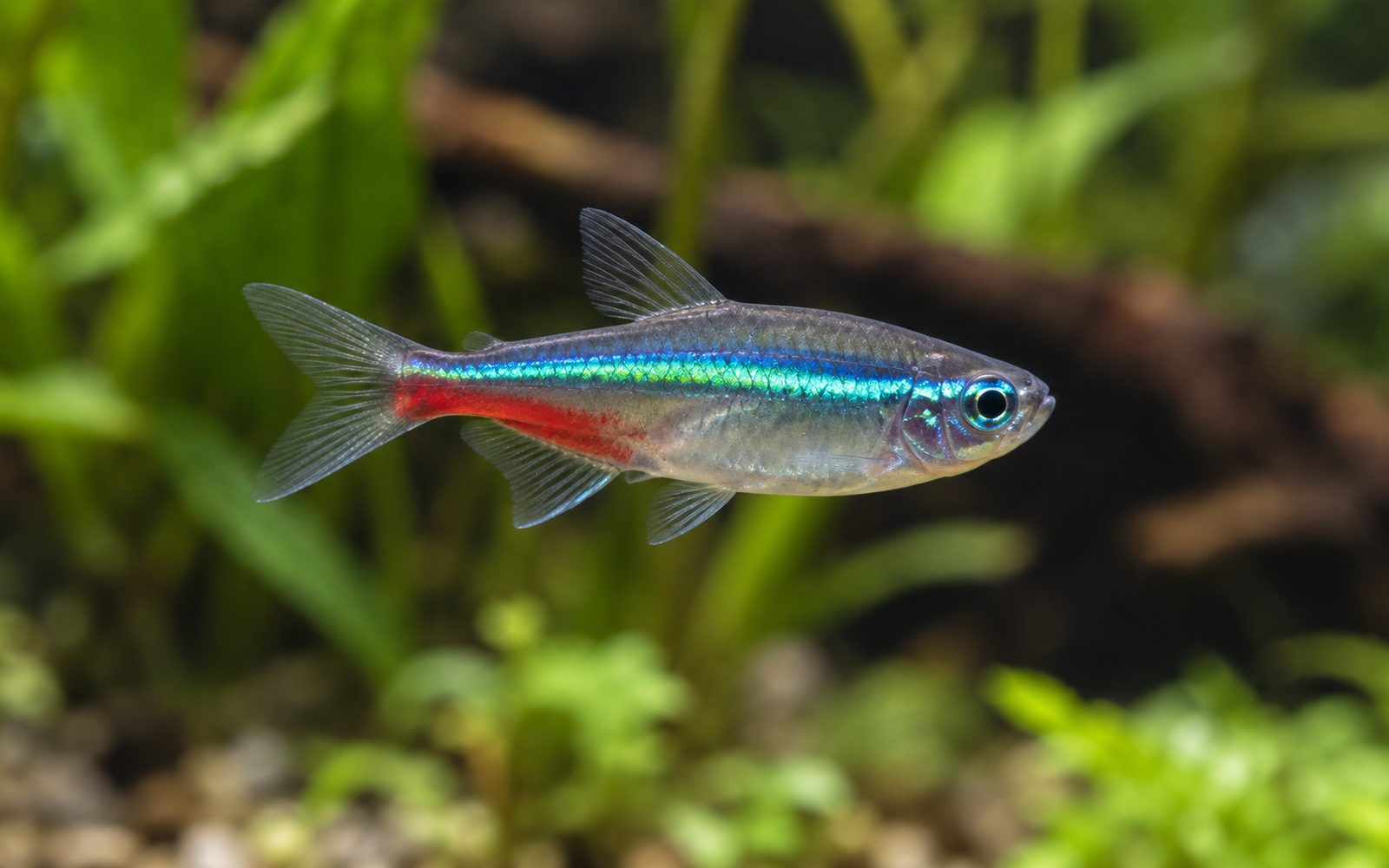
The green neon tetra is the smallest relative of the neon and cardinal tetras; its adult size is around 2.5 cm. The iridescent stripe along its body shifts from blue to green depending on the light and runs all the way to the base of the tail. The red area is much smaller than the neon's and appears only on the rear lower part of the belly.
It is a blackwater species used to soft, acidic water. It is hardy in the right water conditions but short-lived in hard, alkaline water. It is very well suited to planted nano tanks.
Natural Habitat
It lives in floodplains and swamps of the Rio Negro and upper Orinoco basins, in very soft, acidic waters stained tea-colored by tannins. It is found there in large schools.
Tank Setup
- Volume: at least 40 liters for a school of 10–20.
- Water: 24–28°C, pH 5–6.5, very soft water. Soft water prepared with reverse osmosis water is suitable.
- Decor: Dark substrate, roots, dried leaves and floating plants. Dim light brings out the colors.
- Maturity: It should not be added to a newly set-up tank; it is sensitive to ammonia and nitrite swings.
Diet
Omnivorous, but its mouth is very small. Micro granules, finely crumbled flakes, frozen cyclops, daphnia and newly hatched brine shrimp are suitable. Feed small amounts 1–2 times a day.
Behavior and Compatibility
Very peaceful and shy. It swims as a school in the middle and lower-middle layers of the tank. It does no harm at all to adult shrimp.
Good companions: cardinals and other small tetras, micro rasboras, pygmy corydoras, otocinclus, dwarf cichlids such as apistogramma, shrimp.
Avoid: any fish that can fit it in its mouth, active and large tetras, species that need hard water.
Group and Colony Structure
At least 10, ideally 20 or more individuals are recommended. In the wild it lives in large schools and behaves much more comfortably in a large group. The sex ratio does not matter. When kept in the same tank as cardinal tetras, the two species usually form separate schools; each should be kept in sufficient numbers to form its own school.
Breeding
Difficult to breed in the aquarium. It needs very soft (around GH 1), acidic water, a dark environment and fine-leaved plants. The eggs and fry are light-sensitive. A significant share of the fish sold in the trade are wild-caught.
Health and Common Problems
- Water parameters: in hard, alkaline water its immunity weakens and its lifespan shortens.
- White spot and velvet: common after transport; quarantine and slow acclimation are essential.
- Neon tetra disease: like other Paracheirodon species, it can be affected by this disease; individuals showing symptoms should be removed immediately.
Sexing
Females are plumper with a rounder belly; the stripe may look slightly bent in females. Males are slimmer.
Tank mates
This list is calculated automatically from the species profile and grows as new species are added to the catalog. Try it in the planner for a definite answer.
Usually compatible
 Flame Tetra
 Blackfin Corydoras
 Polystictus Corydoras
 Emerald Cory
 Porthole Catfish
 Keyhole Cichlid
 Cupid Cichlid
 Geophagus altifrons
 Geophagus surinamensis
 Cryptocoryne Parva
Should not be kept together





Hobbyist notes
Things you won't find in books, learned by trial and error. The most helpful ones are on top.
Change history and contributors
- Page created · October 16, 2026