
Water parameters
Overview
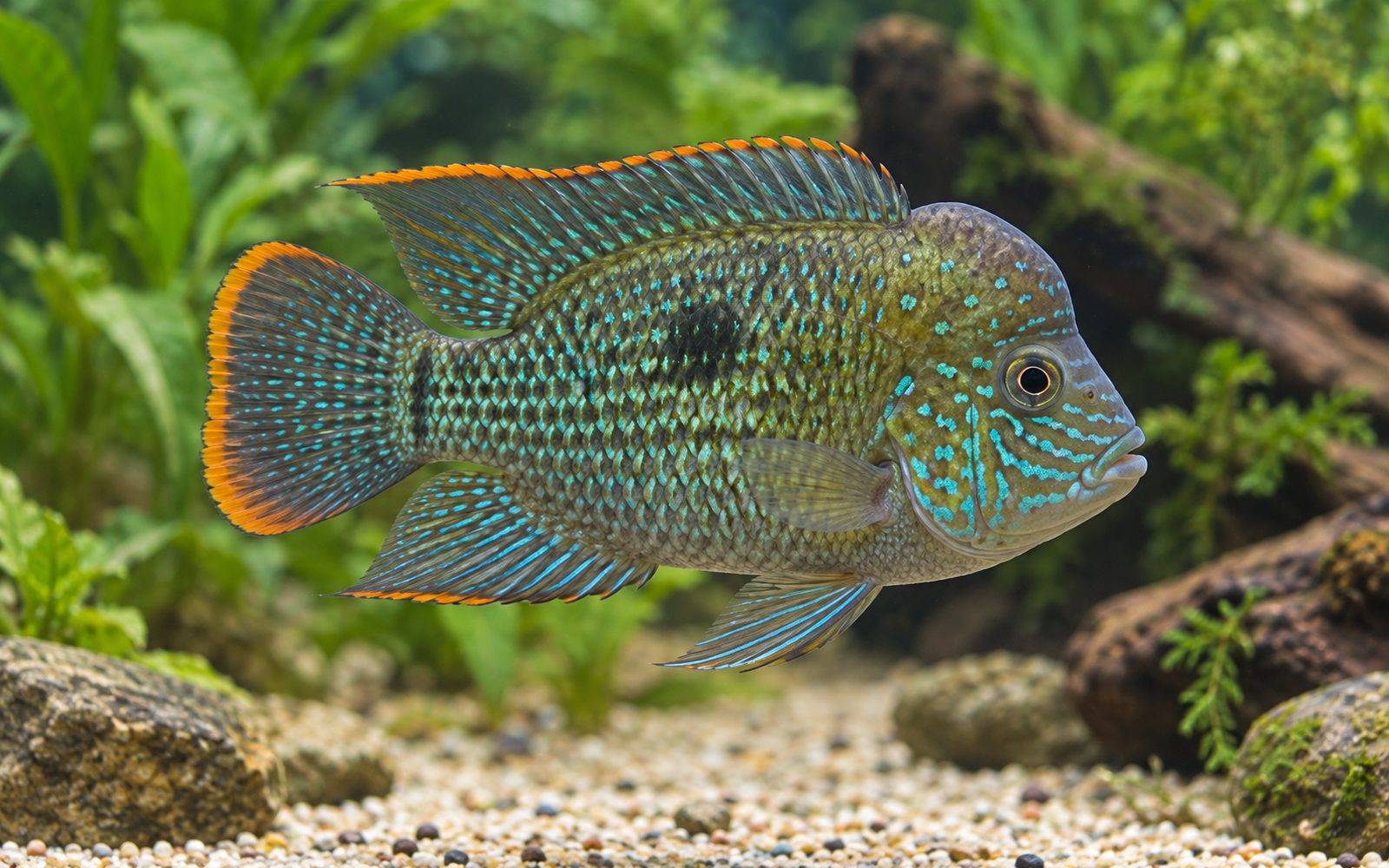
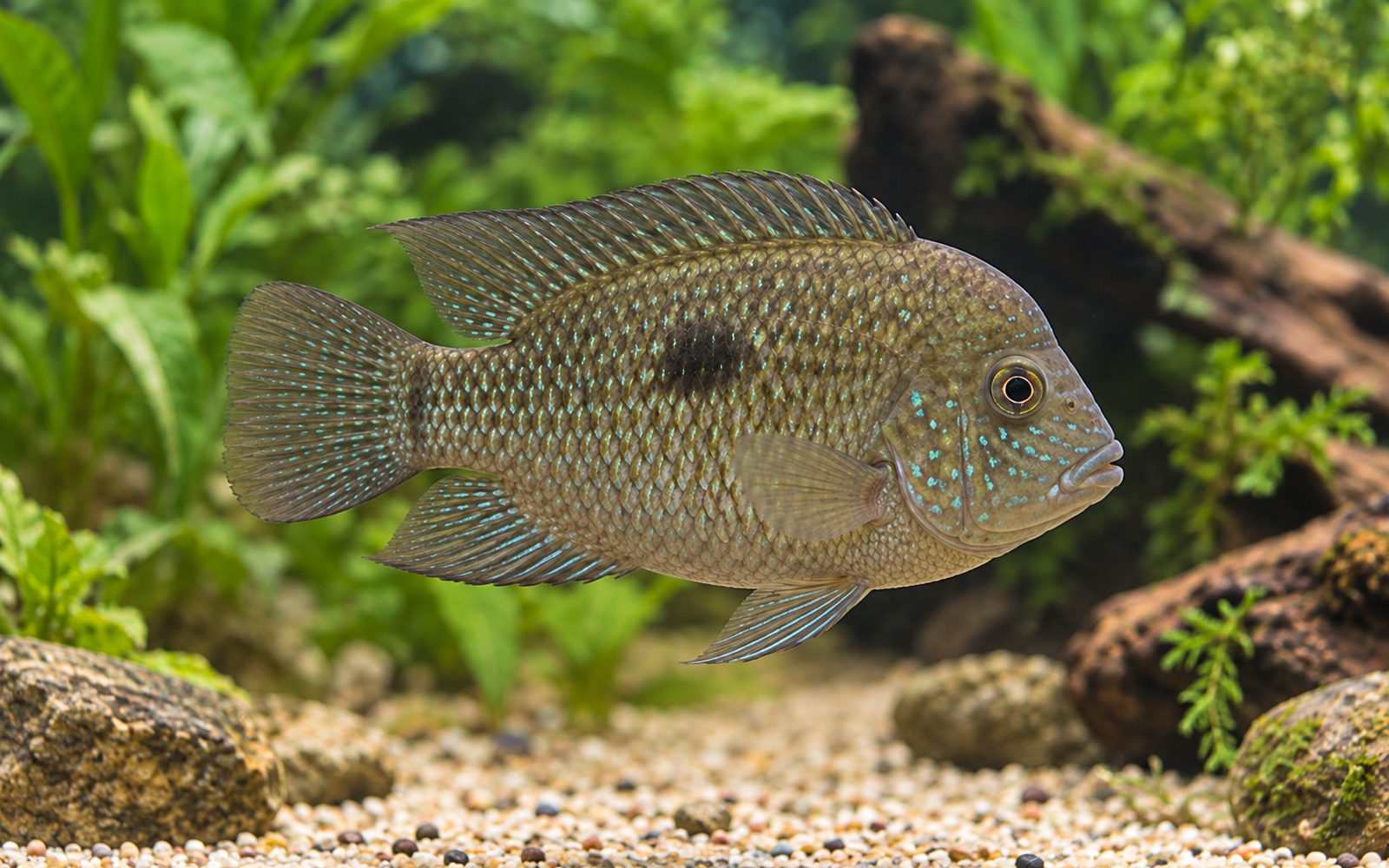
The green terror is a large acara from the Pacific coast of South America. Its greenish body is decorated with turquoise-shimmering scales and its cheeks with wavy blue–green lines. Mature males develop a prominent hump on the forehead and have a bright orange band along the edge of the dorsal and tail fins; the trade name "gold saum" comes from this.
Similar-looking fish with a white fin edge, known as "white saum", are now recognized as a separate species (Andinoacara stalsbergi). It is a relative of the blue acara (Andinoacara pulcher), but much larger and more aggressive.
Natural Habitat
It lives in the Pacific-draining rivers of Ecuador and northern Peru, in slow- to moderately flowing waters of the coastal plains. In this region the temperature varies with the season and the water is usually moderately hard.
Tank Setup
- Volume: at least 300 liters and 120–150 cm of length for a single adult or a pair.
- Decor: caves built from large rocks and roots, and obstacles that break lines of sight. Plants are uprooted because it digs the sand; decor must be seated firmly.
- Filter: a canister filter turning over 5 times the tank volume per hour; a 30% water change weekly.
- Temperature: 22–26°C is ideal; constantly very warm water shortens its lifespan.
Diet
Omnivorous with a big appetite. Use large cichlid granules as the staple; supplement with frozen shrimp, mysis, bloodworms and vegetable-based food. Overfeeding quickly degrades water quality.
Behavior and Compatibility
Juveniles look somewhat docile; they become territorial and tough as they mature. During breeding it may attack everyone in the same aquarium.
Good companions: robust cichlids of the same size such as the Jack Dempsey, Texas cichlid and severum; large plecos; silver dollars. All in a large aquarium.
Avoid: small, peaceful fish, shrimp, snails, calm Amazon species such as angelfish and discus, planted layouts.
Group and Colony Structure
It can be kept alone. To obtain a pair, juveniles are raised together; the bonded pair becomes severely aggressive toward other individuals, and the extras should be removed. In a male–female pair put together later, the male may kill the female; use a perforated divider if necessary.
Breeding
The pair lays a few hundred eggs on a flat stone it has cleaned. The eggs hatch in 3–4 days and the larvae are moved into pits in the sand. Both parents guard the fry for a long time. The fry are fed baby brine shrimp.
Health and Common Problems
- Hole-in-the-head disease (HLLE): pits, mainly on the head, with dirty water and a monotonous diet.
- Injuries: from fights; prone to secondary bacterial infection.
- Bloating: with excessive and one-sided feeding.
Sexing
The male is noticeably larger, develops a hump on the forehead and the orange edge on its fins is bright and wide. The female is smaller and paler; the orange edge is faint or absent.
Tank mates
This list is calculated automatically from the species profile and grows as new species are added to the catalog. Try it in the planner for a definite answer.
Usually compatible
 Banded Jewel Cichlid
 Spotted Tilapia
 Jack Dempsey
 Jaguar Cichlid
 Red Devil Cichlid
 Red Terror Cichlid
 Convict Cichlid
 Cryptocoryne Parva
 Wolf Cichlid
 Jewel Cichlid
Should not be kept together








Hobbyist notes
Things you won't find in books, learned by trial and error. The most helpful ones are on top.
Change history and contributors
- Page created · October 16, 2026