
Water parameters
Overview
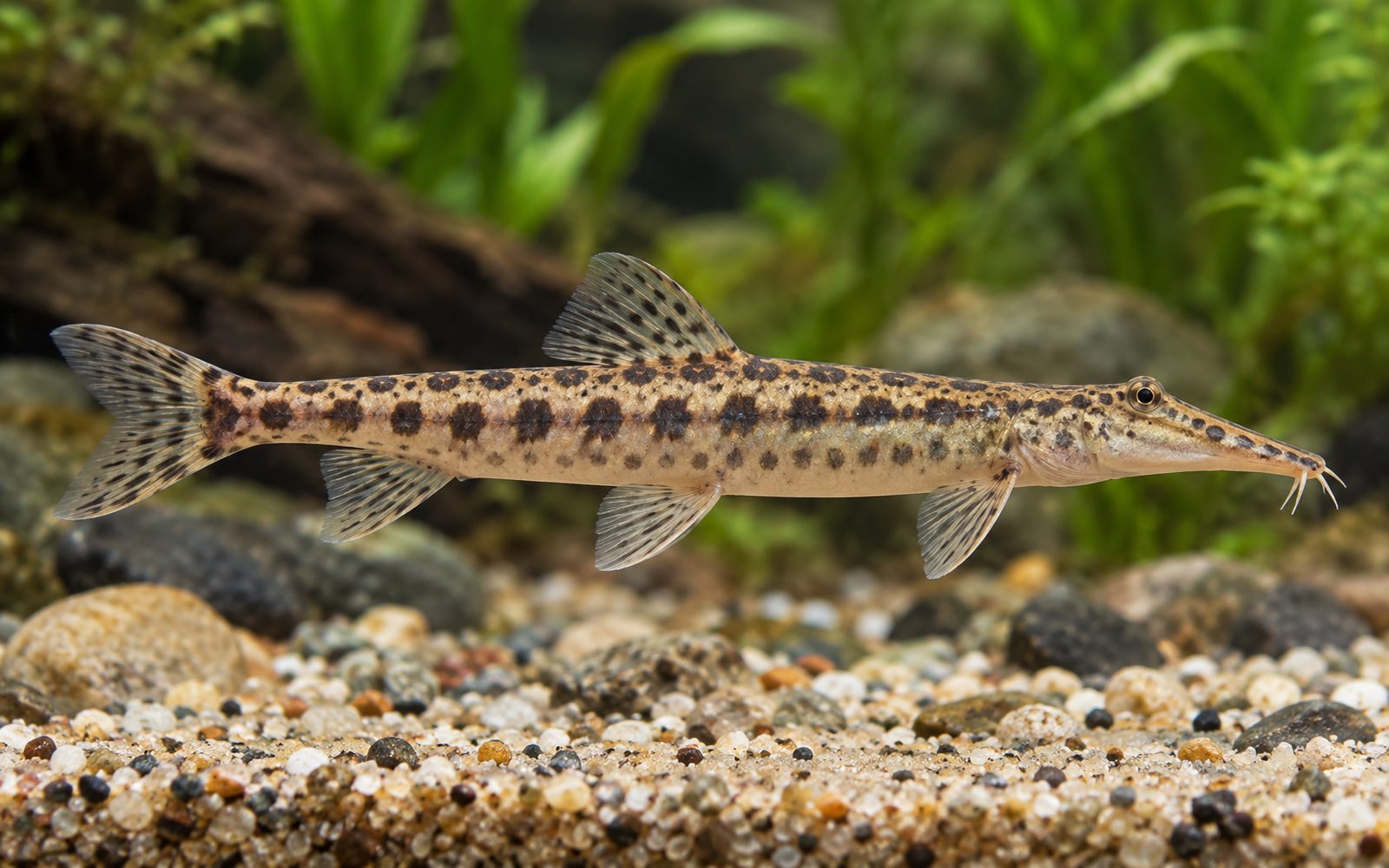
With its long, downward-curved snout and eyes set high on the head, the horseface loach really does resemble a horse's head. Its body is sand-colored and covered with rows of dark spots; this pattern makes it almost invisible in the sand. Staying buried in the sand all day with only its eyes showing is the behavior hobbyists love most.
It is sold at 6–8 cm in stores, but it can grow up to 20 cm. In the trade it is mostly sold under the name Acantopsis choirorhynchos; today this name is considered a synonym of A. dialuzona. It is also known that some of the fish sold may be closely related species not yet described.
Natural Habitat
It lives in clear, flowing, sandy-bottomed rivers and streams of Sumatra, Borneo, Java and the Malay Peninsula. In the wild it is found in loose groups on sandy flats.
Tank Setup
- Volume: at least 250 liters and 150 cm in length for 4–6 adults; what really matters is a large sand surface.
- Water: 24–28°C, pH 6–7.5. Clean, oxygen-rich water; 30–40% water change weekly.
- Substrate: fine, soft sand is essential, at least 5–8 cm deep. Coarse gravel causes both stress and injuries.
- Flow: moderate flow and plenty of oxygen.
- Decor: leave open sand areas; roots, rocks and sturdy plants along the edges.
Diet
It catches small organisms by taking sand into its mouth and sifting it through its gills. It accepts sinking granules and tablets; it must also be supplemented with frozen bloodworms, brine shrimp, tubifex and daphnia. Food must reach the sand; if fast-swimming upper-level fish grab the food, give sinking food in the evening.
Behavior and Compatibility
Peaceful. There are temporary territorial scuffles with its own kind, but serious injury is rare. It gets along well with fish that swim in the upper and middle levels of the aquarium.
Good companions: rasboras, danios, devarios, tetras, gouramis, peaceful medium-sized barbs.
Avoid: aggressive cichlids that claim the bottom, quarrelsome loaches, large bottom dwellers that constantly disturb it.
Group and Colony Structure
In the wild it lives in loose groups; in the aquarium at least 4, ideally 6 individuals are recommended. It is not a schooling fish, but it is more relaxed and more visible when sifting sand together with its own kind. Since this number requires a large footprint, plan the aquarium accordingly.
Breeding
Breeding in the aquarium is not known. Those in the trade are collected from the wild.
Health and Common Problems
- Substrate injuries: on coarse gravel the belly and snout get injured and bacterial infections develop.
- Ich: like small-scaled loaches, it is sensitive to medications; start at half dose.
- Wasting: newcomers may be underfed; live and frozen food are important in the first weeks.
Sexing
No reliable external difference is known. Mature females are thought to be fuller.
Tank mates
This list is calculated automatically from the species profile and grows as new species are added to the catalog. Try it in the planner for a definite answer.
Usually compatible
 Flame Tetra
Glass Tetra
Flame Tetra
Glass Tetra
 Blackfin Corydoras
 Polystictus Corydoras
 Emerald Betta
 Emerald Cory
 Porthole Catfish
 Keyhole Cichlid
 Firemouth Cichlid
 Cupid Cichlid
Should not be kept together




Hobbyist notes
Things you won't find in books, learned by trial and error. The most helpful ones are on top.
Change history and contributors
- Page created · October 16, 2026