
Water parameters
Overview
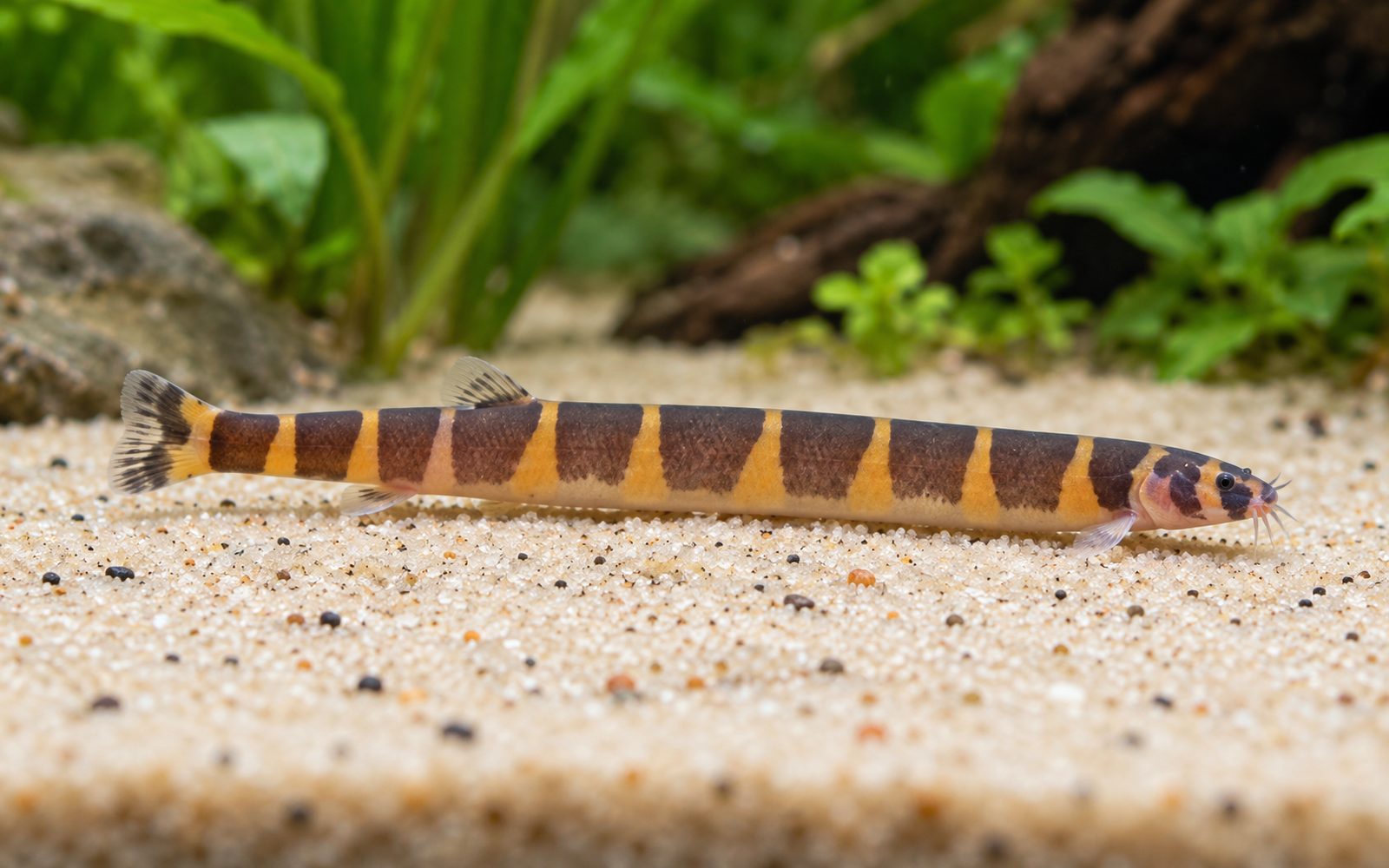
With its thin, long body and dark bands on a yellow-orange background, the kuhli looks like an eel, but it is a scavenging fish (a loach). During the day it usually hides in the sand or under roots; in the evening and at night it comes out and roams in a group. It is easy to care for and long-lived.
Natural Habitat
It lives in Southeast Asian forest streams, in slow-flowing, shaded waters with a soft bottom covered in leaf litter. The water is soft, acidic and slightly brown from tannins.
Tank Setup
- Volume: 60 liters for a group of 5–6; floor area is important.
- Substrate: Fine, soft sand is essential; it buries itself. It gets injured on sharp gravel.
- Decor: Roots, dried leaves, dense plants and caves. A kuhli with places to hide becomes bolder and shows itself in the daytime too.
- Escapes: It can slip through very small gaps. Gaps in the lid should be closed and a sponge fitted over the filter intake.
Diet
An omnivore leaning toward meaty foods. Sinking granules and tablets, frozen bloodworms, tubifex, brine shrimp and daphnia. Sinking food given in the evening before the lights go out ensures it gets its share.
Behavior and Compatibility
Extremely peaceful; it does not bother any fish. A kuhli kept alone is almost never seen; in a group of at least 5–6 they rest entwined with each other and are more active.
Good companions: rasboras, small tetras, dwarf gouramis, corydoras, otocinclus, shrimp (it leaves adults alone but may eat the young).
Avoid: large fish that can fit it in their mouths and aggressive cichlids that claim the bottom.
Group and Colony Structure
A kuhli kept alone is almost never seen. Kept with at least 5–6, ideally 8 or more individuals, they rest entwined with each other, comb the bottom as a group in the evening and start showing themselves during the day as well.
Other Pangio species (such as the black kuhli) can join the group. The sex ratio does not matter.
Breeding
It breeds rarely in the aquarium, and mostly by chance. Spawning usually happens in densely planted, mature aquariums, among the roots of floating plants or in clumps of plants. The eggs are greenish. Fry can grow up on their own among dense plants.
Health and Common Problems
- White spot: Because its scales are very small it is sensitive to medications; start treatment with half the dose and favor raising the temperature.
- Loss: Most cases of kuhlis "disappearing" are escapes into the filter intake or through a gap in the lid.
Sexing
Females are larger and plumper; the greenish eggs of mature females can be seen through the body. Males have larger, paddle-shaped pectoral fins with a thickened first ray.
Tank mates
This list is calculated automatically from the species profile and grows as new species are added to the catalog. Try it in the planner for a definite answer.
Usually compatible
 Flame Tetra
Glass Tetra
Flame Tetra
Glass Tetra
 Blackfin Corydoras
 Polystictus Corydoras
 Emerald Betta
 Emerald Cory
 Porthole Catfish
 Keyhole Cichlid
 Cupid Cichlid
 Geophagus altifrons
Should not be kept together






Hobbyist notes
Things you won't find in books, learned by trial and error. The most helpful ones are on top.
Change history and contributors
- Page created · October 16, 2026