
Water parameters
Overview
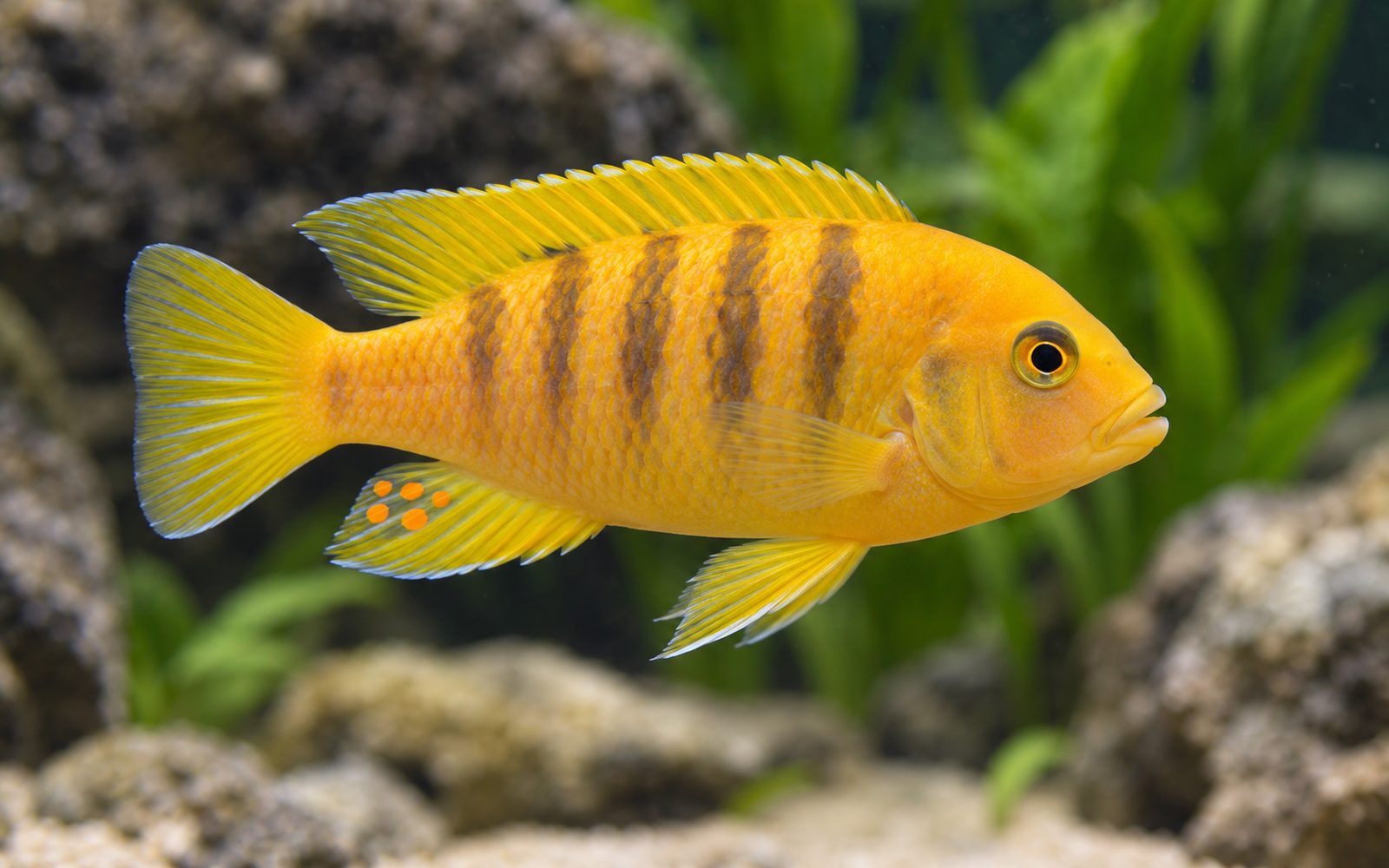
The kenyi is an interesting mbuna whose colors are distributed "in reverse" between the sexes. All fry are born blue with black vertical bars; females keep this color for life, while males turn yellow-orange as they grow. As a result, blue and yellow kenyis in a store can be mistaken for separate species.
It is easy to care for, has a hearty appetite and is hardy; the real challenge is its temperament. A mature male kenyi is a strong candidate for the most aggressive fish in the aquarium: it constantly chases its own females, other males and mbuna of similar size. Success is difficult without a properly set-up large aquarium and a large group.
Natural Habitat
It lives around the Mbenji Islands in the central part of Lake Malawi, along shores where sand meets rock and in shallow rocky areas. It feeds by scraping the algae layer on rock surfaces and the small organisms within it. The water is hard, alkaline and clear.
Tank Setup
- Volume: at least 300 liters and 120–150 cm in length. In a small aquarium a kenyi intimidates every other fish.
- Rockwork: Many caves and visual barriers from the bottom up to near the water surface. It is vital that a chased fish can get out of sight.
- Water: Hard and alkaline (pH 7.8–8.5); aragonite or coral sand substrate, Malawi salt if needed.
- Filter: Strong filtration and weekly 30–50% water changes.
Diet
Herbivorous. A spirulina-rich mbuna food should be the staple; blanched spinach, nori and vegetables can be offered occasionally. Bloodworms and high-protein foods can lead to Malawi bloat. Feeding small amounts twice a day also reduces fights at feeding time.
Behavior and Compatibility
Males become increasingly aggressive as they grow. Blue and black-barred species (zebra mbuna, saulosi males, elongatus) are especially targeted because they resemble kenyi females, while yellow fish look like rivals to the male kenyi. The best compatibility comes with mbuna of different colors, the same size and able to defend themselves.
Good companions: sturdy mbuna of similar size (red zebra, auratus, Labeotropheus species), large Synodontis catfish suited to hard water.
Avoid: small and calm mbuna, blue-black barred mbuna, all haps and Aulonocara species, community fish, shrimp and snails.
Group and Colony Structure
- Single male: Only one male kenyi is kept in aquariums of 300–400 liters. Two males usually end with the death of the weaker one.
- Number of females: at least 3, preferably 4–5 females per male. Too few females means the male's pressure piles up on a single female.
- Crowded community: Keeping the mbuna aquarium somewhat crowded spreads out aggression, but this is only sustainable with strong filtration and frequent water changes.
- In a group raised from juveniles, surplus males should be removed as they turn yellow.
Breeding
A mouthbrooder that breeds easily. The male calls the female in front of a rock, the female picks up the eggs in her mouth and they are fertilized via the egg spots on the male's anal fin. The female carries 10–30 eggs for around 3 weeks and does not eat during this time. The fry are also blue at first; males begin to turn yellow at about 5–7 cm.
Health and Common Problems
- Malawi bloat: triggered by the wrong diet and stress; loss of appetite and a swollen belly are the first signs.
- Fight wounds: torn fins and scale loss are common in females under the male's pressure.
- A fish that is always hiding: this is the fish at the bottom of the hierarchy; if it is not removed in time, it may be lost.
Sexing
Sexing is very easy in mature fish: males are yellow-orange, females blue with black bars. Because all juveniles are blue, in a group bought young the sexes only become clear when the males begin to change color. Males also grow larger and carry prominent egg spots on the anal fin.
Tank mates
This list is calculated automatically from the species profile and grows as new species are added to the catalog. Try it in the planner for a definite answer.
Usually compatible
 Banded Jewel Cichlid
 Spotted Tilapia
 Demasoni Cichlid
 Flowerhorn
 Jack Dempsey
 Redhead Cichlid
 Red Devil Cichlid
 Red Terror Cichlid
 Convict Cichlid
 Pundamilia nyererei
Should not be kept together








Hobbyist notes
Things you won't find in books, learned by trial and error. The most helpful ones are on top.
Change history and contributors
- Page created · October 16, 2026