
Water parameters
Overview
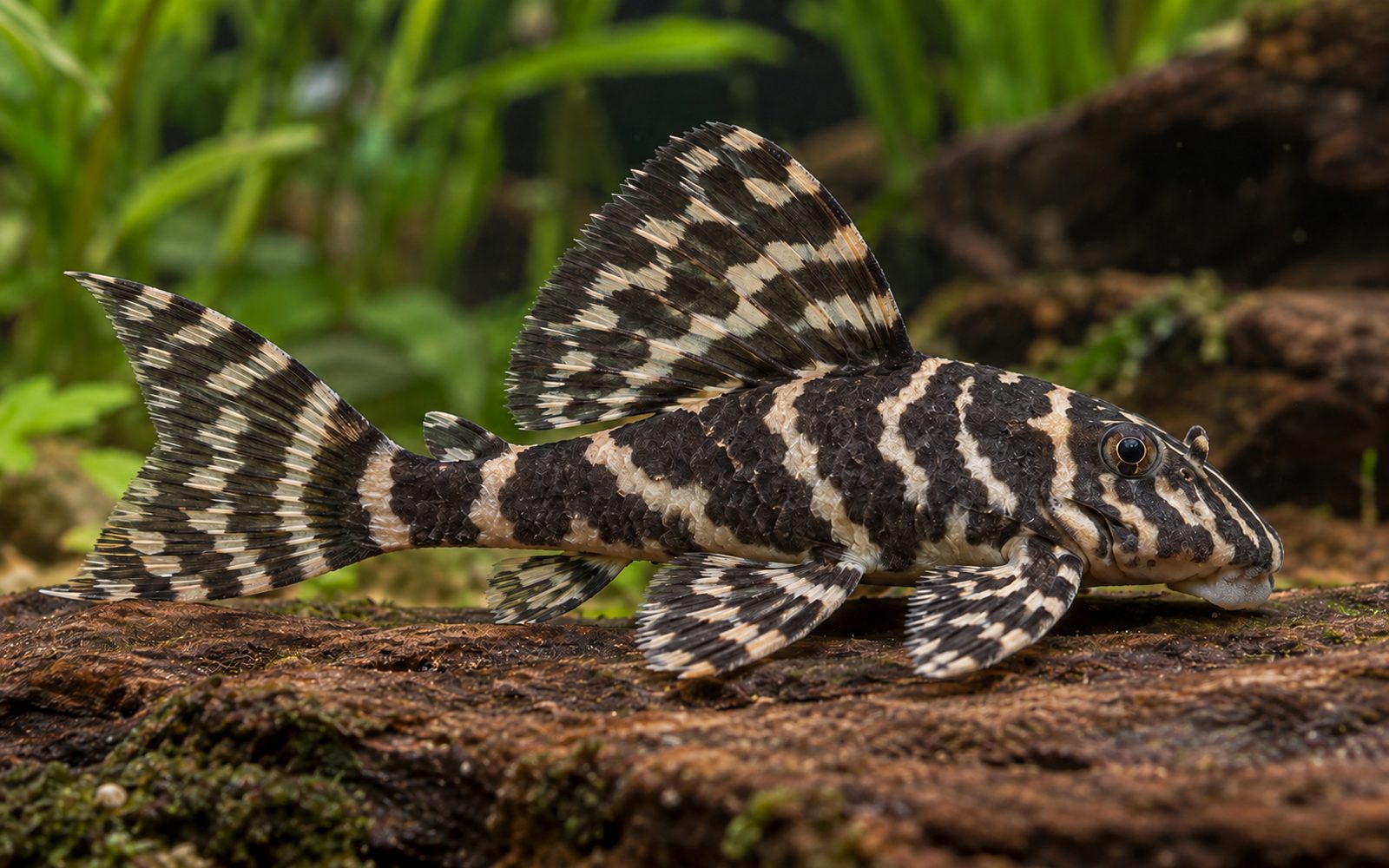
Despite the "zebra" in its name, the Colombian zebra pleco is a different species from the true zebra pleco. The cream-colored bands on its dark body are more irregular and broken up; the pattern varies from individual to individual. It is one of four Hypancistrus species described from the Orinoco in 2007.
Adults reach only 6–7 cm, making it one of the smallest L-number plecos. This makes it a suitable Hypancistrus for small aquariums. Because it is bred regularly in the aquarium, captive-bred individuals are easy to find.
Natural Habitat
It lives in rock crevices and hollows in the rocky stretches with flow in the Orinoco basin. The water is warm, soft, slightly acidic and oxygen-rich.
Tank Setup
- Volume: 80 liters for a small group.
- Cave: A small, narrow cave for each individual; clay tubes and piles of flat stones.
- Flow and oxygen: An extra circulation pump and aeration.
- Water: 26–28°C; soft, slightly acidic water is preferred. A 30% water change every week.
Diet
Mainly carnivorous. Bloodworms, mysis, brine shrimp, shrimp pieces and protein-rich sinking granules should be the staple; a vegetable-based wafer can be given occasionally. It is not an algae cleaner. Because it is small, give food after the lights go off, in spots it can reach.
Behavior and Compatibility
Peaceful and shy; it stays in its cave during the day. Males have brief chases over caves. It leaves other species alone but easily falls behind in the competition for food.
Good companions: Small, calm tetras (cardinal, rummy-nose), rasboras, dwarf cichlids, sterbai corydoras.
Avoid: Other Hypancistrus species (hybridization), large territorial plecos, aggressive cichlids, fast, greedy bottom dwellers.
Group and Colony Structure
It can be kept singly; a group of 3–5 individuals behaves more naturally. Provide more caves than there are males. For breeding, 2 females per male is suitable. Thanks to its small size, an 80–100 liter aquarium can be enough for a breeding group of a few individuals.
Breeding
It breeds regularly in the aquarium. The female lays her large eggs in the male's cave; the male guards the eggs and fry. The fry emerge once the yolk sac is used up and are fed fine granules and crushed frozen food. The number of eggs is small but the eggs are large, so the fry hatch quite well developed.
Health and Common Problems
Low oxygen and nitrate buildup lead to loss of appetite and bacterial infections. Because of its small size, the risk of starvation is high when it is kept with larger tankmates. It is sensitive to copper. Since less oxygen dissolves in warm water, increase aeration during the summer months.
Sexing
Mature males have a wider head and longer pectoral fin spines and cheek odontodes. Females are noticeably wider in the belly when viewed from above.
Tank mates
This list is calculated automatically from the species profile and grows as new species are added to the catalog. Try it in the planner for a definite answer.
Usually compatible
 Polystictus Corydoras
 Emerald Betta
 Emerald Cory
 Porthole Catfish
 Keyhole Cichlid
 Cupid Cichlid
 Geophagus altifrons
 Geophagus surinamensis
 Cryptocoryne Parva
 Gold Spot Pleco (L001)
Should not be kept together






Hobbyist notes
Things you won't find in books, learned by trial and error. The most helpful ones are on top.
Change history and contributors
- Page created · October 16, 2026