
Water parameters
Overview
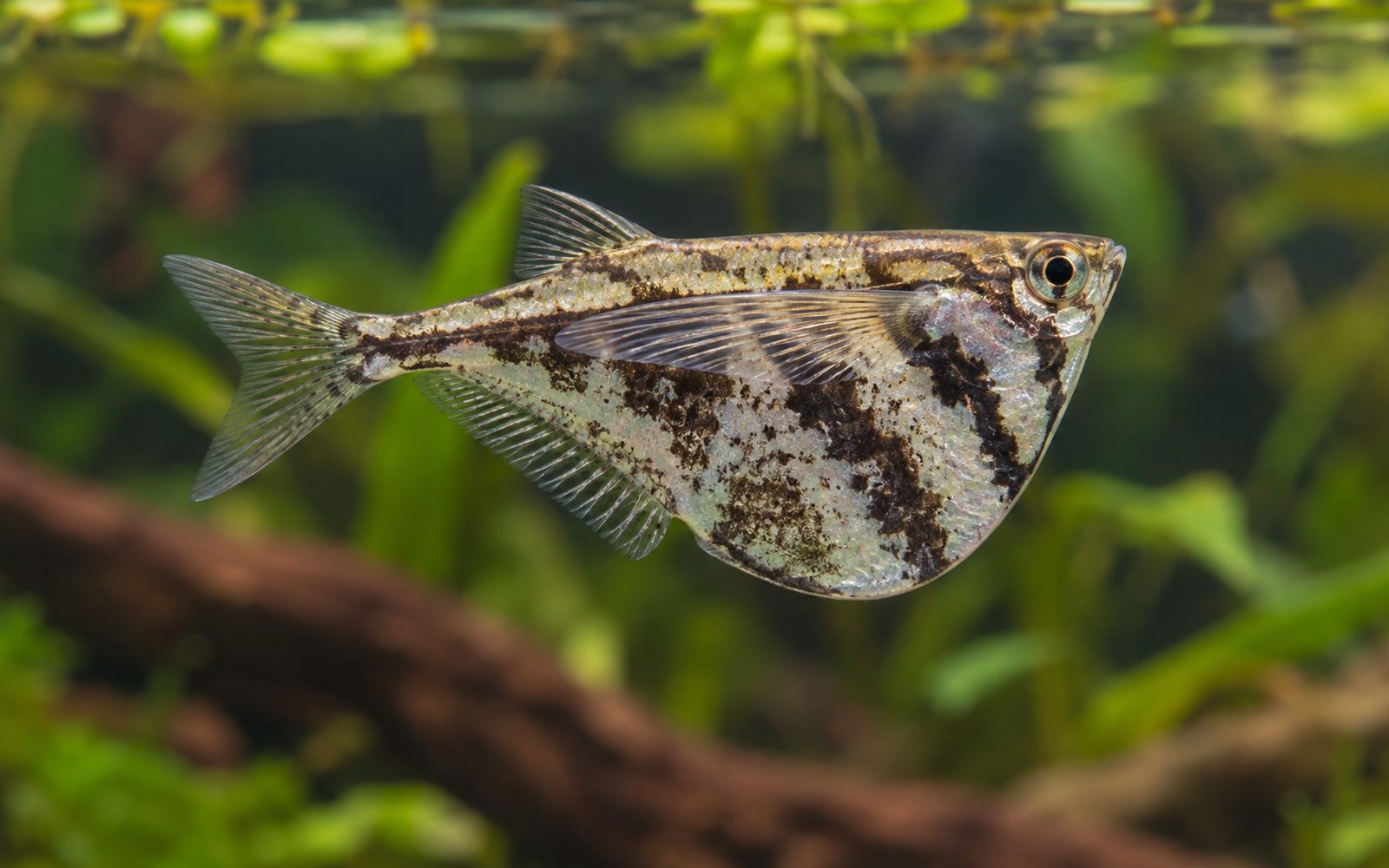
The marbled hatchetfish has a hatchet-shaped body with a straight back and a chest that deepens downward. Dark, slanting bands on its body form a marble-like pattern. Thanks to its long pectoral fins attached to powerful chest muscles, it can leave the water surface and leap short distances when in danger.
It spends its life just below the water surface and feeds on insects that fall onto the surface. With the right setup its care is not difficult, but it cannot be kept in an aquarium without a lid.
Natural Habitat
It lives in shaded, still waters covered with floating plants in the flooded forests of the Amazon basin and the Guyana region. The water is soft, acidic and often dark from tannins.
Tank Setup
- Volume: at least 60 liters for a group of 6–10; surface area matters more than depth.
- Water: 24–27°C, pH 6–7, soft water.
- Lid: a tight-fitting lid is absolutely necessary; it can get out through even small gaps.
- Decor: floating plants on part of the surface provide shelter, but an open surface area should also be left for swimming. Avoid strong surface flow.
Diet
Mainly carnivorous, and it takes its food only from the water surface. Floating flakes, frozen or live mosquito larvae, fruit flies, brine shrimp and daphnia are suitable. It does not feed on food that sinks to the bottom.
Behavior and Compatibility
A peaceful and skittish species. It stays in a school just below the surface. Sudden movements and noise can make it jump. It does not harm other species and can be kept safely with shrimp.
Good companions: small tetras, pencilfish, rasboras, corydoras, otocinclus, dwarf cichlids, shrimp.
Avoid: aggressive species that swim at the surface, large predators, active and boisterous species.
Group and Colony Structure
It is a schooling fish: at least 6, ideally 10 or more individuals. In a larger group it is less easily startled and more visible at the surface. Fish kept alone or in very small numbers weaken from stress. The sex ratio does not matter. The school usually stays in the same area of the surface, lined up side by side, so a large, open surface area is important for the fish's comfort.
Breeding
It rarely breeds in the aquarium. In successful cases, very soft, acidic water, dim light and floating plants with fine roots near the surface were used; the eggs are released among the roots or plants. The great majority of the fish sold in the trade are wild-caught.
Health and Common Problems
- White spot (ich): common in wild-caught fish after transport; quarantine and slow acclimation are important.
- Weight loss: if not given enough surface food, it quickly becomes thin; watch the belly line.
- Jumping: losses are unavoidable in a tank without a lid.
Sexing
Hard to tell apart from the outside. Females carrying eggs look wider when viewed from above.
Tank mates
This list is calculated automatically from the species profile and grows as new species are added to the catalog. Try it in the planner for a definite answer.
Usually compatible
 Flame Tetra
 Blackfin Corydoras
 Polystictus Corydoras
 Emerald Cory
 Porthole Catfish
 Keyhole Cichlid
 Cupid Cichlid
 Geophagus altifrons
 Geophagus surinamensis
 Cryptocoryne Parva
Should not be kept together







Hobbyist notes
Things you won't find in books, learned by trial and error. The most helpful ones are on top.
Change history and contributors
- Page created · October 16, 2026