
Water parameters
Overview
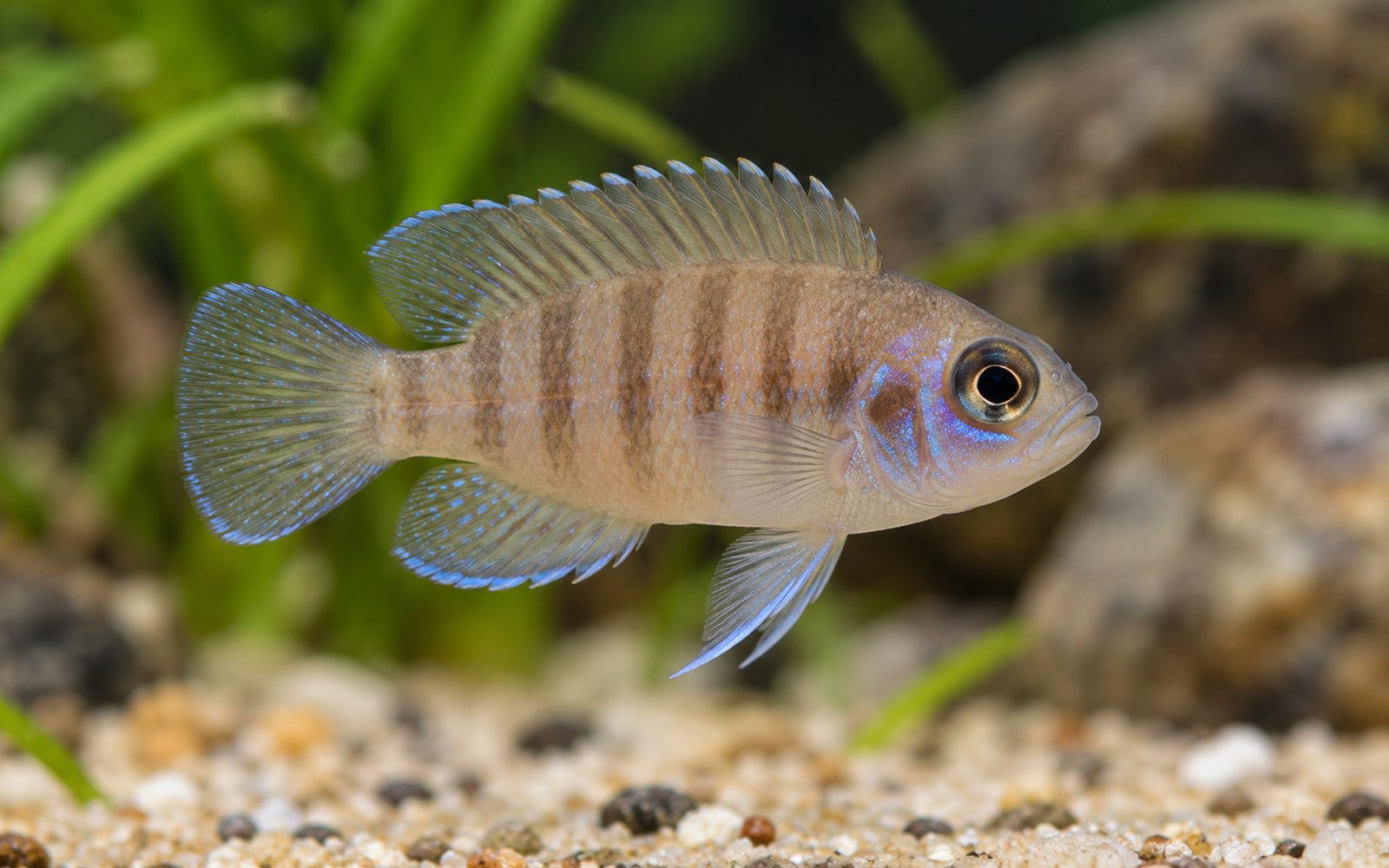
The brevis is a small shell-dwelling cichlid named for its short, stocky body (brevis: short). Males reach 5 cm and females 3.5–4 cm. The body is brownish-beige with faint vertical bands; a bluish sheen can be seen on the head and fin edges.
Its most important difference from other shell dwellers is its life as a pair: the male and female often share the same shell, and when danger threatens both take refuge in the same shell. It is calmer and digs less; its territorial defense is not as fierce as that of ocellatus. This makes it a good choice for those who want to start with shell-dwelling cichlids.
Natural Habitat
It lives on the lake's sandy and muddy bottoms, among empty Neothauma snail shells. In the shell bed it is seen as pairs scattered at some distance from each other; each pair claims one or several shells.
Tank Setup
- Volume: 40–54 liters for a pair; 80–100 liters and a large footprint for 2–3 pairs.
- Shells: at least 2–3 shells per pair; choose clean, unpainted shells with an opening of around 2.5–3 cm that both fish can enter.
- Substrate: fine sand and a few small stones.
- Water: pH 8–9, hard water; a 20% water change every week.
- Plants: it does little harm to plants; Anubias and Vallisneria can be used.
Diet
A small carnivore. Fine-grained granules and crushed flakes should be the staple; vary them with frozen cyclops, brine shrimp and daphnia. Food should be given in small amounts so that it falls near the shells.
Behavior and Compatibility
Calm; the pair spends most of its time right next to its shell. It is wary of bottom dwellers larger than itself; in the same aquarium as dominant shell dwellers it stays in the background and may not get to feed.
Good companions: middle to upper water fish such as Cyprichromis or Paracyprichromis in a large aquarium, calm Julidochromis species.
Avoid: dominant shell dwellers such as ocellatus and multifasciatus in a small aquarium, cichlids that set up territories on the bottom, large and carnivorous fish. It eats baby shrimp.
Group and Colony Structure
- Kept as a pair; the pair needs to have formed naturally. 4–6 juveniles can be grown up together and the pair that forms chosen.
- With enough floor space, 2–3 pairs can live as a loose colony, each given its own group of shells.
- The number of shells should be at least 2–3 times the number of pairs.
- The fry grow up near the pair; when mature they look for their own shells and the extras are removed.
Breeding
The female lays her eggs inside the shared shell and takes on most of the care; the male stays nearby and defends the shell. The fry begin to emerge from the shell after about a week to ten days; they are fed newly hatched brine shrimp and powdered food. The parents protect the fry for a while.
Health and Common Problems
- Hardy; soft water and low pH are the biggest risk.
- In a small volume, overfeeding leads to ammonia buildup.
- When kept with dominant species it may be unable to feed and lose weight; keep an eye on how full its belly is.
Sexing
Males are larger (about 5 cm versus 3.5–4 cm) and their fins are slightly longer. It is difficult to tell juveniles apart; two fish that start using the same shell together are most likely a pair.
Tank mates
This list is calculated automatically from the species profile and grows as new species are added to the catalog. Try it in the planner for a definite answer.
Usually compatible
 Egyptian Mouthbrooder
 Yellow Tail Acei
Amazon Molly
Yellow Tail Acei
Amazon Molly
 Butterfly Goodeid
Anatolian Killifish
Sulphur Head Peacock
Butterfly Goodeid
Anatolian Killifish
Sulphur Head Peacock
 Horned Nerite Snail
Burdur Killifish
Chalinochromis brichardi
Cyathopharynx furcifer
Horned Nerite Snail
Burdur Killifish
Chalinochromis brichardi
Cyathopharynx furcifer
Should not be kept together






Hobbyist notes
Things you won't find in books, learned by trial and error. The most helpful ones are on top.
Change history and contributors
- Page created · October 16, 2026