
Water parameters
Overview
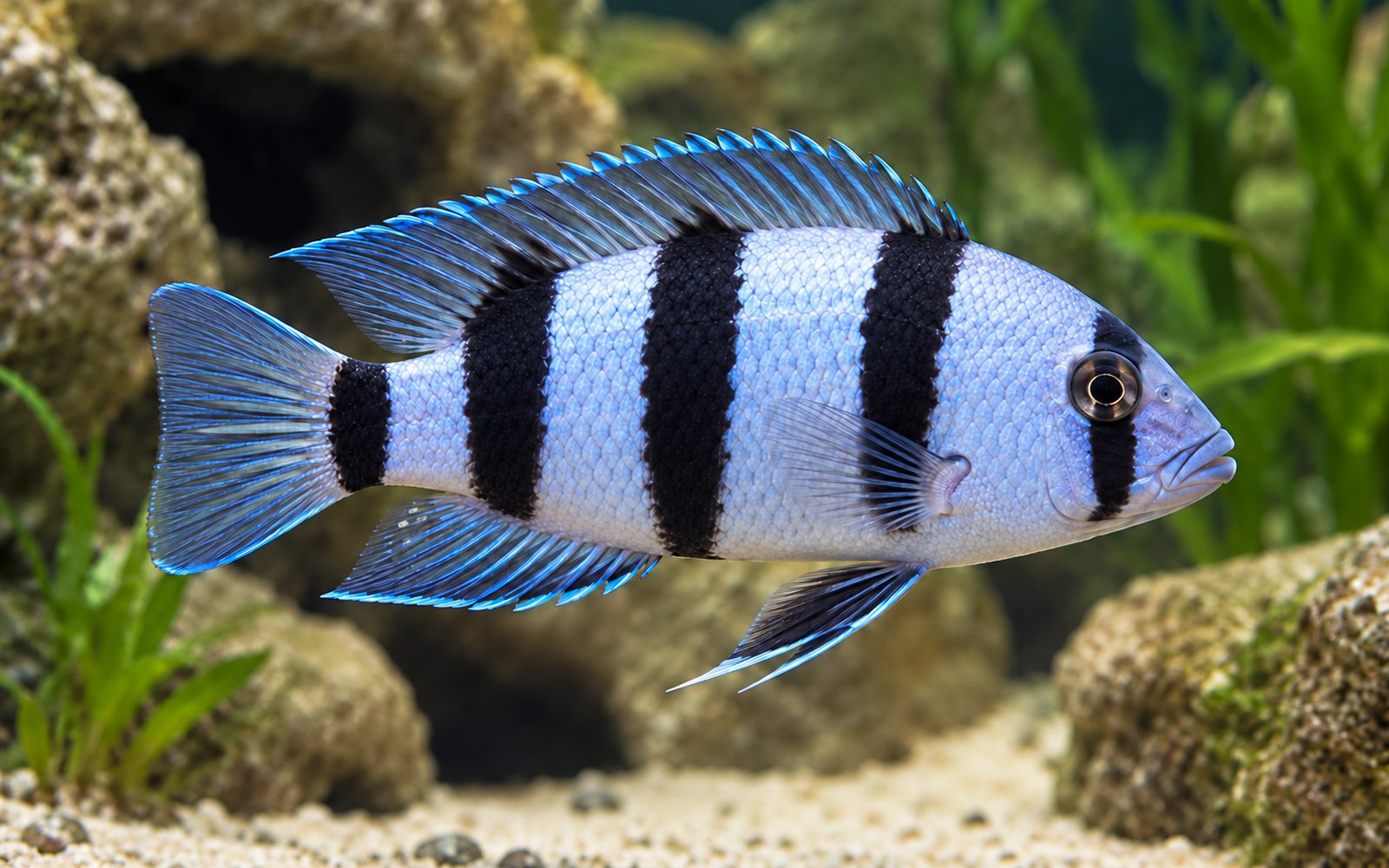
With five thick black vertical bands on a bluish-white background, the tretocephalus is one of the most easily recognized Neolamprologus species of Tanganyika. It reaches 12–14 cm; a bright blue band along the fin edges completes the pattern. Because of its appearance it is confused with the sexfasciatus; the sexfasciatus has six bands and its background color usually leans toward yellow.
It is a strongly built, self-assured and territorial fish. With the right companions it becomes one of the characterful residents of a large Tanganyika aquarium; for poorly chosen small or calm species, however, it is a serious threat.
Natural Habitat
It lives along the lake's rocky shores and in transition zones where rock and sand mix. Pairs take a cave or the underside of a rock as their nest and defend the surrounding area. Among the rocks and on the sand it hunts invertebrates such as snails, small crustaceans and insect larvae.
Tank Setup
- Volume: at least 200 liters and a length of 120 cm for a pair; 300 liters or more with other species.
- Rockwork: a few sturdy caves and rock groups that break lines of sight; every fish should have places to retreat to.
- Water: pH 8–9, hard and stable; a 25–30% water change every week.
- Substrate: fine sand; it digs deeply around its nest.
Diet
Carnivorous. A quality cichlid granule should be the staple; vary it with frozen mysis, krill, brine shrimp and small pieces of shrimp. Foods with shells suit its natural diet. Do not feed mammalian meat.
Behavior and Compatibility
It defends a wide area around its cave. It is especially intolerant of its own species, the sexfasciatus and similarly banded fish. It hunts fish that fit in its mouth and fry; it also eats snails.
Good companions: Altolamprologus, large Julidochromis species, Cyprichromis (adult), Synodontis catfish; Tropheus in a large aquarium.
Avoid: the sexfasciatus and other banded Neolamprologus species, shell-dwelling cichlids, small and calm fish, shrimp and snails.
Group and Colony Structure
- Kept as a pair; more than one pair works only in a very large aquarium.
- 5–6 juveniles are grown up together and the pair that forms is chosen; pairing adults later is risky.
- Once the pair is established, the fry stay in the territory for a while, are chased as they grow and should be removed.
- In incompatible pairs the female can be badly injured; acclimating them with a divider helps.
Breeding
The pair spawns inside a cave or under a stone. The female tends the eggs while the male guards the surroundings. The eggs hatch within a few days and the fry become free-swimming after about a week. They are fed newly hatched brine shrimp and powdered food; the parents protect the fry for a while.
Health and Common Problems
- Hardy; the main problems are soft water, low pH and high nitrate.
- Bloat: seen with overfeeding and a monotonous diet.
- Fight wounds: unavoidable with unsuitable species or in a small aquarium.
Sexing
Difficult from the outside. Males are usually larger and their forehead becomes more pronounced with age. A definite distinction is made by looking at the genital papilla.
Tank mates
This list is calculated automatically from the species profile and grows as new species are added to the catalog. Try it in the planner for a definite answer.
Usually compatible
 Demasoni Cichlid
 Pundamilia nyererei
 Pundamilia pundamilia
 Zebra Obliquidens
Burton's Mouthbrooder
Zebra Obliquidens
Burton's Mouthbrooder
 Auratus Cichlid
 Bumblebee Cichlid
Ice Blue Zebra
Bumblebee Cichlid
Ice Blue Zebra
 Afra Cichlid
 Elongatus Mbuna
Should not be kept together








Hobbyist notes
Things you won't find in books, learned by trial and error. The most helpful ones are on top.
Change history and contributors
- Page created · October 16, 2026