
Water parameters
Overview
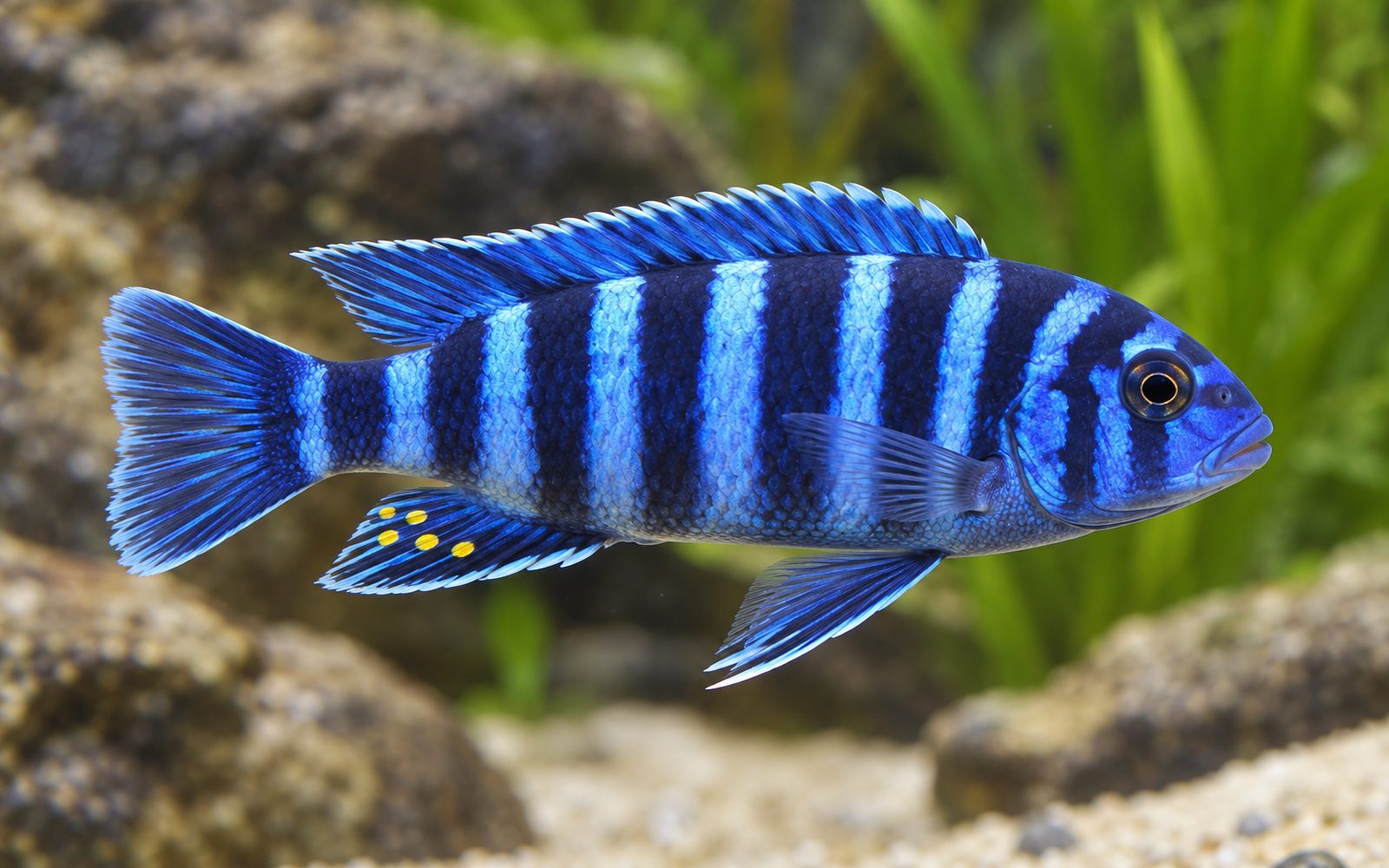
The elongatus is a small mbuna named for its long, slender body. There are many local forms of slightly different color on different rocky areas of the lake; names such as "Mpanga" and "Chewere" refer to these forms. What they share is a body lined with dark navy and light blue bars and a rather pugnacious temperament.
It belongs to the same group of relatives (Chindongo) as the demasoni and, like it, is aggressive to a degree you would not expect from its size. In a small group or an aquarium with few rocks, the dominant male wears down the other fish one by one. It is a species suited to experienced Malawi keepers.
Natural Habitat
It lives on the rocky shores of the northern part of Lake Malawi, among and on top of rock piles. It feeds on the algae layer on the rocks and on plankton drifting in the water above the rocks. The water is hard, alkaline and very clear.
Tank Setup
- Volume: at least 250 liters and 120 cm in length for a large group.
- Rockwork: Rock piles that cover most of the aquarium, with many caves and broken lines of sight, are essential.
- Water: Hard and alkaline (pH 7.8–8.5); aragonite substrate and Malawi salt.
- Maintenance: Strong filtration, weekly 30–50% water changes.
Diet
Omnivorous; it is somewhat more open to animal foods than other species of the zebra group. A spirulina-based mbuna food should be the staple, and brine shrimp or mysis can be offered a few times a week. Bloodworms and foods containing mammalian meat should be avoided.
Behavior and Compatibility
Males are very aggressive both toward males of their own species and toward other blue-barred fish. They also pressure the females through constant courtship. When kept crowded together with sturdy mbuna of different colors and similar size, this pressure is spread out.
Good companions: yellow and orange mbuna (yellow lab, red zebra), species with different patterns such as auratus females, Synodontis catfish suited to hard water.
Avoid: blue-barred or striped species such as demasoni, saulosi, zebra mbuna and maingano, calm mbuna, all haps and Aulonocara species, community fish, shrimp.
Group and Colony Structure
- Large group: at least 6, preferably 10–12 fish. Losses are common in groups of 2–4.
- Ratio: 4–5 females per male. In a group raised from juveniles, surplus males should be removed as they become distinguishable.
- Add them at the same time: The whole group goes into the aquarium together; a fish added later becomes a target.
- Single form: Because different local forms can hybridize with each other, keeping a single form in the aquarium is recommended.
Breeding
A mouthbrooder. The male courts in front of a cave; the female picks up 10–20 eggs in her mouth and carries them for about 3 weeks, not eating during this time. After release, the fry hide in rock crevices; in a crowded aquarium some of them can survive.
Health and Common Problems
- Malawi bloat: triggered by the wrong diet and stress.
- Fight wounds: seen in females and weaker males when the group is small or there are few rocks.
- A hiding, darkened fish: this is the fish at the bottom of the hierarchy; it should not be overlooked.
Sexing
Males are larger, darker and more sharply barred, and carry prominent egg spots on the anal fin. In most forms females are paler, gray-blue or brownish, and their bars look fainter. Because the color difference varies by form, reliable sexing is done by examining the genital papilla.
Tank mates
This list is calculated automatically from the species profile and grows as new species are added to the catalog. Try it in the planner for a definite answer.
Usually compatible
 Banded Jewel Cichlid
 Demasoni Cichlid
 Jack Dempsey
 Red Devil Cichlid
 Convict Cichlid
 Pundamilia nyererei
 Pundamilia pundamilia
 Zebra Obliquidens
 Anubias Angustifolia
 Anubias Barteri
Should not be kept together








Hobbyist notes
Things you won't find in books, learned by trial and error. The most helpful ones are on top.
Change history and contributors
- Page created · October 16, 2026