
Water parameters
Overview
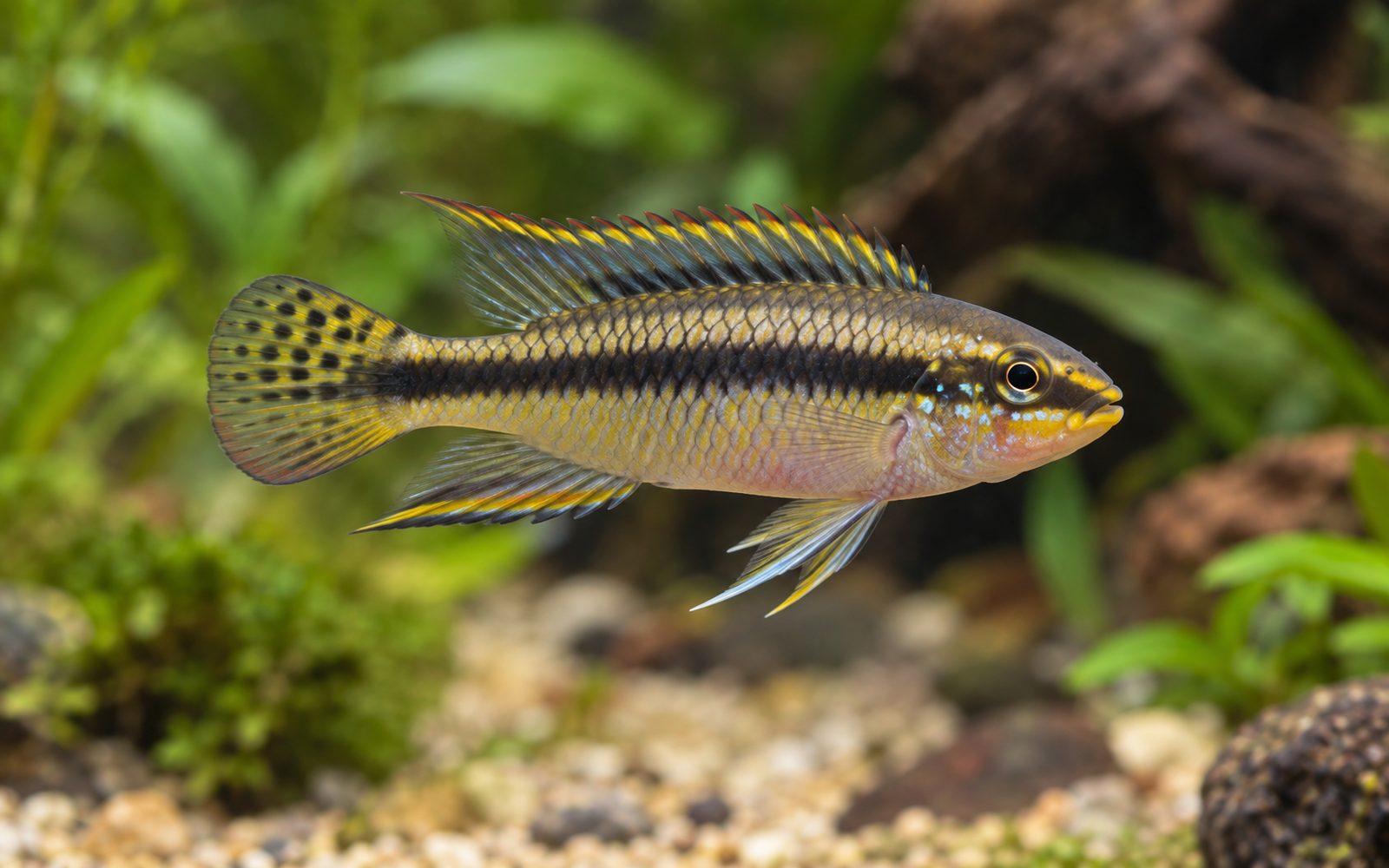
Pelvicachromis taeniatus is a close relative of the well-known kribensis (P. pulcher) and carries a dark horizontal stripe running from the eye to the tail on its body. Unlike most Pelvicachromis species, the males are as colorful as the females; the dark outlines of the scales and the often bright yellow upper lip help identify the species.
Populations living separately in many streams in Nigeria and Cameroon form very different color forms. These forms are sold under the name of their collection site and should not be crossed with each other so that the lines stay pure.
Color and Fin Varieties
- Moliwe: a locality form from Cameroon that is commonly seen in the trade.
- Nigeria Red: a form from Nigeria with pronounced red tones.
- Other locality forms (Dehane, Kienke, Lobe, Wouri, Calabar): forms sold under the name of the stream where they were collected; their pattern and color distribution differ from one another, and they should not be mixed.
Natural Habitat
It lives in forest streams in the coastal regions of Nigeria and Cameroon, in still or slow-flowing, often densely planted waters. These waters are usually soft and slightly acidic.
Tank Setup
- Volume: at least 80 liters for a pair.
- Cave: a coconut shell, small flowerpot or stone cave is essential.
- Substrate and decor: fine sand, roots, plants and visual barriers.
- Water: 23–26°C; it likes softer water than the kribensis. For breeding, pH 6–7 and 24–25°C are suitable. A 25% water change every week.
Diet
Omnivorous. Sinking granules and tablets, frozen bloodworms, brine shrimp, daphnia and mysis; plant-based food now and then. It feeds on the bottom.
Behavior and Compatibility
Peaceful most of the time; during breeding it fiercely defends the area around its cave and chases bottom dwellers. It rarely shows interest in midwater fish. It eats shrimp.
Good companions: schooling fish that swim in the middle layer (tetras, rasboras, African characins such as the Congo tetra), bristlenose plecos.
Avoid: other dwarf cichlid pairs in a small aquarium, fish that constantly roam the bottom, shrimp, large aggressive cichlids.
Group and Colony Structure
Kept as a monogamous pair. Several juveniles are grown up together until they pair off, or a bonded pair is bought. One pair per aquarium; a second pair requires 150 liters or more and a layout with the caves kept far apart.
Breeding
The female usually takes the initiative: she curves her body to show the male her purple belly and invites him into the cave. The eggs are laid on the ceiling or wall of the cave; the female tends the eggs inside while the male guards the outside. The eggs hatch in 2–3 days, and the fry become free-swimming after 7–8 days and are led around as a school by both parents. The fry are fed newly hatched brine shrimp. As in the kribensis, pH can affect the sex ratio of the fry.
Health and Common Problems
Hardy, but wild forms are more sensitive to hard water and high nitrate than the kribensis. Bacterial infections can occur with a monotonous diet and dirty water.
Sexing
Males are larger (around 8 cm), with pointed dorsal and anal fins and a rounded tail that is usually spotted on its upper half. Females are smaller and rounder; during breeding a pink flush appears on their flanks along with a deep purple belly, and their dorsal fin has a dark band and a shining silver–gold edge.
Tank mates
This list is calculated automatically from the species profile and grows as new species are added to the catalog. Try it in the planner for a definite answer.
Usually compatible
 Emerald Betta
 Emerald Cory
 Porthole Catfish
 Keyhole Cichlid
 Firemouth Cichlid
 Buffalohead Cichlid
 Festivum
 Geophagus surinamensis
 Rainbow Cichlid
Should not be kept together





Hobbyist notes
Things you won't find in books, learned by trial and error. The most helpful ones are on top.
Change history and contributors
- Page created · October 16, 2026