
Water parameters
Overview
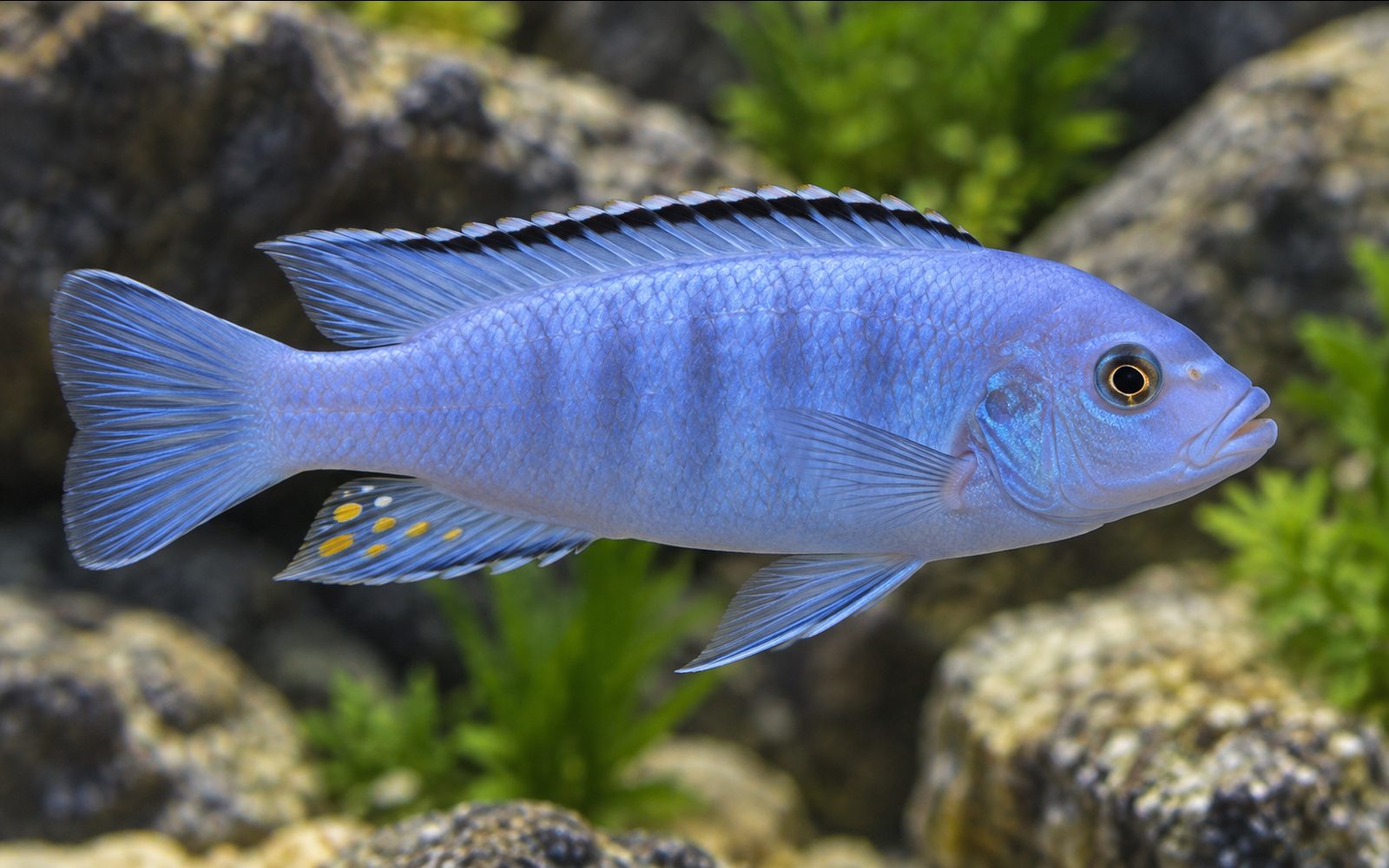
The socolofi is an mbuna from the Mozambique shore of the lake in which both sexes are plain powder blue. Its body is slimmer and longer than that of the zebra group; the thin dark line on the dorsal fin is its most distinctive mark. Besides the natural blue form, a white albino form with red eyes is also commonly sold for aquariums.
Among mbuna it has what could be called a "moderate" temperament: males defend their territory but are not as ruthless as the kenyi or elongatus. With its hardiness and easy breeding, it is one of the suitable species for those starting a Malawi aquarium.
Color and Fin Varieties
- Blue (natural form): plain powder-blue body, dorsal fin with a dark line.
- Albino socolofi: white or cream body, red eyes; a color form bred in the aquarium.
Natural Habitat
It lives along the Mozambique shore of Lake Malawi, in shallow areas where sand and rock mix. It feeds by picking up the algae layer on rock surfaces and the small organisms within it. The water is hard, alkaline and clear; the temperature is around 24–27°C.
Tank Setup
- Volume: at least 250 liters and 120 cm in length for a harem together with other mbuna.
- Rockwork: Plenty of caves and crevices; open sand areas can also be left.
- Water: Hard and alkaline (pH 7.8–8.5); coral sand, aragonite or Malawi salt.
- Maintenance: Strong filtration and weekly 30–50% water changes.
Diet
Mainly herbivorous. A spirulina-based mbuna food should be the staple; vegetables can be added occasionally, and brine shrimp and mysis can be given in small amounts once a week. Bloodworms and foods containing mammalian meat can trigger Malawi bloat.
Behavior and Compatibility
Males claim a rock and chase especially blue fish. Females and juveniles are calm. A balanced community can be set up with mbuna that differ in color and are of similar size and temperament.
Good companions: yellow lab, yellow-tail acei, red zebra, rusty cichlid, Synodontis catfish suited to hard water.
Avoid: plain blue mbuna such as the cobalt blue zebra (fighting and hybridization), very aggressive species such as kenyi and elongatus, Aulonocara and haps, community fish, shrimp and snails.
Group and Colony Structure
- Harem: 1 male and 3–4 females.
- Albino and blue forms: They are the same species and can be kept together; however, if separate lines are to be bred, they should not be mixed.
- For fish added later, the rockwork should be rearranged and territories broken up.
- In a crowded mbuna community, together with strong filtration, aggression is spread out better.
Breeding
A mouthbrooder that breeds easily. The male courts in front of a rock or in a shallow pit he has dug in the sand; the female picks up the eggs in her mouth and they are fertilized via the egg spots on the male's anal fin. The female carries 15–30 eggs for around 3 weeks, not eating during this time. The fry have the adults' color.
Health and Common Problems
- Malawi bloat: triggered by the wrong diet and stress.
- Albino form: may be shyer under strong light; shaded rock crevices help.
- Fight wounds: reduced with the right ratio and rockwork.
Sexing
Both sexes are blue. Males grow larger, their dorsal and anal fins are longer and end in points, and there are prominent egg spots on the anal fin. Females are slightly paler and smaller. For reliable sexing, the genital papilla is examined.
Tank mates
This list is calculated automatically from the species profile and grows as new species are added to the catalog. Try it in the planner for a definite answer.
Usually compatible
 Yellow Regal Peacock
 Firemouth Cichlid
 Rainbow Cichlid
 Pearl Cichlid
 Red Hump Eartheater
 Egyptian Mouthbrooder
 Yellow Tail Acei
 Butterfly Goodeid
American Flagfish
Anatolian Killifish
Butterfly Goodeid
American Flagfish
Anatolian Killifish
Should not be kept together




Hobbyist notes
Things you won't find in books, learned by trial and error. The most helpful ones are on top.
Change history and contributors
- Page created · October 16, 2026