
Water parameters
Overview
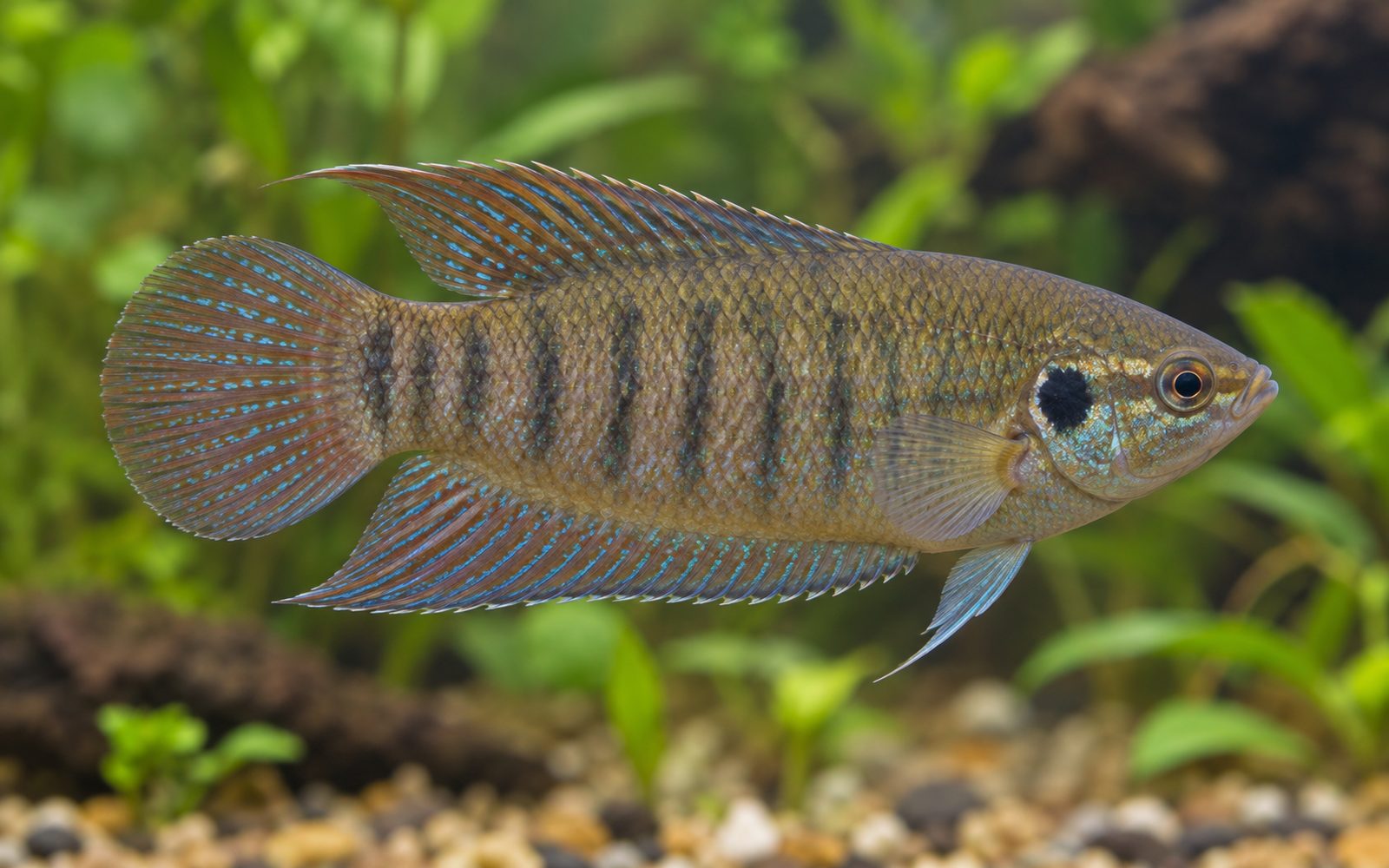
The round-tailed paradise fish is the northern relative of the well-known paradise fish (Macropodus opercularis). Its easiest distinguishing feature is a fan-like round tail rather than a forked one with long tips. Its olive-brown body has faint vertical bands and a dark eyespot on the gill cover; in the breeding season males darken almost to black. It grows to 6–7 cm.
It is one of the most cold-tolerant labyrinth fish: in the wild it survives water that freezes over in winter. This makes it suitable for unheated room aquariums and for garden ponds in the summer months. Although calmer than its relative, its males are territorial.
Natural Habitat
It lives in ponds, rice paddies, ditches and slow-flowing canals of China and the Korean Peninsula. These waters are warm in summer and very cold in winter; dense vegetation and a muddy bottom dominate. It spends the winter in a slowed-down state among submerged plants and mud.
Tank Setup
- Volume: at least 60 liters for one male and two females.
- Water: 16–22°C is ideal; no heater is needed. A cool period of a few weeks at 12–15°C in winter suits its natural cycle. pH 6.5–8.
- Plants: cold-tolerant plants (hornwort, vallisneria, java moss), floating plants and hiding places.
- Flow: gentle; a sponge filter or one with a soft outlet.
- Lid: it jumps well; a tight lid is needed.
Diet
Mainly carnivorous. It accepts flakes and granules; supplement with frozen or live bloodworms, brine shrimp, daphnia and mosquito larvae. Its metabolism slows during the cold period; reduce feeding when the water drops below 15°C.
Behavior and Compatibility
More docile than the paradise fish, but males are territorial toward each other and may chase females hard in the breeding season. It hunts shrimp and fish fry that fit in its mouth. It may harass slow, long-finned fish.
Good companions: fast, robust fish suited to cool water: zebra danio, rosy barb, white cloud mountain minnow (Tanichthys), bronze corydoras (in aquariums where the water does not drop below 20°C).
Avoid: tropical species that need warm water, dwarf shrimp, long-finned fish, small and slow fish, a second male of its own species (in a small aquarium).
Group and Colony Structure
One male and 2 females are recommended. In large, planted aquariums or ponds, several males can live together by establishing their own areas. Females get along with each other but need places to escape the male's chasing.
Breeding
After the winter cool period, the urge to breed increases as the water starts to warm. The male builds a bubble nest at the surface; he carries the eggs released during the embraces to the nest and guards them. The female should be removed after spawning. The eggs hatch in a few days; the fry are fed infusoria, then brine shrimp nauplii. The male is removed once the fry become free-swimming.
Health and Common Problems
Very hardy. The main problem is keeping it constantly warm (26°C or above); under these conditions its lifespan shortens and it becomes prone to disease. Sudden temperature changes can trigger ich. Quarantine new fish.
Sexing
Males are larger, darker and have a shiny bluish sheen; their dorsal and anal fins are long and pointed. Females are smaller and paler with short fins; their vertical bands look more distinct, and their bellies fill out when carrying eggs.
Tank mates
This list is calculated automatically from the species profile and grows as new species are added to the catalog. Try it in the planner for a definite answer.
Usually compatible
 Emerald Cory
 Porthole Catfish
 Keyhole Cichlid
 Rainbow Cichlid
 Gymnogeophagus balzanii
 Red Hump Eartheater
 Cryptocoryne Parva
 Egyptian Mouthbrooder
 European Bitterling
 Weeping Moss
Should not be kept together






Hobbyist notes
Things you won't find in books, learned by trial and error. The most helpful ones are on top.
Change history and contributors
- Page created · October 16, 2026