
Water parameters
Overview
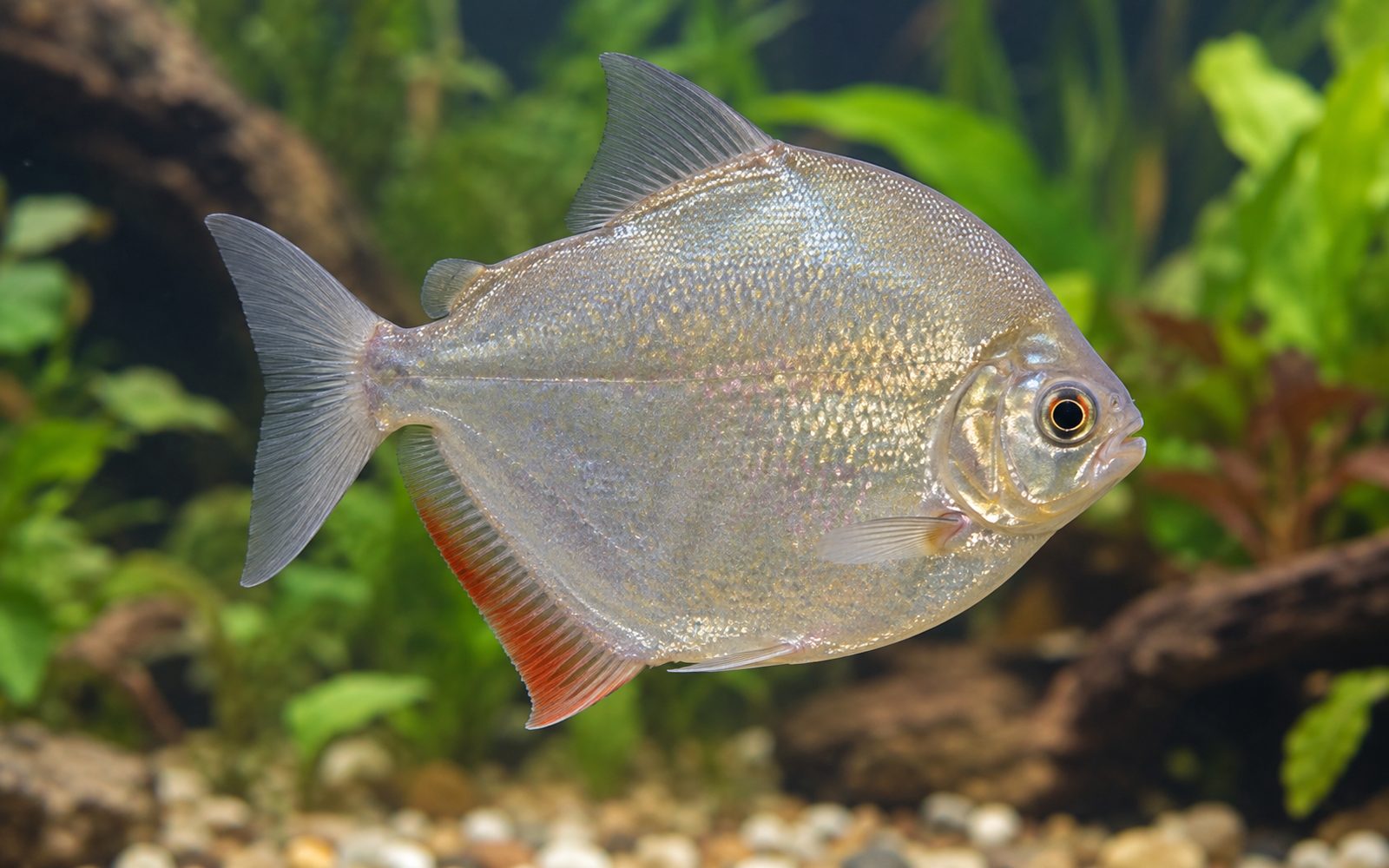
With its laterally compressed, almost round silver body, the silver dollar resembles a coin. It belongs to the same family as piranhas and pacus, but its teeth are suited to tearing off plants and its diet is largely plant-based. Fish sold in the trade as "silver dollars" can belong to several different Metynnis species; their care is very similar.
It is a schooling species that reaches 14–15 cm. The small juveniles seen in stores grow quickly; a large aquarium should be planned from the start.
Natural Habitat
It lives in schools in densely vegetated, slow-flowing river branches and floodplain lakes of the Amazon basin. The water is soft and slightly acidic; during the flood season it feeds on plants and fruit in the flooded forest.
Tank Setup
- Volume: at least 300 liters for a group of 5–8; a length of 120 cm or more.
- Water: 24–28°C, pH 6–7.5, soft to moderately hard water.
- Plants: most live plants get eaten; even hard-leaved species such as Anubias and Java fern can be damaged. It is more practical to set up the decor with roots, stones and artificial plants.
- Lid: it jumps powerfully when startled; a lid is needed.
- Filter: because it eats a lot, strong filtration and a 30% water change every week are recommended.
Diet
Mainly herbivorous. Make flakes and granules with spirulina and plant ingredients the staple. Blanched spinach, lettuce, zucchini, cucumber slices and peas are eaten eagerly. Protein sources such as frozen bloodworms or mysis shrimp can be added a few times a week.
Behavior and Compatibility
A peaceful and skittish species. It swims in a school in the middle water and flees together at sudden movements. It does not attack other fish but may eat small shrimp and very small fry that fit in its mouth.
Good companions: large, peaceful species: large plecos, large corydoras, Congo tetras, peaceful medium to large cichlids such as severums and geophagus, kissing gouramis.
Avoid: dwarf shrimp, nano fish, planted aquariums, aggressive large cichlids.
Group and Colony Structure
It is a schooling fish: at least 5, ideally 8 individuals. Fish kept alone or in pairs become extremely skittish and hide constantly. The sex ratio does not matter.
Breeding
It is an egg scatterer. In large, mature aquariums pairs sometimes spawn on their own; the eggs scatter among plants or onto the bottom. There is no parental care, and other fish eat the eggs. The fry become free-swimming after a few days and are fed fine powdered food.
Health and Common Problems
- White spot (ich): may appear after transport; quarantine is recommended.
- Water quality: a large, heavy-eating school increases the waste load; keep nitrate low.
- Injury: it may crash into the glass and decor when fleeing suddenly; a calm room and steady lighting help.
Sexing
Males have a longer anal fin whose front part is lobed and has a reddish or dark edge. Females have a straight-edged anal fin and slightly plumper bodies.
Tank mates
This list is calculated automatically from the species profile and grows as new species are added to the catalog. Try it in the planner for a definite answer.
Usually compatible
 Flame Tetra
Glass Tetra
Flame Tetra
Glass Tetra
 Blackfin Corydoras
 Polystictus Corydoras
 Emerald Betta
 Emerald Cory
 Porthole Catfish
 Keyhole Cichlid
 Cupid Cichlid
 Buffalohead Cichlid
Should not be kept together






Hobbyist notes
Things you won't find in books, learned by trial and error. The most helpful ones are on top.
Change history and contributors
- Page created · October 16, 2026