
Water parameters
Overview
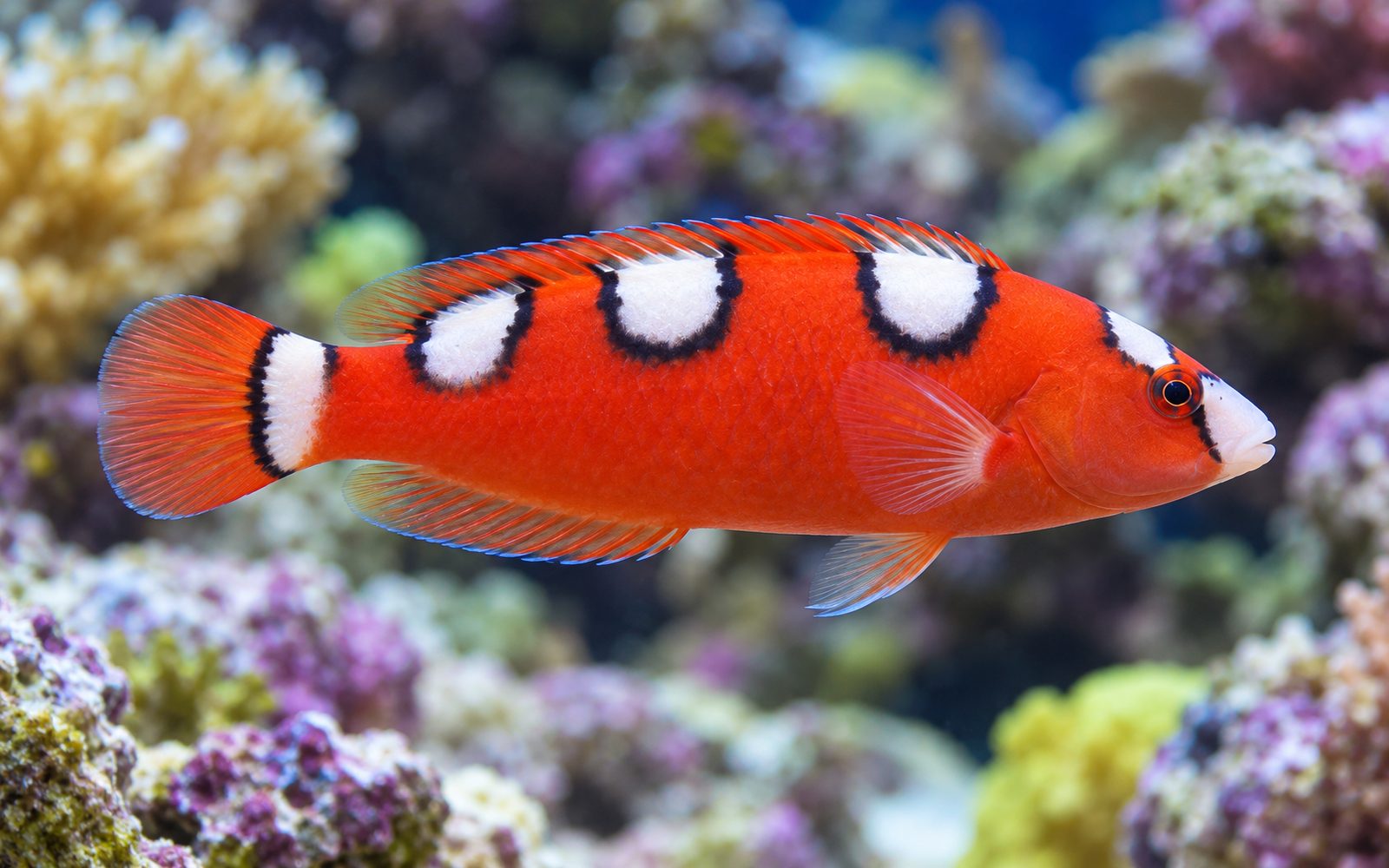
The yellowtail coris is one of the wrasses with the most striking color change between the juvenile and adult stages. Juveniles sold in stores are orange-red and carry large, black-edged white saddles on their backs. As they grow, the body turns dark blue-green and brown and fills with bright blue spots; the tail becomes bright yellow, and green and orange lines appear on the head. It is a relative of the Mediterranean rainbow wrasse (Coris julis).
The small, cute juveniles turn into a greedy, rock-toppling fish that reaches 40 cm as an adult; it is not suitable for a small reef aquarium. All individuals are wild-collected.
Natural Habitat
It lives on Indo-Pacific reefs in places with a mix of sand, rubble and rock. It hunts crabs, snails and worms by flipping over stones; at night and when in danger it buries itself in the sand.
Tank Setup
- Volume: at least 600 liters and 180 cm of length for an adult.
- Sand: a fine-grained sand bed at least 5–8 cm deep is essential; it sleeps buried in it.
- Lid: it jumps; use a sturdy lid.
- Water: salinity 1.023–1.026 specific gravity, pH 8.1–8.4, temperature 24–27°C.
- Reef compatibility: not reef safe. It eats shrimp, crabs, snails, sea urchins and worms; it topples small rocks and coral fragments. Rocks should be secured.
Diet
Carnivorous. Frozen mysis, krill, chopped shrimp, mussel and squid, and marine fish granules. Juveniles are fed 2–3 times a day, adults 1–2 times a day. Hard-shelled foods such as shell-on shrimp and small mussels support natural hunting behavior. Because it constantly stirs up the sand while searching for food, a very fine sand bed can cause cloudiness; a powerful mechanical filter balances this out.
Behavior and Compatibility
Juveniles are relatively docile; adults are bold, active and sometimes cranky. It attacks its own kind and similar wrasses. Very small fish that fit in its mouth are also at risk.
Good companions: in a large aquarium, tangs, large angelfish, foxface, Heniochus, large damsels, calm triggerfish.
Avoid: reefs with shrimp, snails and crabs; small and timid fish; a second large wrasse.
Group and Colony Structure
Keep a single individual in the aquarium. In the wild, loose groups of one male and several females are seen.
Breeding
A wrasse that starts out as a female (protogynous); the dominant individual changes into a male. Male and female rise into the water column and release pelagic eggs. It does not breed in the aquarium.
Health and Common Problems
- Marine ich and velvet: new fish should be observed in quarantine.
- Skin wounds: caused by burying itself in sharp gravel.
- Jumping: a common cause of loss in an uncovered aquarium.
Sexing
The sex of juveniles cannot be told. Among adults, the dominant individual that changes into a male is the largest in the group and has more intense colors.
Tank mates
This list is calculated automatically from the species profile and grows as new species are added to the catalog. Try it in the planner for a definite answer.
Should not be kept together


Hobbyist notes
Things you won't find in books, learned by trial and error. The most helpful ones are on top.
Change history and contributors
- Page created · October 16, 2026