
Water parameters
Overview
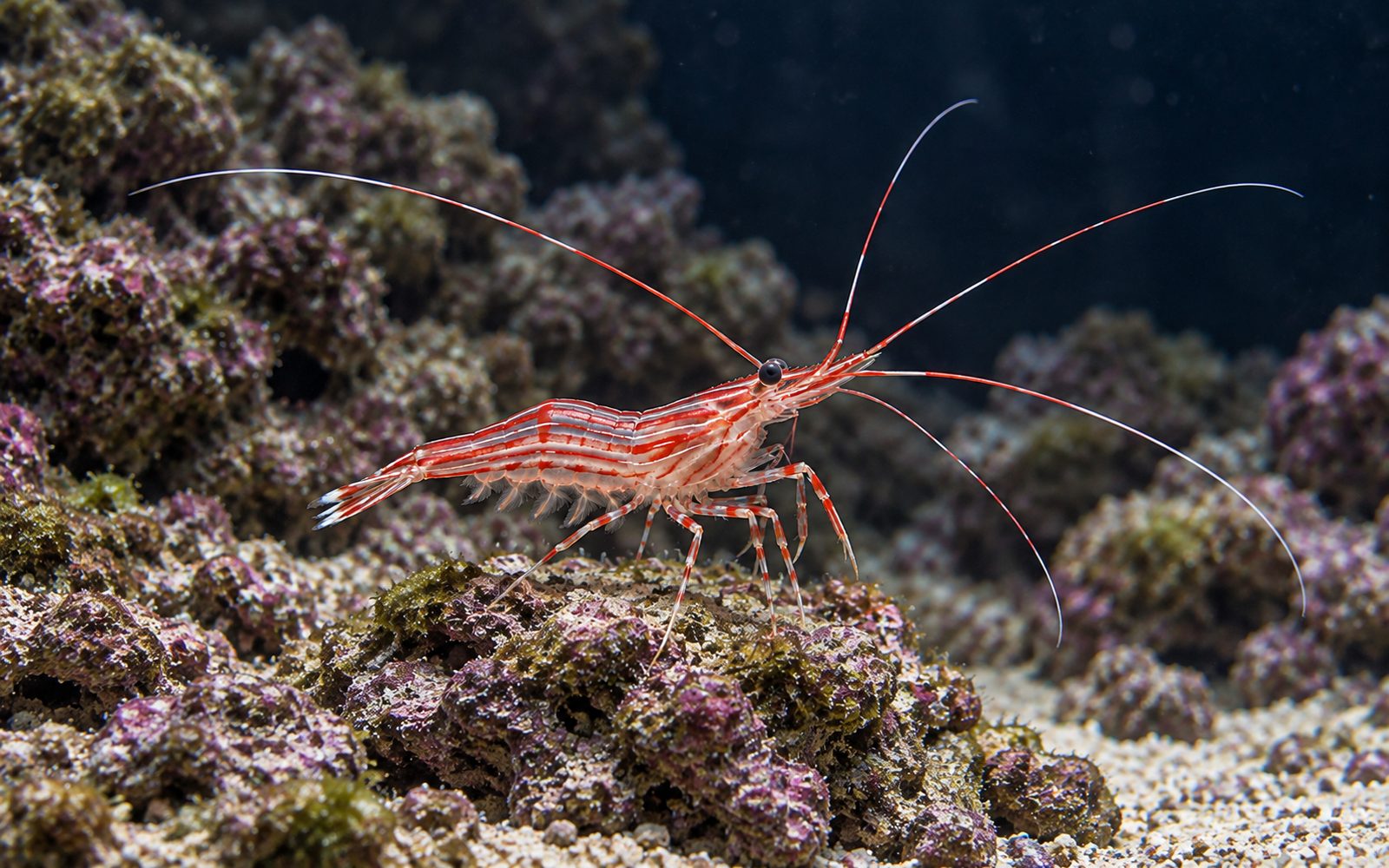
The arrow crab carries a pointed projection (rostrum) extending like an arrowhead from the front of its small, triangular body. Its body is cream to gold with thin dark lines; its legs are more than three times as long as its body and as thin as a spider's legs. The tips of its claws are often purple-blue. Although the body is only about 3–6 cm, with its legs it covers an area of more than 15 cm.
Marine aquarists usually buy it to reduce bristle worms that have multiplied excessively. However, this benefit comes at a price: when hungry it may also catch feather duster worms, small shrimp, hermit crabs and small fish sleeping at night. For this reason it suits aquariums with medium to large fish rather than reefs with small fish and valuable invertebrates. Specimens in the trade are wild-collected.
Natural Habitat
It is common in the Western Atlantic from North Carolina to Brazil, in the Caribbean and the Gulf of Mexico. It lives on rocky and coral reefs, at the base of sponges and rock ledges. During the day it usually stays in holes; at night it comes out to look for carrion and catches prey such as worms and small crustaceans.
Tank Setup
- Volume: at least 120 liters; live rock with plenty of caves and ledges to climb.
- Water: salinity 1.023–1.026 specific gravity, pH 8.1–8.4, temperature 23–27°C.
- Reef compatibility: It leaves corals alone, but it is a risk to small shrimp, feather duster worms and small fish; for this reason it should be kept in a reef with caution.
- Acclimation and medication: Its thin legs are sensitive to salinity changes; acclimate by the drip method for at least 1 hour. Copper-based medications are lethal.
Diet
A carnivorous scavenger. In the aquarium it is not satisfied with bristle worms and leftover food alone; give mysis, chopped shrimp, mussel or carnivore sinking granules 3–4 times a week. Food offered with tweezers is taken immediately with its claws. Regular and sufficient feeding noticeably reduces the risk of it attacking other animals.
Behavior and Compatibility
It moves slowly and majestically and can be seen during the day as well. It is territorial toward its own kind and similar crabs. Large fish may pull off its thin legs.
Good companions: medium to large clownfish, tangs, damselfish, dwarf angelfish; large snails.
Avoid: small gobies, slender small fish such as firefish, dwarf shrimp, feather duster worms; triggerfish, pufferfish and large wrasses; a second arrow crab.
Group and Colony Structure
Kept singly. Because it is territorial, two individuals in the same aquarium chase each other; a molting individual may be killed at that time. The only arrow crab in the aquarium claims its own cave and the area around it.
Breeding
The female carries her eggs under her abdomen; the larvae that hatch develop in the plankton. No offspring are obtained in home aquariums.
Health and Common Problems
- Lost legs: common; they grow back over a few molts.
- Molting: during this period it is motionless and vulnerable; it needs an environment without aggressive fish.
- Sudden deaths: copper, rapid salinity changes and low oxygen.
Sexing
Males usually have longer and thicker claw-bearing legs. The folded tail section under the body (abdomen) is wider in females and becomes prominent when carrying eggs.
Tank mates
This list is calculated automatically from the species profile and grows as new species are added to the catalog. Try it in the planner for a definite answer.
Should not be kept together


Hobbyist notes
Things you won't find in books, learned by trial and error. The most helpful ones are on top.
Change history and contributors
- Page created · October 16, 2026