
Water parameters
Overview
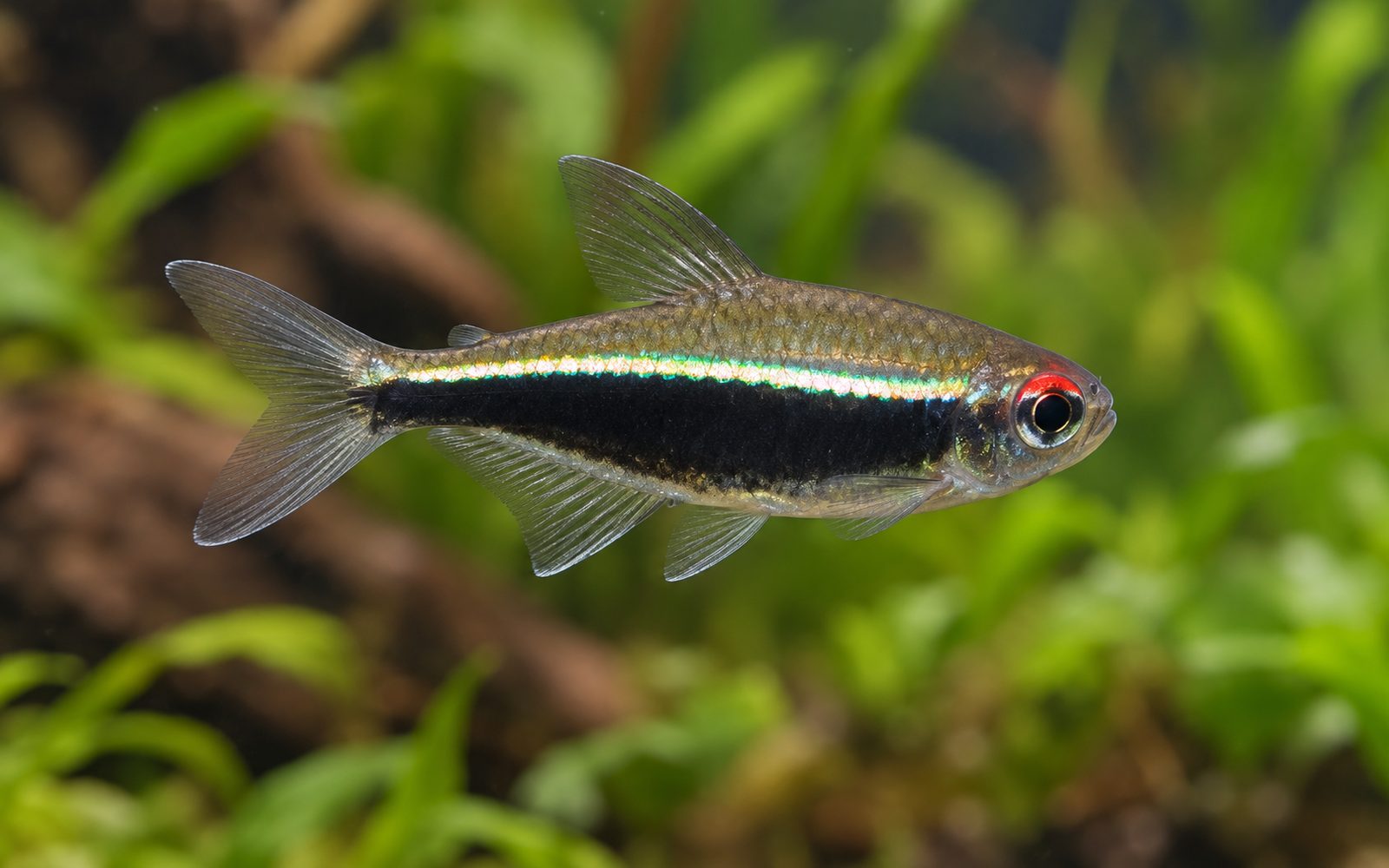
The black neon tetra has a simple but striking pattern made up of a broad black band running along the body and a bright, greenish-white stripe just above it. The upper half of the eye is red. Although its name resembles the neon's, it belongs to a different genus and is hardier than the neon.
Almost all fish sold in the trade are farm-bred. Its adaptability to a wide range of water conditions, disease resistance and peaceful nature make it one of the best tetras for beginners.
Natural Habitat
It lives in the slow-flowing, vegetated and shaded tributaries of the Taquari River system, part of the Paraguay basin, in the Brazilian state of Mato Grosso do Sul. The water is soft and slightly acidic.
Tank Setup
- Volume: at least 60 liters for a school of 8–12; a length of 60 cm or more.
- Water: 23–26°C, pH 6–7.5; it prefers soft water but also adapts to moderately hard water.
- Decor: A dark substrate and a densely planted background bring out the black-and-white pattern. Leave open swimming space in the middle.
- Maintenance: 20–25% water change weekly; gentle to moderate flow.
Diet
Omnivorous and easy to feed. Small granules and flakes should be the staple; vary the diet with frozen brine shrimp, daphnia, cyclops and small bloodworms. Feed 1–2 times a day, as much as is eaten within a few minutes.
Behavior and Compatibility
A very peaceful and active species. It swims as a school in the middle and upper-middle layers of the tank. It has no tendency to nip fins and leaves adult shrimp alone.
Good companions: neons and other small tetras, rasboras, corydoras, otocinclus, dwarf gouramis, small livebearers, dwarf cichlids, shrimp.
Avoid: fish large enough to fit it in their mouths (including adult angelfish) and aggressive species that chase constantly.
Group and Colony Structure
At least 8, ideally 12 or more individuals are recommended. In a large school black neons turn together and behave more boldly; when kept in small numbers the school breaks up and their colors fade. The sex ratio does not matter.
Breeding
It can be bred in the aquarium. Prepare a separate tank with soft, acidic water (around pH 6), dim light and fine-leaved plants or a spawning mop. The female scatters her eggs among the plants; the parents must be removed because they eat the eggs. The fry become free-swimming after a few days and are fed infusoria.
Health and Common Problems
- Hardiness: resistant to disease; most problems come from poor water quality.
- White spot (ich): may appear in newly arrived fish and with sudden temperature changes.
- Quarantine: keeping new fish separate for 2 weeks protects the school.
Sexing
Females are larger with a noticeably fuller belly. Males are slimmer. The difference is easiest to see from above or by comparing individuals side by side in a mature group.
Tank mates
This list is calculated automatically from the species profile and grows as new species are added to the catalog. Try it in the planner for a definite answer.
Usually compatible
 Flame Tetra
 Blackfin Corydoras
 Polystictus Corydoras
 Emerald Cory
 Emerald Dwarf Rasbora
 Porthole Catfish
 Keyhole Cichlid
 Cupid Cichlid
 Geophagus surinamensis
 Cryptocoryne Parva
Should not be kept together







Hobbyist notes
Things you won't find in books, learned by trial and error. The most helpful ones are on top.
Change history and contributors
- Page created · October 16, 2026