
Water parameters
Overview
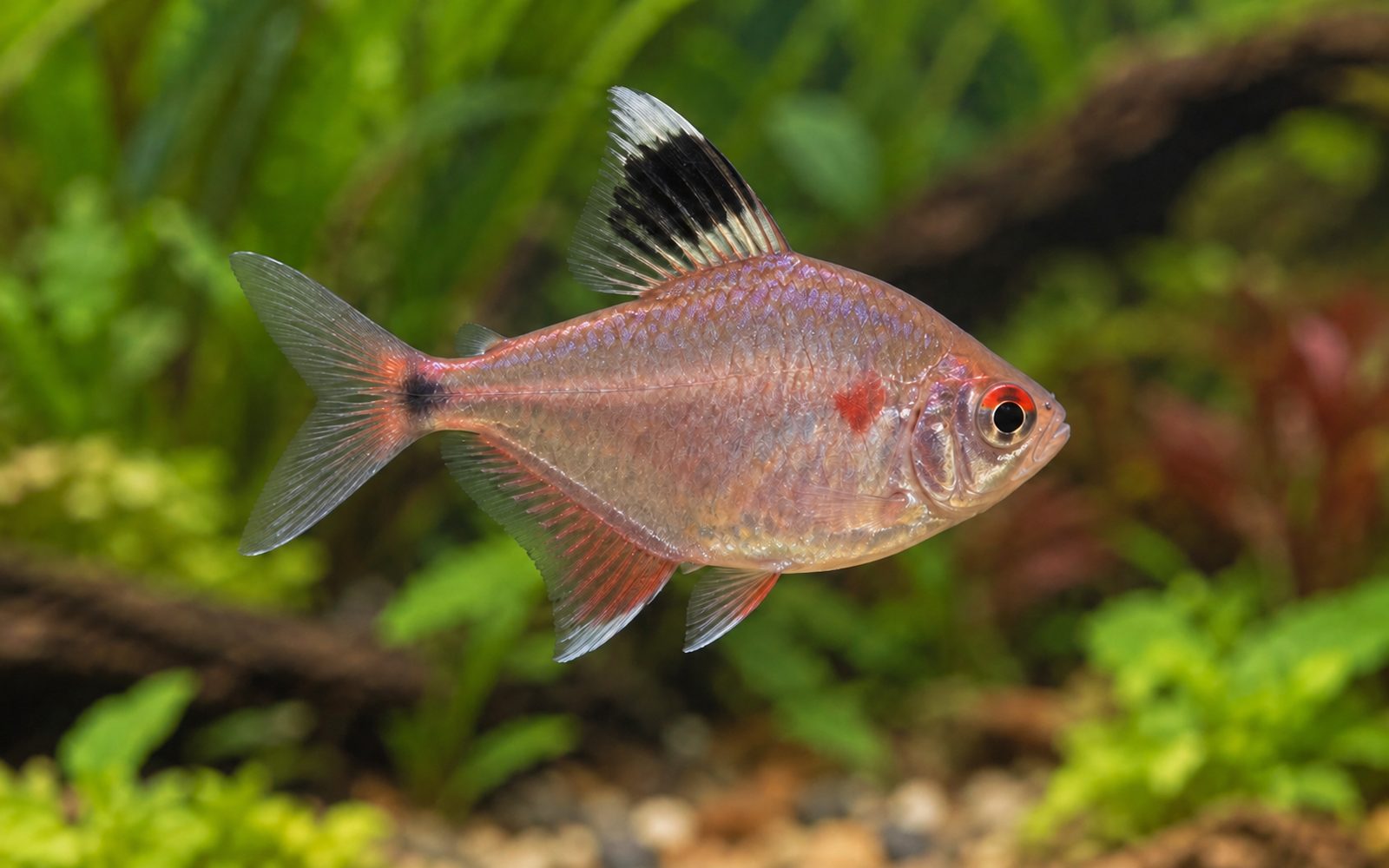
The bleeding heart tetra takes its name from the bright red spot on the side of its tall, flat body, just behind the gill cover. The body has silvery-pink tones; the dorsal fin has a black area and a white tip. As males mature, their dorsal and anal fins lengthen and look like sails. Reaching 6 cm as an adult, it counts as a large species among the tetras.
With its calm nature and striking looks, it is a good schooling fish for medium and large planted aquariums. Juveniles look pale in the store; the colors come out in mature fish.
Natural Habitat
It lives in slow-flowing, shaded forest streams and floodplains of the upper Amazon basin in Peru, Colombia and Brazil. These waters are soft, acidic and usually lightly stained with tannins.
Tank Setup
- Volume: at least 100 liters for a group of 6–10; a length of 80 cm or more.
- Water: 24–27°C, pH 5.5–7, soft to moderately hard water.
- Decor: roots, broad-leaved plants, floating plants and a dark substrate. Dried leaves make the setting more natural.
- Maintenance: a 25% water change every week; gentle flow.
Diet
Omnivorous. Make quality flakes and granules the staple and vary it with frozen brine shrimp, bloodworms, daphnia and mysis shrimp. Because it is large, it also takes medium-sized granules with ease.
Behavior and Compatibility
Peaceful and somewhat timid. Males display to each other by spreading their fins, but real fights are rare. It gets along with peaceful species of its own size and smaller. It usually leaves adult shrimp alone but may eat their young.
Good companions: medium-sized tetras, corydoras, plecos, discus, angelfish (if raised together), dwarf cichlids, gouramis.
Avoid: fin-nipping species (serpae tetras, tiger barbs), large predators, rough cichlids.
Group and Colony Structure
A group of at least 6, ideally 10 is recommended. In a larger group the schooling behavior becomes more pronounced and the males display more. Fish kept in small numbers hide among the plants. The sex ratio is not critical.
Breeding
It is an egg scatterer, but breeding it in the aquarium is more demanding than for many tetras. It needs very soft and acidic water, dim light and fine-leaved plants. The parents should be removed after spawning. A large share of the fish sold in the trade come from breeding farms.
Health and Common Problems
- White spot (ich): common after the stress of transport; quarantine and gradual acclimation are important.
- Fin damage: long-finned males get frayed fins if kept with fin-nipping tankmates.
- Water quality: nitrate buildup causes colors to fade; do not skip regular water changes.
Sexing
When males mature, the dorsal fin becomes long and sickle-shaped, and the anal fin also widens. Females have a short, rounded dorsal fin and plumper bodies.
Tank mates
This list is calculated automatically from the species profile and grows as new species are added to the catalog. Try it in the planner for a definite answer.
Usually compatible
 Flame Tetra
 Blackfin Corydoras
 Polystictus Corydoras
 Emerald Cory
 Porthole Catfish
 Keyhole Cichlid
 Cupid Cichlid
 Geophagus altifrons
 Geophagus surinamensis
 Cryptocoryne Parva
Should not be kept together






Hobbyist notes
Things you won't find in books, learned by trial and error. The most helpful ones are on top.
Change history and contributors
- Page created · October 16, 2026