
Water parameters
Overview
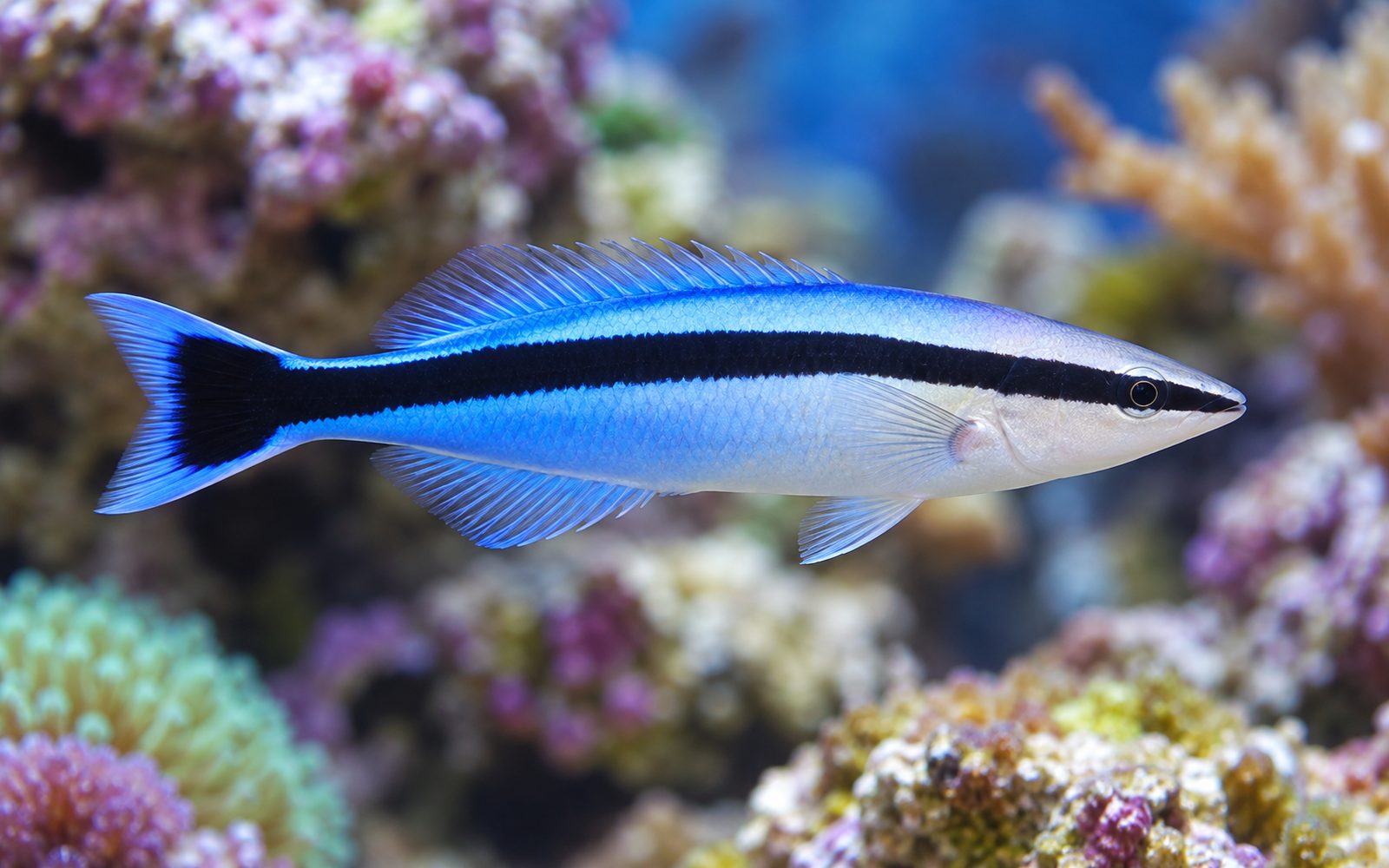
The bluestreak cleaner wrasse is a small member of the wrasse family that runs the "cleaning stations" on reefs. Its body, which shifts from white to blue from front to back, has a black stripe that widens from the snout towards the tail. In the wild large fish come to its station and open their mouths and gills; the cleaner fish eats skin parasites, dead tissue and mucus.
Ethical warning: This species is an obligate cleaner that lives almost entirely on the parasites of other fish. It cannot find this food in a home aquarium; specimens that do not accept prepared food waste away and die within a few weeks to a few months. All specimens are wild-collected, and every fish collected means a cleaning station on the reef left empty. For this reason buying one is not recommended. If cleaning behavior is wanted in the aquarium, cleaner shrimp (Lysmata amboinensis) or captive-bred neon gobies (Elacatinus) are far more sustainable options.
Natural Habitat
On Indo-Pacific reefs it sets up a cleaning station on a particular rock or coral outcrop; it usually lives as a pair or in a small group made up of one male and several females.
Tank Setup
- Volume: At least 200 liters and a mature aquarium housing many fish; in an aquarium with few fish it cannot find food.
- Water: Salinity specific gravity 1.023–1.026, pH 8.1–8.4, temperature 24–27°C.
- Reef compatibility: Reef-safe; it leaves corals and invertebrates alone.
Diet
Carnivorous. In the wild it eats parasites. In the aquarium some specimens accept frozen mysis, brine shrimp, fish roe and very fine granules over time; it is essential to see this in the store before buying. It should be fed small amounts several times a day.
Behavior and Compatibility
Peaceful; it constantly approaches other fish and tries to clean them. Some fish are bothered by this persistence.
Good companions: Peaceful, medium-sized reef fish: tangs, dwarf angelfish, anthias, clownfish.
Avoid: Lionfish and predators that can fit it in their mouths; small aquariums with few fish.
Group and Colony Structure
A single specimen is kept in the aquarium. A pair can find enough food only in very large, well-stocked aquariums.
Breeding
In the wild it forms harems made up of one male and several females; if the male dies, the dominant female changes into a male. A pelagic spawner. Breeding it in the aquarium is not common; captive-bred specimens are almost unavailable.
Health and Common Problems
- Starvation: This is the biggest problem; the belly caves in and the color fades.
- Confusion with the mimic blenny: The false cleanerfish (Aspidontus taeniatus) mimics this species and tears pieces from fishes' skin; the position of its mouth differs (in the blenny it is underneath).
- Marine white spot and velvet: Like other fish, quarantine is needed.
Sexing
Cannot be distinguished externally; males are usually the largest individual in the group.
Tank mates
This list is calculated automatically from the species profile and grows as new species are added to the catalog. Try it in the planner for a definite answer.
Should not be kept together



Hobbyist notes
Things you won't find in books, learned by trial and error. The most helpful ones are on top.
Change history and contributors
- Page created · October 16, 2026