
Water parameters
Overview
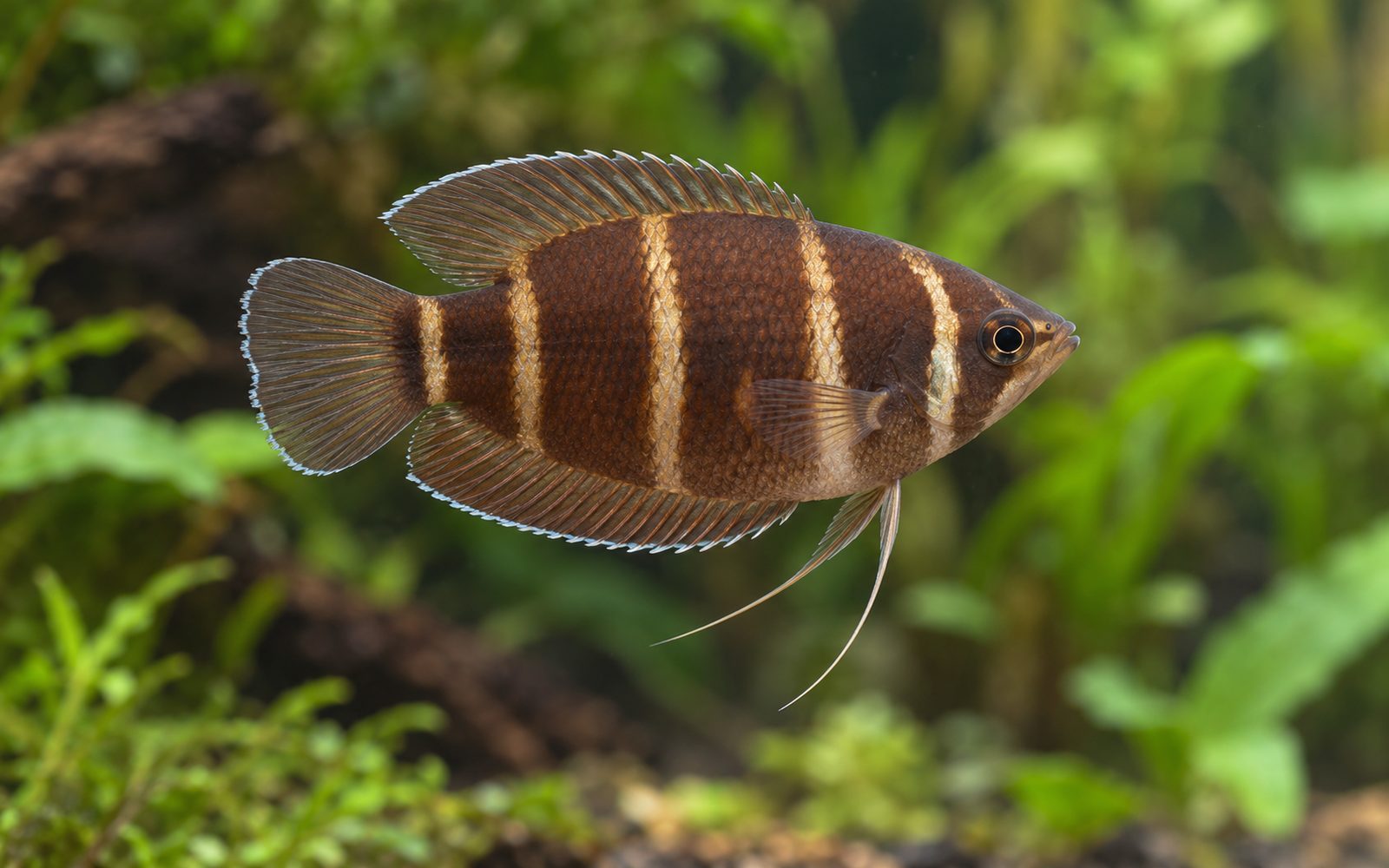
With its dark chocolate-brown oval body crossed by 3–5 thin cream-gold vertical bands, the chocolate gourami is one of the most elegant labyrinth fish in the hobby. It grows to about 5 cm. Unlike other gouramis, it does not build a bubble nest; the female broods the eggs in her mouth.
It is known as much for its delicacy as for its beauty. It is adapted to the very soft, acidic water of peat swamps; in hard water, dirty water or fluctuating conditions it quickly falls ill. For this reason it is recommended for experienced hobbyists and species tanks.
Natural Habitat
It lives in the peat swamp forests of the Malay Peninsula, Sumatra and Borneo. These waters are stained tea-colored by tannins, very soft and acidic (the pH sometimes drops below 4). The bottom is covered with leaf litter, the light is weak and there is almost no current.
Tank Setup
- Volume: at least 60 liters for a group of 5–8; choose a large footprint.
- Water: 25–29°C, pH 4.5–6.5, GH 1–6. Soft water prepared with reverse osmosis or rainwater is needed.
- Setting: Dried leaves, roots and water darkened with peat, dim light, floating plants.
- Flow: Almost none; a sponge filter is ideal.
- Maintenance: A mature aquarium is essential. Small weekly water changes (10–15%) with water of the same parameters are better than large, sudden changes.
Diet
A carnivore that feeds on small creatures. Live or frozen brine shrimp, daphnia, cyclops, microworms and chopped bloodworms should be the staple. Some individuals accept fine flakes and micro granules over time, but dry food alone is not enough. Feed small amounts twice a day.
Behavior and Compatibility
Peaceful, calm and timid. It moves around in a loose group with its own species; next to pushy or fast fish it cannot find food and becomes stressed. It is best kept in a species tank or with very small, calm species.
Good companions: Boraras species, harlequin rasboras, pencilfish, sparkling gouramis, dwarf corydoras, otocinclus.
Avoid: fast and greedy schooling fish, fin nippers, large gouramis, cichlids, species that need hard water.
Group and Colony Structure
A group of at least 5, ideally 8 or more is recommended. A mild pecking order forms within the group, but serious fights are rare. Individuals kept alone or in pairs are more timid. Building the group in one go and from the same source reduces the risk of newcomers bringing in disease.
Breeding
The female is a mouthbrooder. Spawning takes place on the bottom or in midwater; the female takes the fertilized eggs into her mouth and carries them for about two weeks. During this time she does not eat and needs a calm environment. The released fry are relatively large and can eat brine shrimp nauplii right away. Breeding requires very soft, acidic water and flawless water quality.
Health and Common Problems
The most common problems in this species are bacterial infections, velvet (Oodinium) and internal parasites. Hard water, high nitrate and temperature swings quickly weaken its immunity. Keep new individuals in quarantine for 2–3 weeks; darkened, acidic water reduces both stress and the risk of infection.
Sexing
Sexing is difficult. Males are reported to have a thin yellowish line along the edge of the dorsal and anal fins, while females have a rounder, fuller throat line. Reliable sexing is usually done by breeding behavior.
Tank mates
This list is calculated automatically from the species profile and grows as new species are added to the catalog. Try it in the planner for a definite answer.
Usually compatible
 Polystictus Corydoras
 Emerald Cory
 Porthole Catfish
 Keyhole Cichlid
 Cupid Cichlid
 Geophagus altifrons
 Geophagus surinamensis
 Cryptocoryne Parva
 African Glass Catfish
 African Butterfly Cichlid
Should not be kept together






Hobbyist notes
Things you won't find in books, learned by trial and error. The most helpful ones are on top.
Change history and contributors
- Page created · October 16, 2026