
Water parameters
Overview
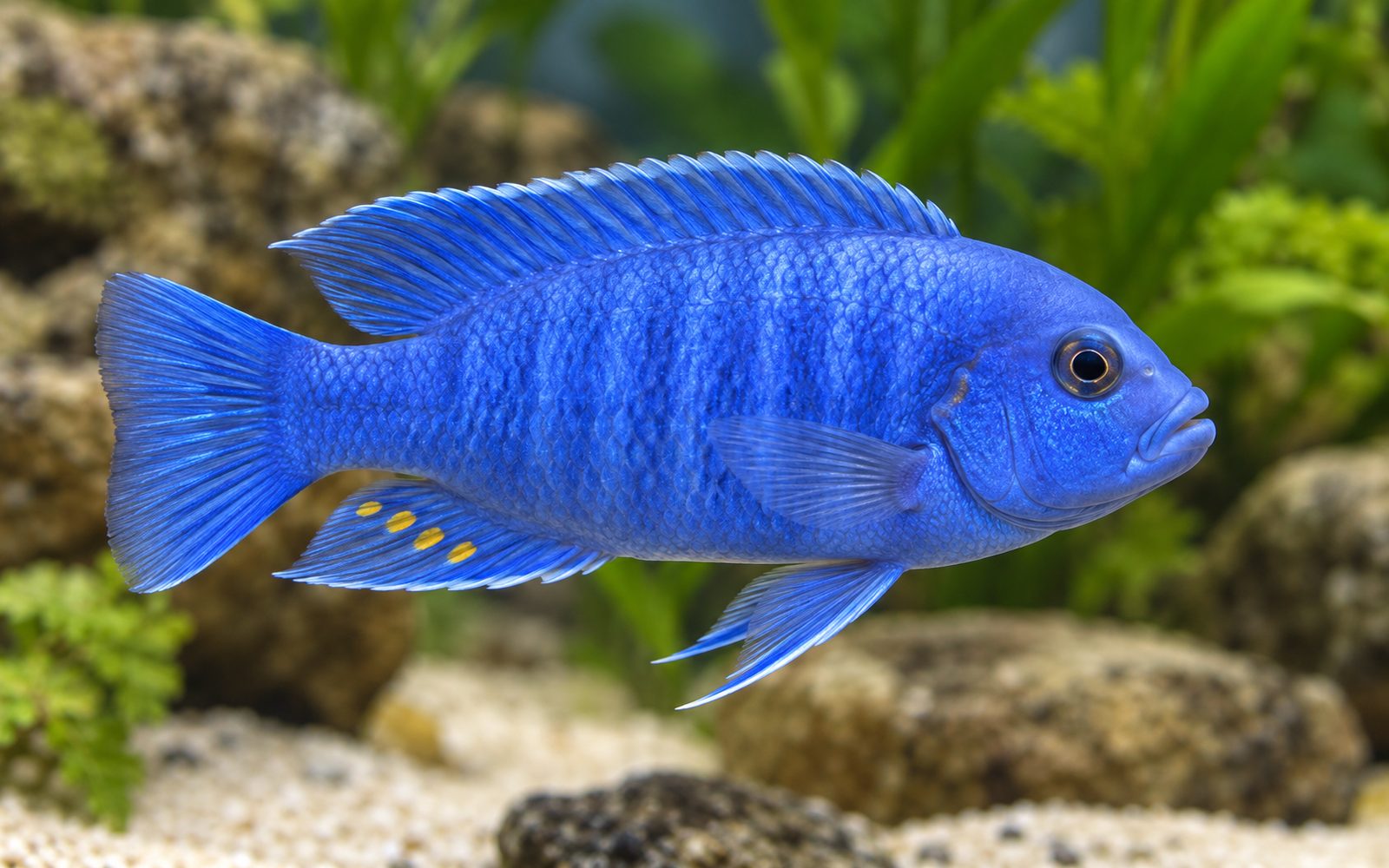
The cobalt blue zebra is the plain blue member of the Maylandia zebra group. What sets it apart from its relative, the zebra mbuna, is the absence of distinct black vertical bars on its body; adults are bright cobalt or powder blue from head to tail. White individuals also occur in the wild and in the aquarium and are sold as "white zebra".
With its tolerance of hard water, hearty appetite and easy breeding, it is one of the staple species of Malawi aquariums. Its males defend their territory and fight especially with blue fish; it does not go in a community aquarium.
Natural Habitat
It lives on the rocky shores of Lake Malawi, in shallow and mid-depth areas. It feeds by scraping the algae layer on the rocks (aufwuchs) and picking up small organisms suspended in the water. The water is clear, hard and alkaline.
Tank Setup
- Volume: at least 250 liters and 120 cm in length for a harem together with other mbuna.
- Rockwork: Many caves and crevices; the rocks should sit on the bottom glass and lines of sight should be broken.
- Water: Hard and alkaline (pH 7.8–8.5); coral sand or aragonite substrate, Malawi salt if needed.
- Maintenance: Strong filtration, weekly 30–50% water changes; keeping nitrate low also keeps the colors vivid.
Diet
Herbivorous. A spirulina- or algae-based mbuna pellet should be the staple; vegetables (blanched spinach, nori) can be added a few times a week. Bloodworms and high-protein foods lead to Malawi bloat. Feed sparingly, 1–2 times a day.
Behavior and Compatibility
Males claim a cluster of rocks and chase especially blue mbuna of their own color. It is not as tough as the kenyi or zebra mbuna, but it is not a calm fish either. Its aggression decreases when it is kept with species that are clearly different in color and pattern.
Good companions: yellow and orange mbuna (yellow lab, red zebra), yellow-tail acei, rusty cichlid, Synodontis catfish suited to hard water.
Avoid: other blue Maylandia species (fighting and hybridization), small blue-barred mbuna such as demasoni, Aulonocara and calm haps, community fish, shrimp and snails.
Group and Colony Structure
The rule of the mbuna setup applies here too:
- 3–4 females per male; a male kept with a single female wears her out.
- One harem per species in the aquarium; there should be no other Maylandia species of the same color.
- Two males can be kept in an aquarium over 300 liters with plenty of rocks, but each must have its own territory.
- Rearranging the rockwork when adding new fish breaks up the old territories and softens fights.
Breeding
A mouthbrooder that breeds easily in the aquarium. The male courts in front of a rock; the female picks up the eggs in her mouth, and fertilization takes place as she reaches for the egg spots on the male's anal fin. The female carries 15–30 eggs for about 3 weeks and does not feed during this time. When released, the fry can be eaten by the adults; rock crevices or a separate fry container improve their chances of survival.
Health and Common Problems
- Malawi bloat: the wrong diet and stress are the biggest risk.
- Hole in the head: associated with insufficient water changes and a monotonous diet.
- Fight wounds: prevented with the right ratio and rockwork.
Sexing
Both sexes are blue, so they cannot be reliably sexed by color. Males are larger and more brightly colored, have prominent yellow egg spots on the anal fin and a slightly longer dorsal fin. Females may be a paler blue or whitish. Reliable sexing is done by examining the genital papilla.
Tank mates
This list is calculated automatically from the species profile and grows as new species are added to the catalog. Try it in the planner for a definite answer.
Usually compatible
 Banded Jewel Cichlid
 Demasoni Cichlid
 Jack Dempsey
 Red Devil Cichlid
 Convict Cichlid
 Pundamilia nyererei
 Pundamilia pundamilia
 Zebra Obliquidens
 Anubias Angustifolia
 Anubias Barteri
Should not be kept together








Hobbyist notes
Things you won't find in books, learned by trial and error. The most helpful ones are on top.
Change history and contributors
- Page created · October 16, 2026