
Water parameters
Overview
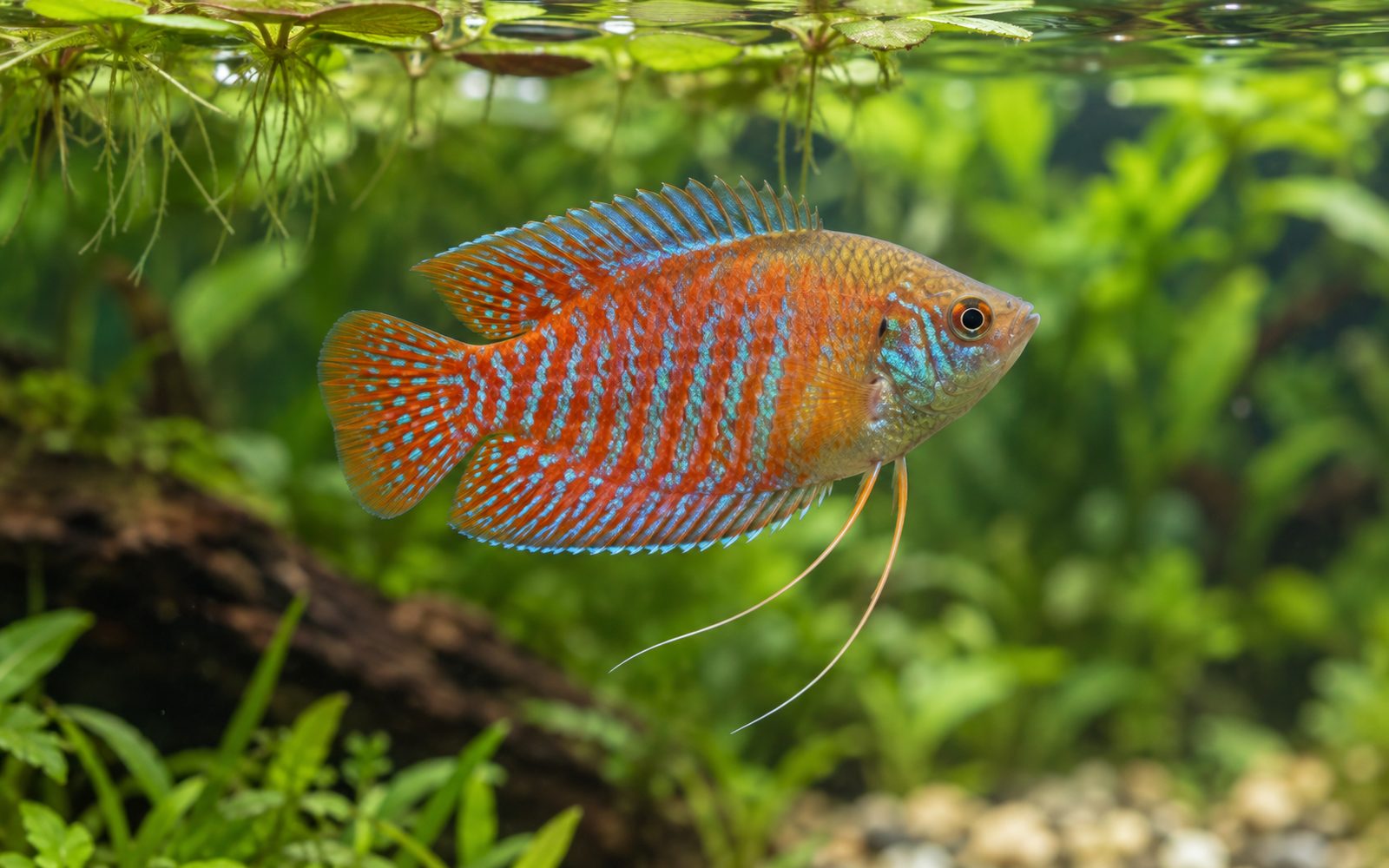
The dwarf gourami belongs to the labyrinth fish family, the same family as the betta, and breathes air from the surface. Males have slanted turquoise bars over an orange-red body; there are also selected forms such as "flame" (entirely red) and "powder blue." It uses its thin, thread-like pelvic fins as touch organs and probes its surroundings with them.
The reason its difficulty is rated "moderate" is dwarf gourami iridovirus (DGIV), which has become widespread in commercial breeding: fish of uncertain origin may fall ill months later.
Natural Habitat
It lives in slow-flowing, plant-filled river tributaries, lakes and rice paddies of the Indian subcontinent. It moves about beneath the surface vegetation.
Tank Setup
- Volume: 40 liters for a single male or a pair; 80 liters or more for several fish.
- Surface: Floating plants (water lettuce, riccia) and stem plants reaching the surface. Flow should be weak.
- Lid: Because it breathes air from the surface, the air under the lid should stay warm and humid; breathing cold air makes it prone to disease.
- Water: 25–27°C.
Diet
Omnivorous. Flakes and granules, spirulina food, frozen brine shrimp, daphnia and bloodworms. It feeds near the surface; sinking food does not interest it much.
Behavior and Compatibility
Generally peaceful and somewhat shy. Males are aggressive toward each other; keep a single male or one male with several females in a tank. It can also be intolerant of similar-looking, surface-dwelling species (bettas, other gouramis).
Good companions: harlequin rasbora, neon tetra, corydoras, kuhli loach, otocinclus.
Avoid: fin nippers (the thread-like pelvic fins become targets), bettas, other male gouramis, busy and crowded fish.
Group and Colony Structure
The safest setup for the dwarf gourami is a single male in the tank. If females can be found, 2–3 females per male can be kept; a single female is worn out by the male's attention.
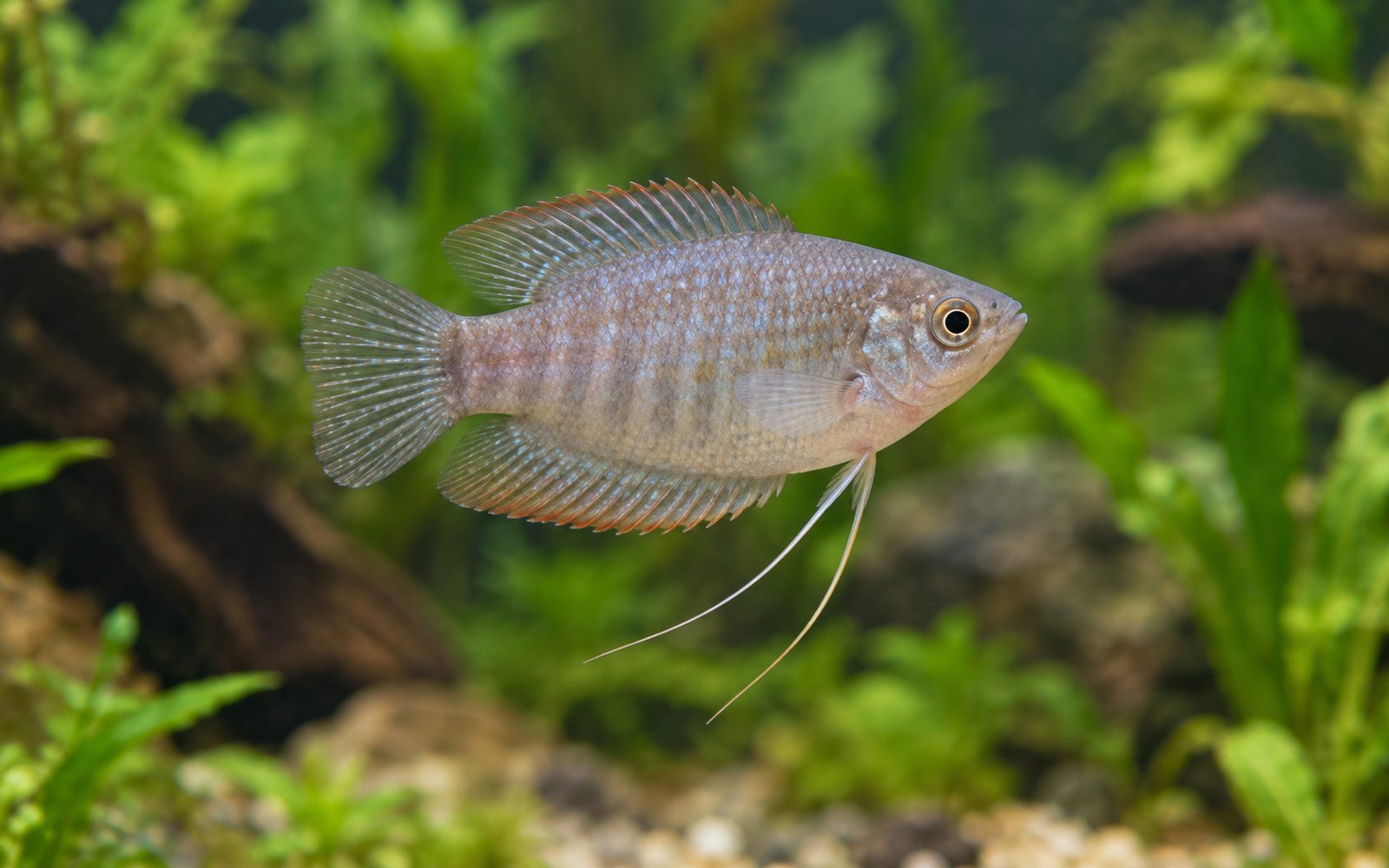
Two males fight constantly over the surface zone in a small tank. More than one male can be tried in a tank of 120 liters or more with the surface divided by plants, but it is still risky. Since mostly only males are sold in stores, finding females can be difficult; females are silvery gray with faint bars.
Breeding
The male builds a bubble nest at the surface, often incorporating bits of floating plants. The female releases her eggs beneath the nest, and the male gathers and guards them. The female should be removed after spawning. The fry are very small and are fed infusoria; until the labyrinth organ develops, it is important that the air above the surface is warm.
Health and Common Problems
- Dwarf gourami iridovirus: loss of color, loss of appetite, a swollen belly, sores. There is no cure and it is contagious. Buying from a reliable breeder and quarantining for at least 4 weeks is the best protection.
- Bacterial infections: under stress and in poor water.
- Exposure to cold air can lead to respiratory problems.
Sexing
Males are brightly colored and barred, with a more pointed dorsal fin. Females are silvery gray with faint bars and a rounded dorsal fin. Mostly only males are sold in stores.
Tank mates
This list is calculated automatically from the species profile and grows as new species are added to the catalog. Try it in the planner for a definite answer.
Usually compatible
 Flame Tetra
 Blackfin Corydoras
 Polystictus Corydoras
 Emerald Cory
 Emerald Dwarf Rasbora
 Porthole Catfish
 Keyhole Cichlid
 Cupid Cichlid
 Geophagus altifrons
 Geophagus surinamensis
Should not be kept together






Hobbyist notes
Things you won't find in books, learned by trial and error. The most helpful ones are on top.
Change history and contributors
- Page created · October 16, 2026