
Water parameters
Overview
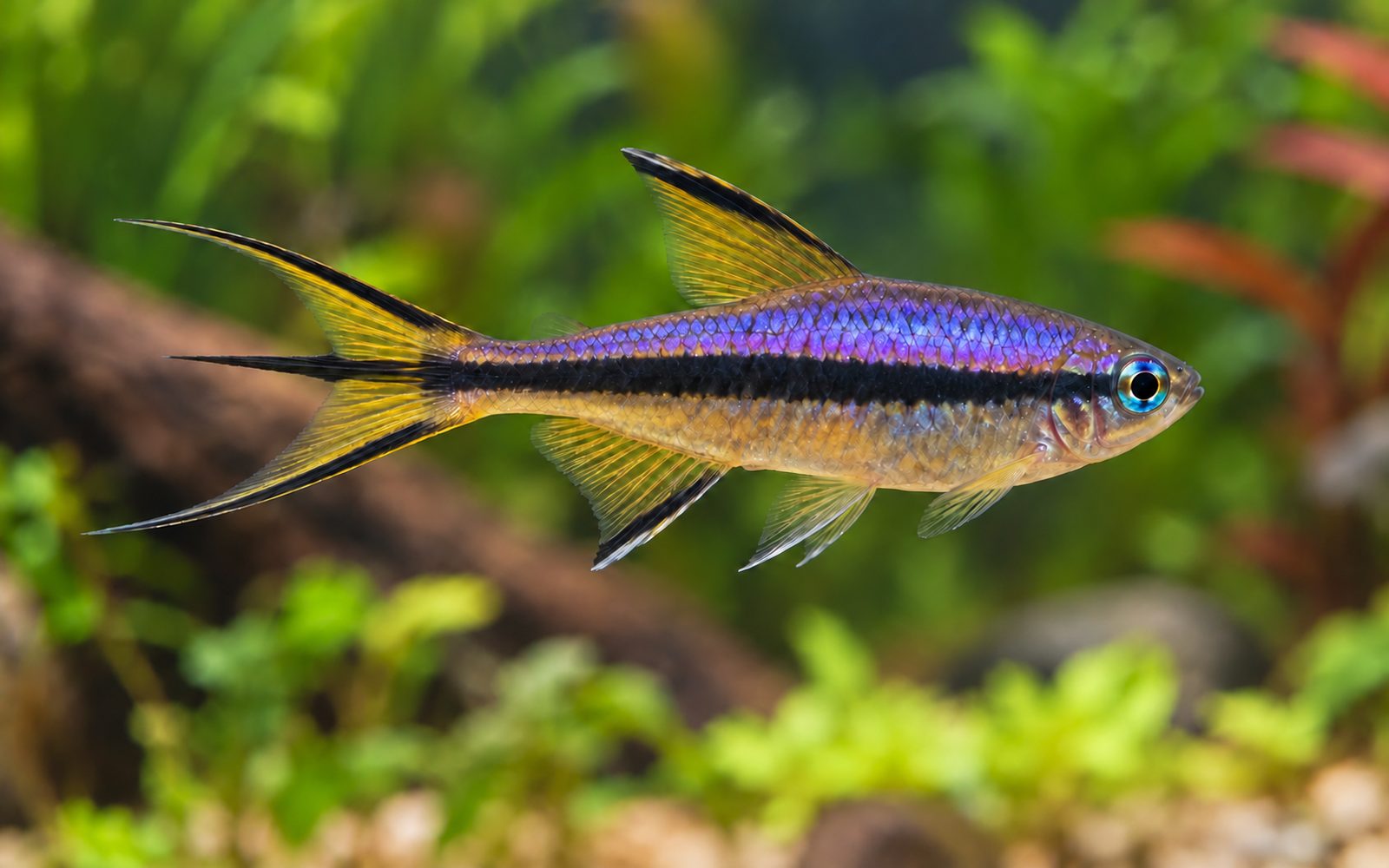
The emperor tetra is recognized by its body, which shifts between purple, blue and bronze tones depending on the angle of the light, and by the thick black band running its whole length. In males, the central rays of the tail fin extend to form a three-pointed spear; the dorsal and anal fins are long as well. The fins are yellowish with black edges.
Unlike typical schooling tetras, it does not swim in a tight cluster; males set up small territories. It is an elegant and hardy choice for calm, planted community aquariums.
Natural Habitat
It lives in slow-flowing, planted and shaded streams in the San Juan and Atrato river basins on the Pacific coast of Colombia. The water is soft and slightly acidic.
Tank Setup
- Volume: at least 80 liters for a group of 6–8.
- Water: 24–27°C, pH 6–7.5, soft to moderately hard water.
- Decor: dense plants, roots and floating plants. Visually separated areas where males can set up territories are helpful.
- Maintenance: a 25% water change every week; gentle flow.
Diet
Omnivorous. Make flakes and granules the staple and vary it with frozen brine shrimp, bloodworms, daphnia and cyclops. Live foods bring out the males' colors.
Behavior and Compatibility
Peaceful, but males display to each other over territory and chase one another; serious injuries are rare. It does not bother other species. It usually leaves adult shrimp alone.
Good companions: corydoras, otocinclus, pencilfish, rasboras, other calm tetras, dwarf cichlids, dwarf gouramis.
Avoid: fin-nipping species (serpae tetras, tiger barbs), large predators, very active and boisterous species.
Group and Colony Structure
It lives in a loose group: at least 6, ideally 8 individuals. A female-heavy ratio (1 male : 2 females) is recommended; if there is more than one male, each should be given room to set up a territory. The fewer the males, the less chasing there is.
Breeding
It is an egg scatterer, but unlike many tetras it tends to release a small number of eggs over several days. A separate tank is prepared with soft, slightly acidic water and moss or fine-leaved plants. Because the parents may eat the eggs, the eggs or fry should be removed regularly. The fry are raised on infusoria and newly hatched brine shrimp.
Health and Common Problems
- Fin damage: the males' long tail rays get frayed if kept with unsuitable tankmates.
- White spot (ich): may appear after transport.
- Water quality: it is sensitive to high nitrate; do regular water changes.
Sexing
Telling them apart is easy. Males are larger and more colorful; the elongated rays in the middle of the tail, the long dorsal and anal fins and the metallic blue eye identify the male. Females are smaller and plainer; they have no tail extension and their eyes are greenish.
Tank mates
This list is calculated automatically from the species profile and grows as new species are added to the catalog. Try it in the planner for a definite answer.
Usually compatible
 Flame Tetra
 Blackfin Corydoras
 Polystictus Corydoras
 Emerald Cory
 Porthole Catfish
 Keyhole Cichlid
 Cupid Cichlid
 Geophagus surinamensis
 Cryptocoryne Parva
 Gold Spot Pleco (L001)
Should not be kept together






Hobbyist notes
Things you won't find in books, learned by trial and error. The most helpful ones are on top.
Change history and contributors
- Page created · October 16, 2026