
Water parameters
Overview
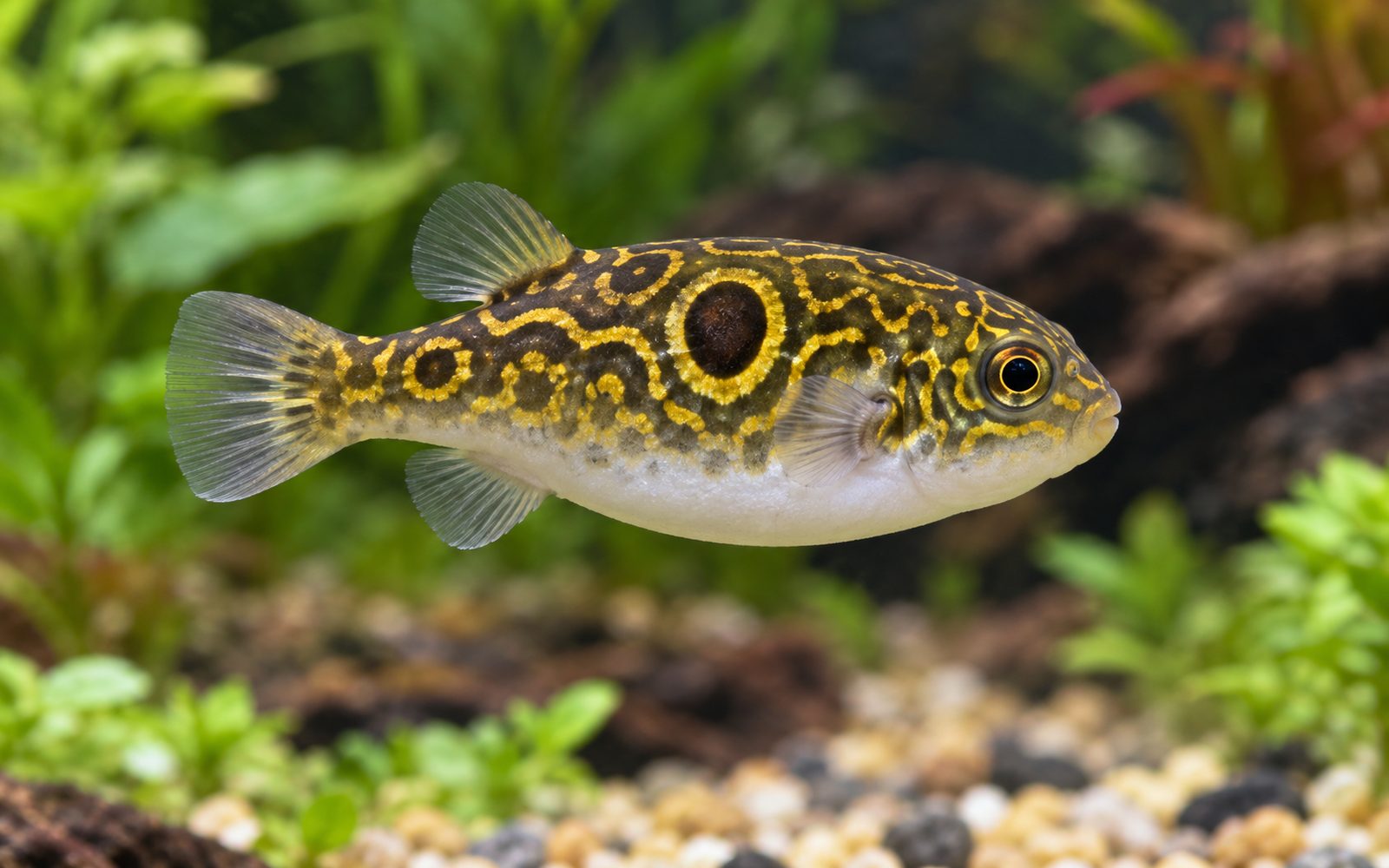
The figure eight puffer is recognized by the golden-yellow winding lines on its dark olive-brown back and the ringed eyespot in front of the dorsal fin; seen from the side, the patterns resemble the number "8." Since it stays around 8 cm and needs much less salt than the green spotted puffer, it is a reasonable starter species for those who want to keep puffers.
Although it was long referred to as a "brackish fish," in the wild it lives mostly in fresh water. It tolerates slightly salty water, but salt is not essential. Its old name Tetraodon biocellatus is still used in stores.
Natural Habitat
It lives in the slow-flowing rivers, floodplains and vegetated banks of Southeast Asia; some populations move down into stretches close to river mouths.
Tank Setup
- Volume: at least 80 liters for a single fish; an 80–100 cm length is ideal.
- Water: 25–27°C, moderately hard and slightly alkaline. A low level of marine salt (specific gravity 1.002–1.005) can optionally be added; if added, it must be kept stable.
- Filter: it leaves a lot of leftover food; strong filtration and a 30% water change weekly.
- Decor: roots, stones and tough-leaved plants; visual barriers calm the fish.
Diet
Carnivorous. Small snails (essential for wearing down the teeth), frozen bloodworms, mysis and brine shrimp, small shell-on shrimp. Most individuals refuse dry food. Give snails at least a few times a week; a fish with overgrown teeth cannot eat.
Behavior and Compatibility
Curious, playful and intelligent; it immediately notices changes in the aquarium. It can be territorial toward conspecifics and other fish and nips the fins of slow fish.
Good companions: it is best kept alone. In a large aquarium it can be tried carefully with fast, large, short-finned species.
Avoid: shrimp, snails (they become food), long-finned and slow species (bettas, angelfish, guppies), small schooling fish.
Group and Colony Structure
Usually kept alone. Some hobbyists have managed to keep several together in a very large, heavily decorated aquarium, but territorial fights and fin nipping are common; it is not recommended for a first attempt.
Breeding
Aquarium breeding is very rare. In the wild it is reported to lay its eggs on a hard surface and guard them; most of the fish sold are wild-caught.
Health and Common Problems
- Overgrown teeth: seen in fish not given snails and shelled food.
- Internal parasites: common in wild-caught fish; quarantine and monitoring of appetite are recommended.
- Medication sensitivity: its scaleless skin is sensitive to copper.
- Puffing up: do not deliberately make the fish inflate; keep it in water when moving it.
Sexing
No reliable external difference is known.
Tank mates
This list is calculated automatically from the species profile and grows as new species are added to the catalog. Try it in the planner for a definite answer.
Usually compatible
 Yellow Regal Peacock
Glass Tetra
Yellow Regal Peacock
Glass Tetra
 Emerald Betta
 Emerald Cory
 Porthole Catfish
 Keyhole Cichlid
 Firemouth Cichlid
 Buffalohead Cichlid
 Rainbow Cichlid
 Gymnogeophagus balzanii
Should not be kept together






Hobbyist notes
Things you won't find in books, learned by trial and error. The most helpful ones are on top.
Change history and contributors
- Page created · October 16, 2026