
Water parameters
Overview
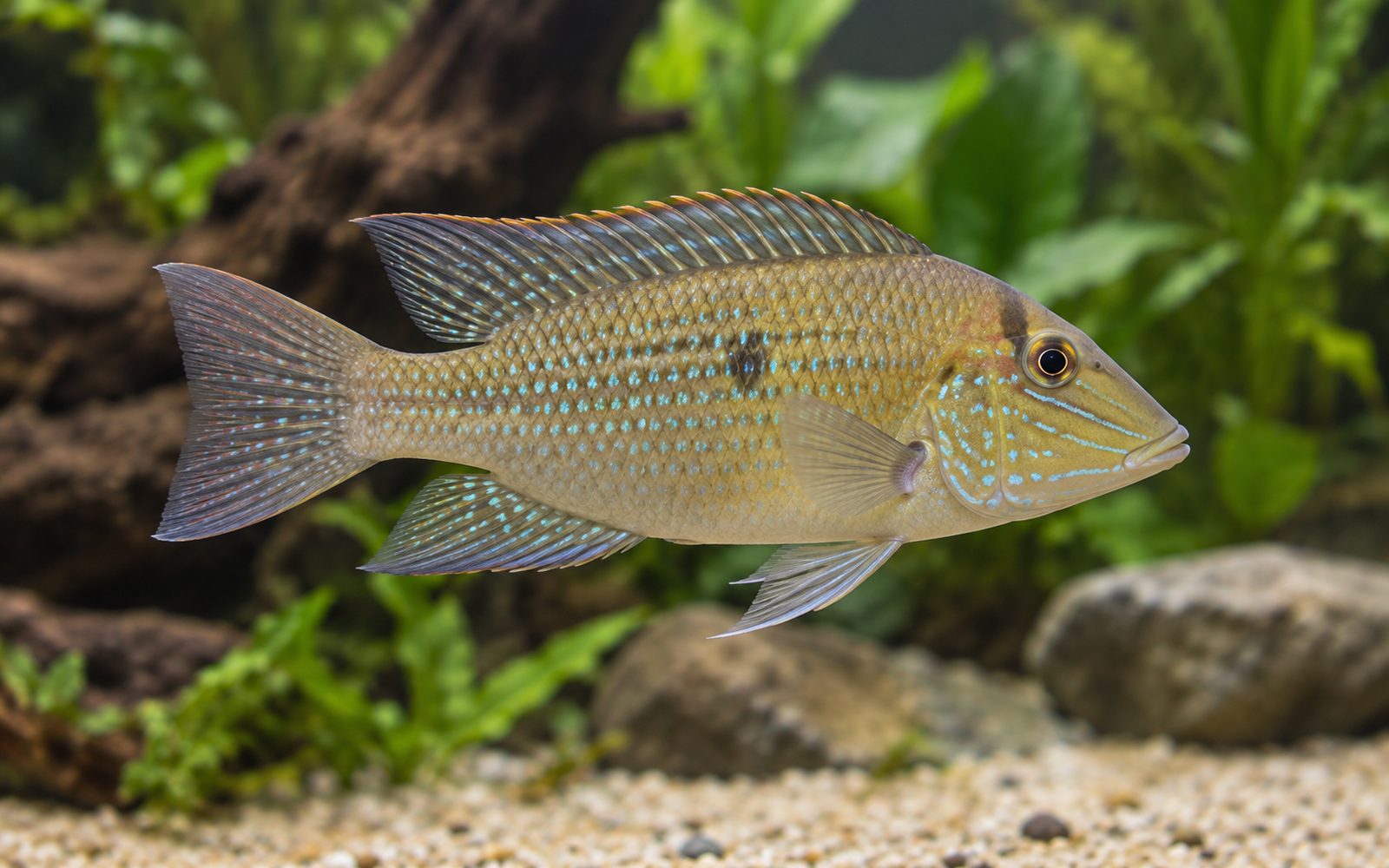
Satanoperca jurupari is one of South America's eartheater cichlids. It is recognized by its long, sloping snout, eyes set high on the head and golden-brown body. All day long it takes in mouthfuls of sand, picks out the small creatures in it and releases the sand back through its gills.
Despite a name that means "demon", it is an extremely peaceful fish. Some of the fish sold under this name in the trade are actually the very similar-looking Satanoperca leucosticta; their care is the same.
Natural Habitat
It lives in groups along the sandy banks of slow-flowing rivers, in lakes and in flooded areas of the Amazon basin. The bottom is usually fine sand and leaf litter; the water is soft, slightly acidic and warm.
Tank Setup
- Volume: at least 300 liters and 150 cm of length for a group of 4–6.
- Substrate: fine, round-grained sand is a must. Gravel damages the mouth and gills and prevents feeding.
- Decor: a large open sand area, with roots and large rocks at the edges. Tough-leaved plants or plants attached to roots are suitable; fine-rooted plants can be damaged by digging.
- Water: sensitive to nitrate; change 30–40% weekly and use a powerful filter with gentle flow.
Diet
Omnivorous; in the wild it eats small crustaceans, larvae and plant debris in the sand. Use small sinking granules and tablets as the staple; vary them with frozen bloodworms, brine shrimp, mysis and mosquito larvae. It is important that the food reaches the bottom. Two or three small meals a day are better than one large meal.
Behavior and Compatibility
Peaceful and social; apart from minor squabbles within the group, there is no fighting. It can be shy; it hides when kept with noisy, aggressive tankmates.
Good companions: angelfish, discus (both like warm water), severum, uaru, festivum, medium to large tetras, corydoras, Ancistrus.
Avoid: aggressive Central American cichlids, gravel-bottomed aquariums, small shrimp.
Group and Colony Structure
It should be kept in a group; at least 4, preferably 6 individuals. A jurupari kept alone becomes timid and loses its color. Over time a pair splits off within the group and defends a small area while breeding.
Breeding
It is a delayed mouthbrooder: the pair lays its eggs on a cleaned stone and guards them for a few days. When the eggs are about to hatch or have hatched, the parents take the larvae into their mouths. Even after becoming free-swimming, the fry shelter in a parent's mouth for some time when danger threatens. The fry are fed baby brine shrimp.
Health and Common Problems
- Hole-in-the-head disease (HLLE): common in this genus; associated with high nitrate and activated carbon residue.
- Mouth and gill irritation: from a coarse substrate.
- Loss of appetite: often the first sign of poor water quality.
Sexing
There is no reliable external difference. Males are sometimes larger and have longer fin extensions. Sexing can only be confirmed by checking the papilla during spawning.
Tank mates
This list is calculated automatically from the species profile and grows as new species are added to the catalog. Try it in the planner for a definite answer.
Usually compatible
 Emerald Betta
 Emerald Cory
 Altum Angelfish
 Keyhole Cichlid
 Firemouth Cichlid
 Cupid Cichlid
 Buffalohead Cichlid
 Discus
 Festivum
Should not be kept together






Hobbyist notes
Things you won't find in books, learned by trial and error. The most helpful ones are on top.
Change history and contributors
- Page created · October 16, 2026