
Water parameters
Overview
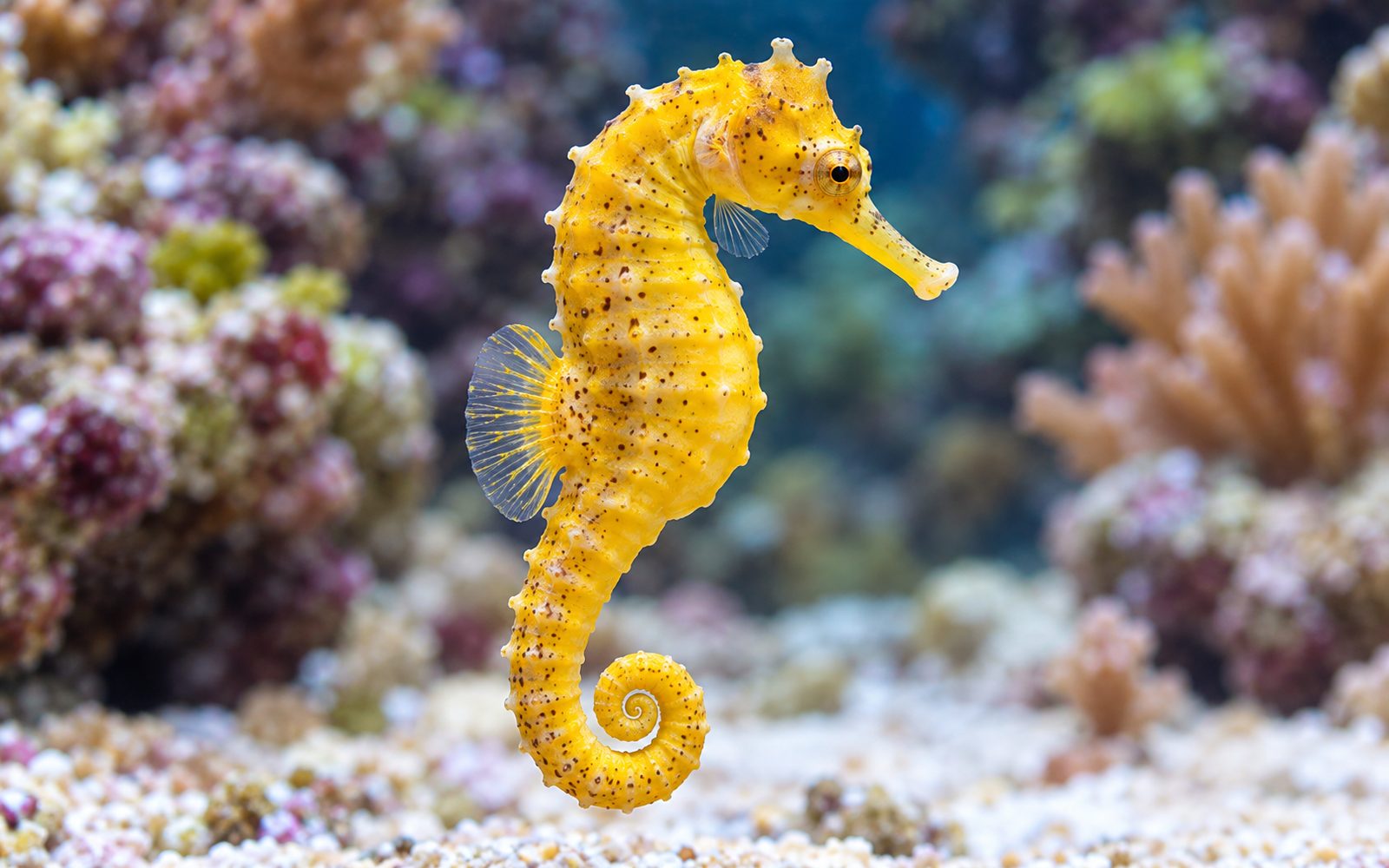
The kuda seahorse is one of the most widely distributed seahorses of the Indo-Pacific. Its color varies between yellow, orange, brown and black; it can darken or lighten over time depending on its surroundings. It holds on to plants and coral branches with its tail and swims slowly by fluttering its dorsal fin.
Legal note: all seahorse species are listed in CITES Appendix II; their international trade requires a permit. The native seahorses of the Mediterranean (Hippocampus hippocampus, H. guttulatus) are protected and must never be collected from the wild.
Choose captive-bred fish: wild-caught seahorses often refuse frozen food and carry parasites. Farm-raised (captive-bred) individuals are used to frozen mysis and are much hardier; buy only these.
Natural Habitat
It lives in shallow coastal waters of the Indo-Pacific, in seagrass meadows, estuaries and mangroves; it is sometimes found in turbid waters as well.
Tank Setup
- Volume: at least 120 liters for a pair; a tall aquarium at least 50 cm deep. Add about 40 liters for each additional pair.
- Water: salinity 1.023–1.025 specific gravity, pH 8.1–8.4. Temperature 22–25°C; bacterial diseases increase in warmer water.
- Flow: gentle, diffuse flow; strong pumps and filter intakes must be protected with a guard or sponge.
- Hitching posts: many vertical objects it can wrap its tail around, such as artificial or live gorgonians, macroalgae and ropes.
- Reef compatibility: reef safe, but only with non-stinging species: anemones and stinging corals (e.g. Euphyllia) injure seahorses.
Diet
Carnivorous. Because it has no stomach, it must be fed 2–3 times a day. The staple is enriched frozen mysis; enriched live brine shrimp and copepods are a supplement. The food should reach it directly or be offered from a feeding dish; seahorses eat slowly and fast fish snatch their food. Leftover food must be removed immediately.
Behavior and Compatibility
Peaceful, slow and shy. During courtship, pairs change color and "dance" together with their tails entwined.
Good companions: other seahorses (from the same source), small, calm gobies, firefish, Banggai and pajama cardinalfish, nerite and Cerith snails.
Avoid: fast, greedy fish (clownfish, damsels, tangs, wrasses), puffers and triggerfish, lionfish, crabs, anemones and stinging corals.
Group and Colony Structure
Keeping them as a pair is recommended. Several pairs of the same species can live together in a large aquarium with enough hitching posts. Mixing seahorses from different sources increases the risk of disease.
Breeding
In seahorses the male becomes pregnant. After the courtship dance, the female deposits her eggs into the brood pouch on the male's belly; the male fertilizes the eggs and carries them for about 2–3 weeks. Hundreds of tiny fry emerge at birth. In the first weeks the fry need very small live foods such as copepods and rotifers; breeding in the aquarium is possible but takes effort.
Health and Common Problems
- Bacterial infections (Vibrio): in high temperatures and dirty water; rot on the snout, tail and skin.
- Gas bubble disease: gas buildup in the pouch or under the skin; the fish loses its balance.
- Internal parasites: especially in wild-caught fish; weight loss and white feces.
Sexing
Easy: males have a distinct brood pouch on the belly. Females have no pouch, and the underside of the belly is more pointed.
Tank mates
This list is calculated automatically from the species profile and grows as new species are added to the catalog. Try it in the planner for a definite answer.
Should not be kept together





Hobbyist notes
Things you won't find in books, learned by trial and error. The most helpful ones are on top.
Change history and contributors
- Page created · October 16, 2026