
Water parameters
Overview
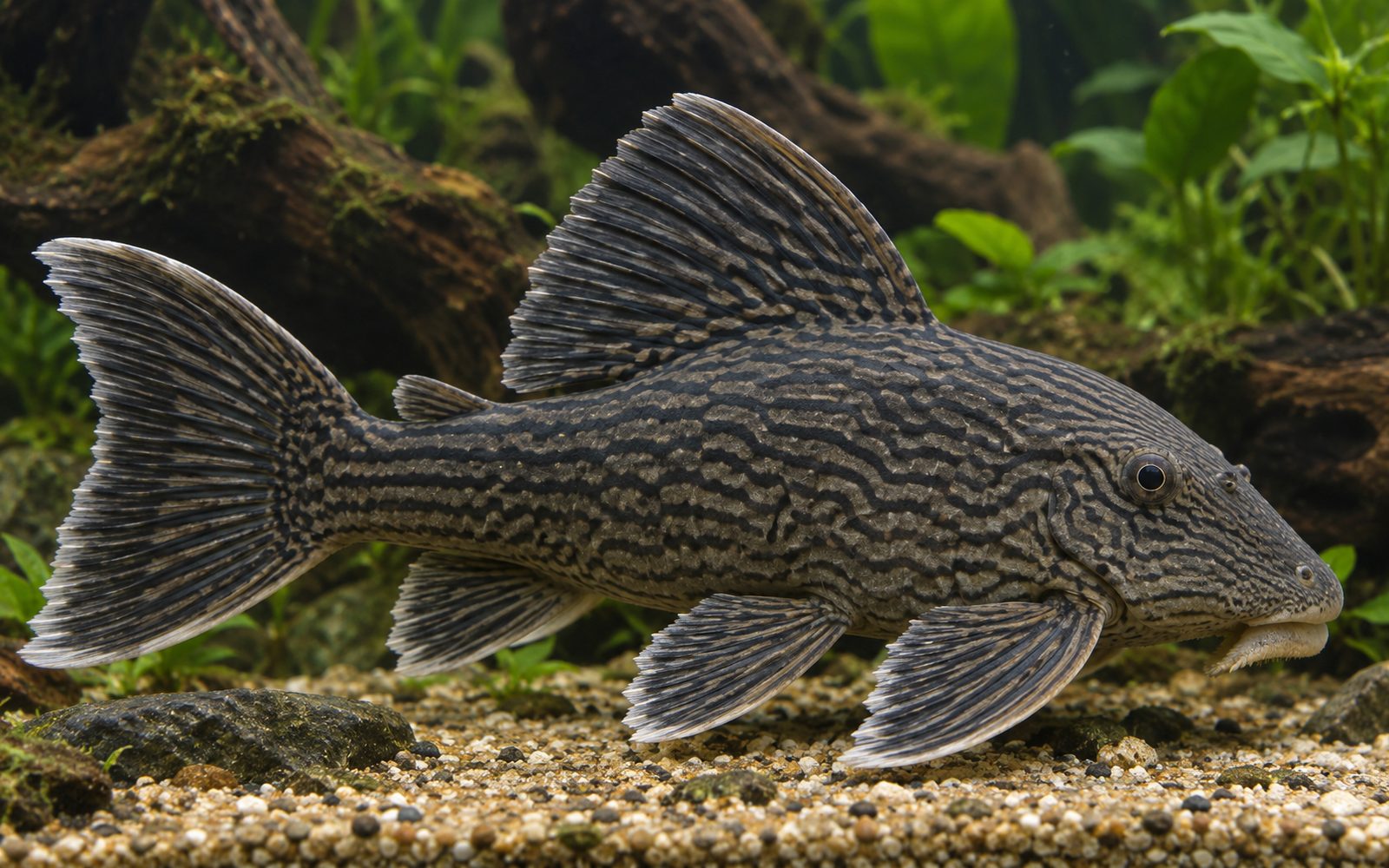
The royal pleco, with its striped body and large build, is the best-known member of the genus Panaque. Juveniles of 5–8 cm are sold, but it grows slowly to 35–40 cm and becomes a large, heavy fish. So before buying one, make sure you will be able to set up an aquarium of at least 500 liters in the future.
Panaque species are among the few fish that can eat wood by scraping it with their spoon-shaped teeth. However, research suggests that although they gnaw and swallow wood, they get much of their nutrition from the microorganisms and decaying organic matter on its surface.
Natural Habitat
It lives in the large rivers of the Orinoco basin, among fallen tree trunks and root tangles. The hollows inside the trunks serve both as shelter and as a food source. The water is usually warm, oxygen-rich and moderately flowing; the fish spend the day inside the hollows of the trunks.
Tank Setup
- Volume: at least 500 liters and 150 cm length for one adult.
- Wood: several large, hard roots; the fish will wear them down over the years.
- Filter: the amount of wood shavings and waste is very high; a canister filter or sump, strong mechanical filtration and weekly gravel vacuuming are essential.
- Decor: plants get gnawed or uprooted; hardy species such as Anubias and Java fern hold up better.
- Water: 25–28°C, a 30–40% water change every week.
Diet
Gnawing on wood is part of its diet. In addition, it should be given blanched zucchini, cucumber, potato, spinach, peas and vegetable sinking tablets. Protein-rich food should be given rarely, at most once a week.
Behavior and Compatibility
Calm toward other species. Toward its own kind and plecos of similar size, however, it is territorial and may fight seriously over a cave or root. It is nocturnal, but once settled it is also seen resting on its root during the day.
Good companions: Medium and large peaceful fish: large tetras, silver dollars, Geophagus species, large rainbowfish.
Avoid: Small aquariums, other large plecos (in limited space), slow, flat-bodied fish (risk of slime-coat sucking), delicate planted layouts.
Group and Colony Structure
In a home aquarium it is kept as a single fish. More than one Panaque can only be attempted in very large systems with plenty of hiding places.
Breeding
In the wild it breeds in hollows along riverbanks. Little is known about breeding in the aquarium; the fish sold are mostly wild-caught.
Health and Common Problems
Hardy, but insufficient fiber and dirty water cause problems. As it grows it noticeably increases the bioload of the tank; watch for nitrate rising quickly. Sensitive to copper.
Sexing
Hard to tell apart externally. In mature males, the odontodes on the rear part of the body and on the pectoral fin spines may be more prominent.
Tank mates
This list is calculated automatically from the species profile and grows as new species are added to the catalog. Try it in the planner for a definite answer.
Usually compatible
 Flame Tetra
Glass Tetra
Flame Tetra
Glass Tetra
 Blackfin Corydoras
 Polystictus Corydoras
 Emerald Betta
 Emerald Cory
 Porthole Catfish
 Altum Angelfish
 Keyhole Cichlid
 Firemouth Cichlid
Should not be kept together





Hobbyist notes
Things you won't find in books, learned by trial and error. The most helpful ones are on top.
Change history and contributors
- Page created · October 16, 2026