
Water parameters
Overview
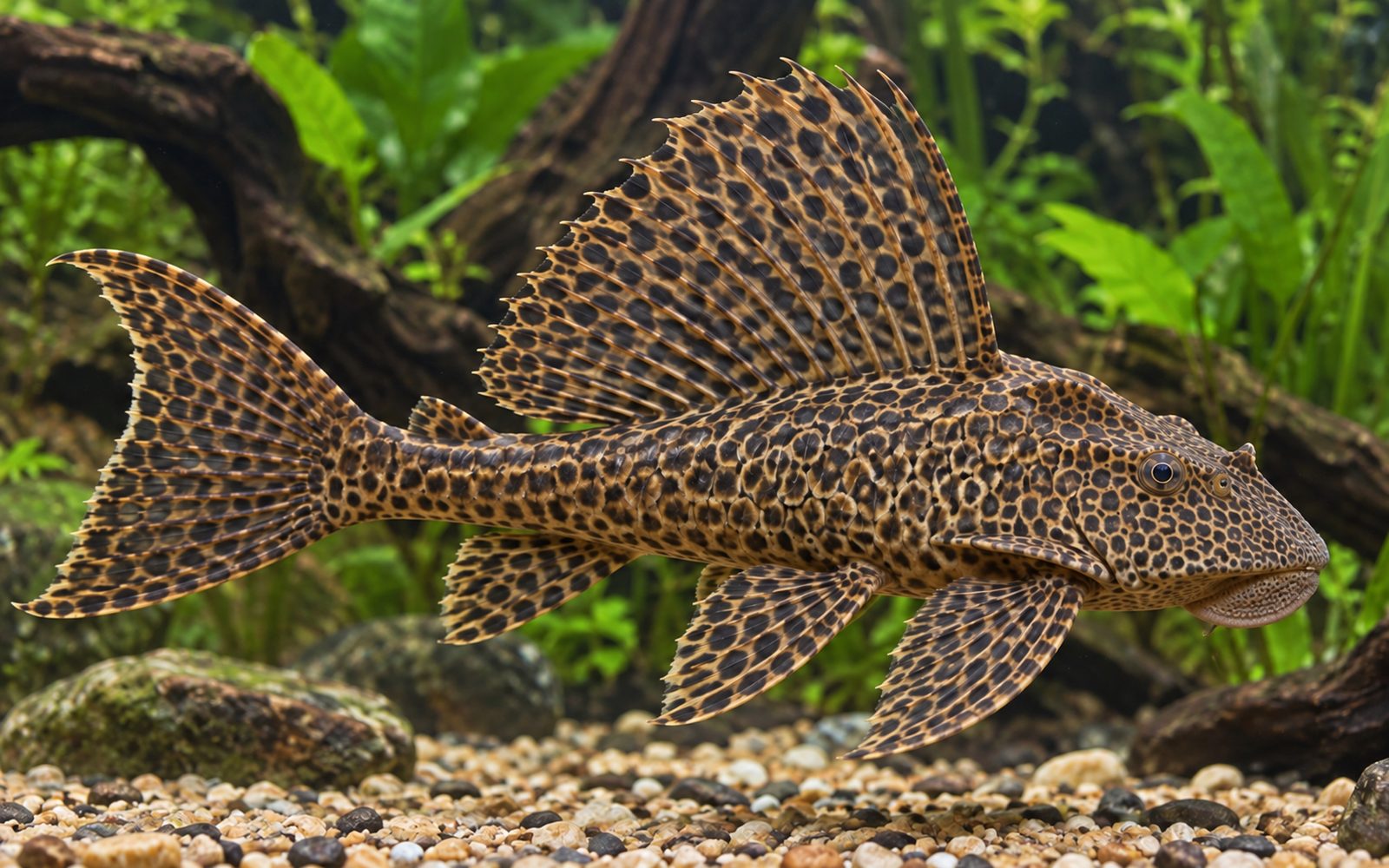
The leopard sailfin pleco is recognized by the tall, sail-shaped fin on its back and the prominent hump on top of its head (the "gibbiceps" in its name comes from this). The dark, leopard-like pattern on a light background becomes more distinct with age.
Juveniles are sold as 5–8 cm "algae eaters", but it reaches 40–50 cm and can live 15–20 years. The same warnings as for the common pleco (P. pardalis) apply: it does not fit in a small aquarium and must never be released into the wild. The numbers L165 and L083 have been given to this species or to very closely related forms; the identity of L083 is disputed.
Natural Habitat
It lives in slow-flowing large rivers, floodplain lakes and still backwaters of the Amazon and Orinoco basins. Muddy bottoms, fallen trees and hollows in the banks are its habitat. When necessary, Pterygoplichthys species can swallow air from the surface and survive even in low-oxygen water.
Tank Setup
- Volume: at least 750 liters and 200 cm length for one adult.
- Filter: a very powerful canister filter or sump; it produces a lot of waste.
- Decor: large, sturdy roots and spacious caves. It uproots and gnaws on plants.
- Water: 24–27°C, adapts to a wide range of parameters; a 30–40% water change every week.
Diet
An omnivore leaning toward a herbivorous diet. Make algae tablets, blanched zucchini, cucumber, potato, spinach and peas the staple; bloodworms or shrimp can be added once a week. The algae in an aquarium is never enough for an adult. Gnawing on wood aids its digestion.
Behavior and Compatibility
Peaceful toward other species. As it grows it becomes territorial toward its own kind and other large bottom dwellers. It has been observed sucking the slime coat of slow, flat-bodied fish.
Good companions: Large, active fish: oscars, silver dollars, large barbs, large Central and South American cichlids (in a very large aquarium).
Avoid: Small aquariums, slow, flat-bodied fish such as discus and goldfish, a second giant pleco (in limited space).
Group and Colony Structure
In a home aquarium it is kept as a single fish. More than one is only possible in ponds or systems over 1000 liters.
Breeding
In the wild it breeds in tunnels it digs in riverbanks; the male guards the eggs. It does not breed in the aquarium; commercial breeding is done in outdoor ponds.
Health and Common Problems
Hardy. The real problem is insufficient space and diet: in a small aquarium, even though growth slows, health deteriorates and water quality collapses. A sunken belly indicates underfeeding. Frequently coming to the surface to gulp air may be a sign that the water's oxygen level is dropping.
Sexing
Hard to tell apart externally. Mature males may have thicker pectoral fin spines covered in odontodes; the difference in the genital papilla can only be seen up close.
Tank mates
This list is calculated automatically from the species profile and grows as new species are added to the catalog. Try it in the planner for a definite answer.
Usually compatible
 Flame Tetra
Glass Tetra
Flame Tetra
Glass Tetra
 Blackfin Corydoras
 Polystictus Corydoras
 Emerald Betta
 Emerald Cory
 Porthole Catfish
 Keyhole Cichlid
 Firemouth Cichlid
 Cupid Cichlid
Should not be kept together


Hobbyist notes
Things you won't find in books, learned by trial and error. The most helpful ones are on top.
Change history and contributors
- Page created · October 16, 2026