
Water parameters
Overview
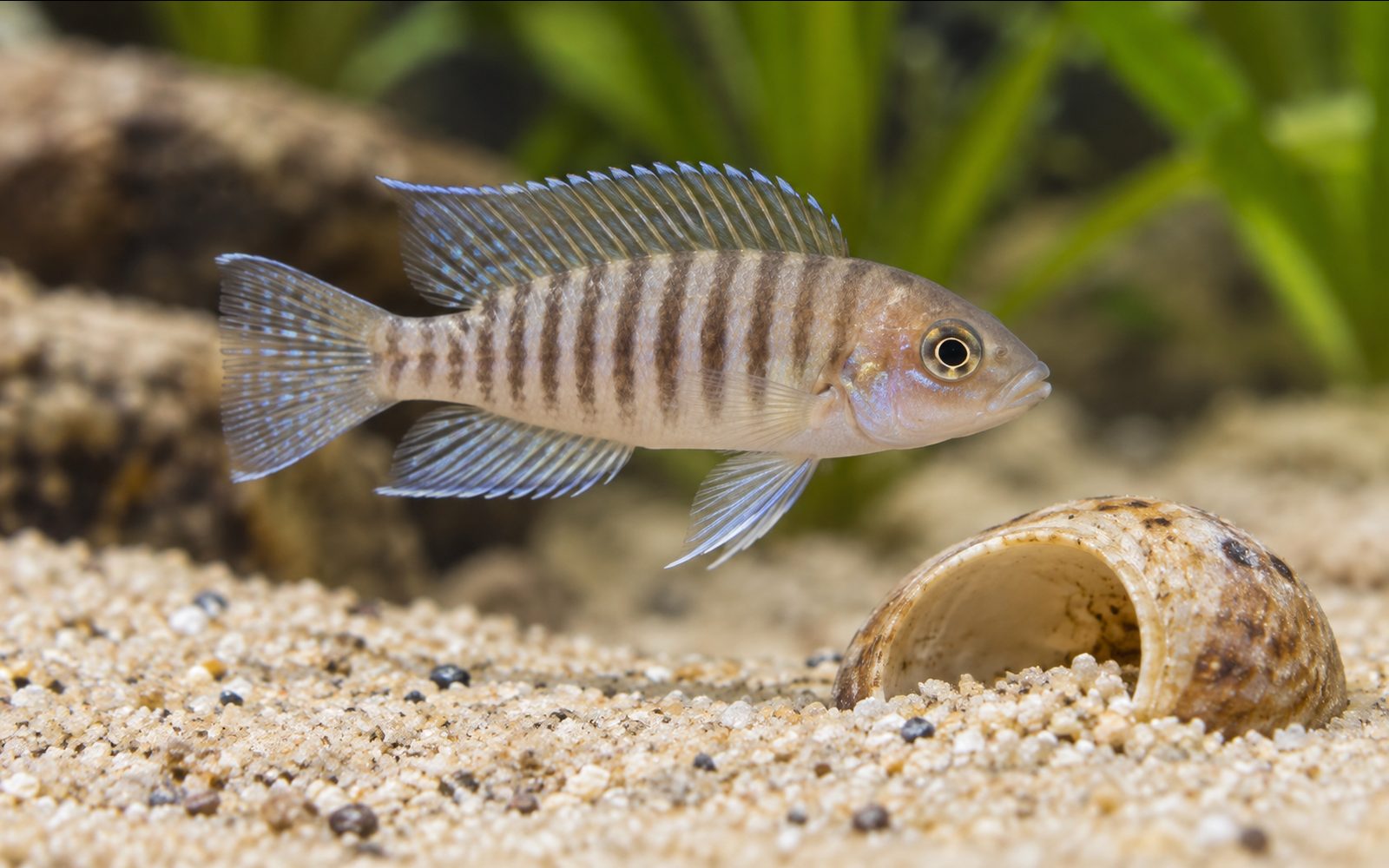
The multifasciatus is one of the smallest known cichlids: adult males barely reach 4.5 cm and females 3 cm. The many thin vertical lines on its light beige body give it its name (multifasciatus: many-banded). Its most fascinating aspect is its way of life: each individual takes an empty snail shell as its home, digs the sand to bury or move shells and defends its small territory within the colony.
Despite its size it is very bold; it will attack even a hand approaching its shell. A colony that forms on its own in a 60 cm aquarium and lasts for years offers one of the most enjoyable sights in the hobby.
Natural Habitat
In the lake it lives in extensive beds made up of the empty shells of the Neothauma snail, found only in Tanganyika, which accumulate on sandy bottoms. In these beds thousands of individuals form tightly packed colonies; each has a shell home and a territory of a few centimeters. When danger threatens, they all dive into their shells at the same moment.
Tank Setup
- Volume: 54–60 liters is enough for a colony of 6–10. What matters is not height but footprint; a length of 60 cm and a depth of at least 30 cm is good.
- Shells: at least 2–3 shells per individual. Use snail shells with an opening of around 2–3 cm, unpainted and thoroughly cleaned; culinary "escargot" (Helix) shells are suitable. Scatter the shells over the sand and the fish will arrange them themselves.
- Substrate: 4–6 cm of fine sand; they dig constantly. Gravel is not suitable.
- Water: hard and alkaline (pH 8–9). Coral sand or aragonite helps keep the pH stable.
- Plants: rooted plants get dug up; Anubias attached to rock and floating plants are more suitable.
Diet
In the wild it feeds on drifting zooplankton and small invertebrates. In the aquarium a fine-grained cichlid granule or crushed flakes should be the staple; frozen cyclops, brine shrimp and daphnia are given a few times a week. Choose small pieces the fry can eat too, and avoid overfeeding in a small volume.
Behavior and Compatibility
It defends an area of 10–15 cm around its shell; it constantly makes small border displays at its neighbors, but serious injuries are rare. It claims the bottom of the aquarium and shows little interest in the middle and upper water.
Good companions: in 100 liters or more, calm Tanganyika species living in the middle to upper water such as Cyprichromis or Paracyprichromis; Julidochromis ornatus or transcriptus in a rocky section.
Avoid: other bottom-dwelling cichlids, other shell-dwelling cichlids in a small aquarium, large or carnivorous fish, Synodontis species that hunt fry. It eats baby shrimp; do not expect shrimp to breed.
Group and Colony Structure
The multifasciatus is a typical colony species:
- 6–10 juveniles are bought together and left to establish their own order. If buying an established group, 1 male : 2–3 females is suitable.
- In a 60 cm aquarium there is usually one, sometimes two dominant males; each male defends a territory that includes the shells of several females.
- There should be more shells than individuals; if shells are scarce, fighting increases.
- The colony grows on its own with fry. When juveniles mature and start looking for space, the extra individuals are removed.
- Adding adults from outside to an established colony is difficult; the newcomer is usually driven away.
Breeding
The female lays a few dozen eggs inside her shell; the male fertilizes them at the shell's opening and guards the territory. The eggs hatch within a few days; after about a week the fry begin to appear at the opening of the shell. They grow on newly hatched brine shrimp and powdered food. The parents protect the fry and do not drive them out of the colony for a long time; thanks to this, several generations can be seen in the aquarium at once.
Health and Common Problems
- Very hardy in general; most problems stem from soft water and low pH.
- Overfeeding: quickly leads to ammonia and nitrate buildup in a small aquarium.
- Contamination from shells: shells with meat remnants inside or painted shells spoil the water; do not use shells until they have been boiled and thoroughly cleaned.
Sexing
Males are noticeably larger (4–4.5 cm versus 3 cm) and claim a wider area. Females are more attached to their shells and are the first to dive into them when danger threatens. It is difficult to tell juveniles apart.
Tank mates
This list is calculated automatically from the species profile and grows as new species are added to the catalog. Try it in the planner for a definite answer.
Usually compatible
 Egyptian Mouthbrooder
 Yellow Tail Acei
Amazon Molly
Yellow Tail Acei
Amazon Molly
 Butterfly Goodeid
Anatolian Killifish
Swamp Guppy
Butterfly Goodeid
Anatolian Killifish
Swamp Guppy
 Horned Nerite Snail
Burdur Killifish
Chalinochromis brichardi
Cyathopharynx furcifer
Horned Nerite Snail
Burdur Killifish
Chalinochromis brichardi
Cyathopharynx furcifer
Should not be kept together






Hobbyist notes
Things you won't find in books, learned by trial and error. The most helpful ones are on top.
Change history and contributors
- Page created · October 16, 2026