
Water parameters
Overview
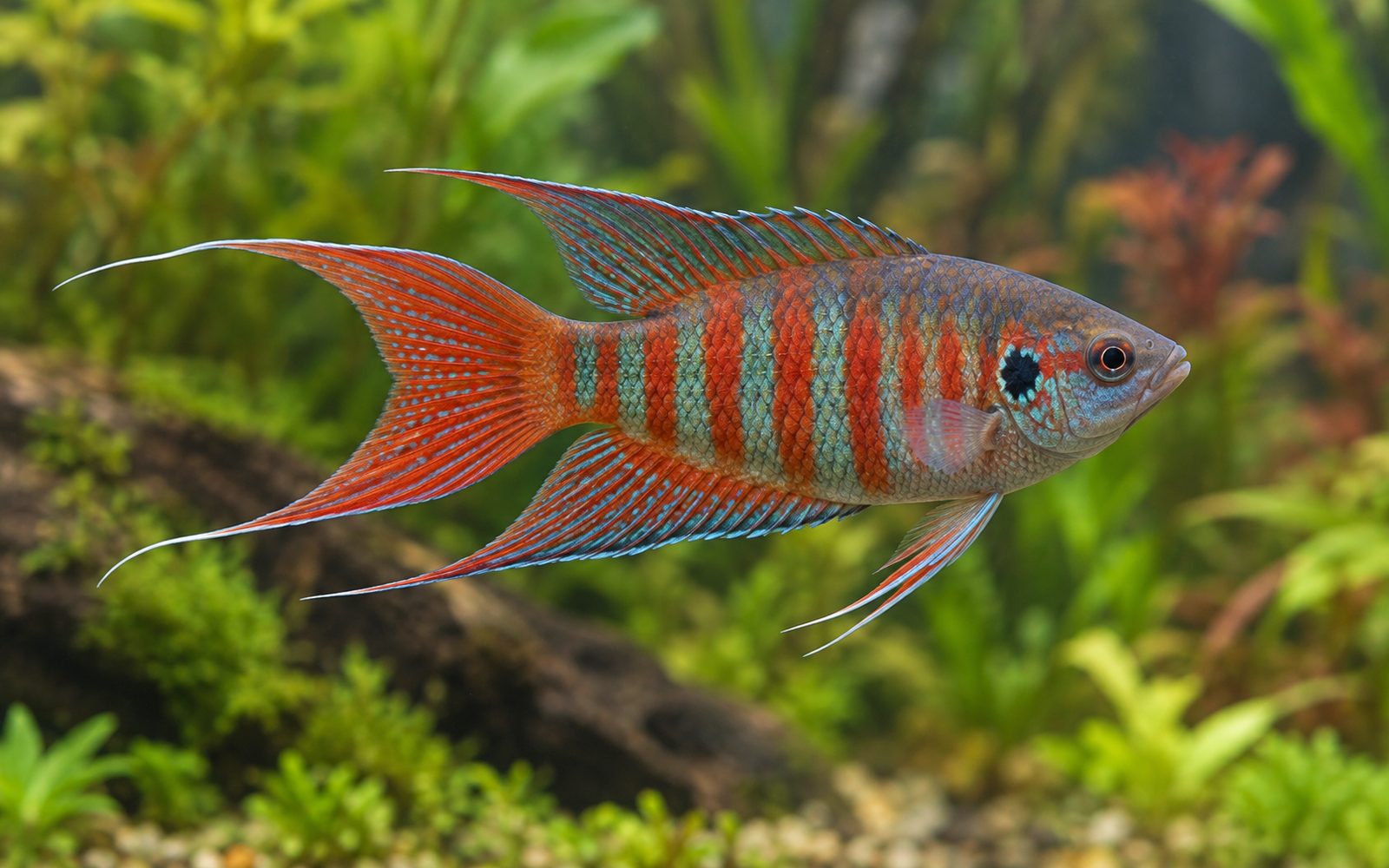
With bright red-orange and blue-green vertical bands crossing its body, a dark eye spot on the gill cover and a forked tail with long tips, the paradise fish is one of the oldest aquarium fish. It is considered one of the first exotic ornamental fish brought to Europe, in the second half of the 19th century. Males reach 8–10 cm including the fins.
It tolerates a wide temperature range; it lives comfortably in an unheated aquarium at room temperature. But behind its cute appearance lies a feisty character: males attack each other, nip the fins of slow fish and hunt fish that fit in their mouths. It is not suited to a community aquarium but to a well-planned setup.
Color and Fin Varieties
- Albino paradise fish: a form with a pink-white body, pale red bands and red eyes.
- Blue (dark) paradise fish: a selectively bred form whose body has shifted to bluish-dark tones; the bands are less distinct.
Natural Habitat
It lives in shallow, planted waters such as rice paddies, ditches, ponds and slow-flowing streams in southern and eastern China, Taiwan and northern Vietnam. Winter waters get quite cold in these regions, which is why the species is much hardier than its tropical relatives.
Tank Setup
- Volume: at least 60 liters for a single male or a pair; 80 liters or more for a harem.
- Water: 18–24°C is ideal; a heater is usually not needed. pH 6–8, a wide hardness range.
- Plants: Dense plants, floating plants and decor that breaks lines of sight; areas where the females can hide are essential.
- Lid: It jumps very well; a tight lid is needed, and leave air between the surface and the lid.
- Flow: Gentle; long-finned males struggle in strong flow.
Diet
Mainly carnivorous and a hearty eater. It accepts quality flakes and granules; supplement with frozen or live bloodworms, brine shrimp, daphnia and mosquito larvae. In the wild it feeds on insect larvae, small crustaceans and fish fry. Feed 1–2 times a day, only as much as is eaten within a few minutes.
Behavior and Compatibility
Males are very aggressive towards each other and fight to the death in a small aquarium. Its relationship with other species varies by individual; it chases slow, long-finned fish and bites their fins. It hunts shrimp, baby snails and small fish that fit in its mouth.
Good companions: fast, sturdy fish of similar size suited to cool water: zebra danios, rosy barbs, larger danio species, bronze corydoras.
Avoid: bettas and other gouramis, long-finned fish such as guppies, small fish such as neon tetras and galaxy rasboras, dwarf shrimp, a second male of its own species.
Group and Colony Structure
The single male rule applies; two males can stay together only in very large, planted aquariums. Giving a male 2 females spreads his attention. Females also establish a hierarchy among themselves; there should be plenty of hiding places.
Breeding
The male builds a large bubble nest among floating plants at the surface, and his colors become their brightest. He draws the female under the nest, and a few hundred eggs are released in embraces; the eggs rise to the surface and are placed in the nest by the male. The female must be removed immediately after spawning; the male attacks her. The eggs hatch in 1–2 days, and once the fry start swimming a few days later the male is removed as well. The fry start on infusoria and quickly reach a size where they can eat brine shrimp nauplii.
Health and Common Problems
Very hardy. The main risk is injuries from wrong tankmate combinations and the bacterial infections that follow them. Keeping it above 28°C for long periods can shorten its life; water a few degrees cooler in winter suits its natural cycle.
Sexing
Males are larger and more vividly colored; their dorsal and anal fins are long and pointed, and the tips of the tail fin end in long filaments. Females are smaller, paler and short-finned; their bellies become noticeably fuller when carrying eggs.
Tank mates
This list is calculated automatically from the species profile and grows as new species are added to the catalog. Try it in the planner for a definite answer.
Usually compatible
 Yellow Regal Peacock
 Emerald Betta
 Emerald Cory
 Porthole Catfish
 Keyhole Cichlid
 Firemouth Cichlid
 Buffalohead Cichlid
 Geophagus surinamensis
 Rainbow Cichlid
 Gymnogeophagus balzanii
Should not be kept together







Hobbyist notes
Things you won't find in books, learned by trial and error. The most helpful ones are on top.
Change history and contributors
- Page created · October 16, 2026