
Water parameters
Overview
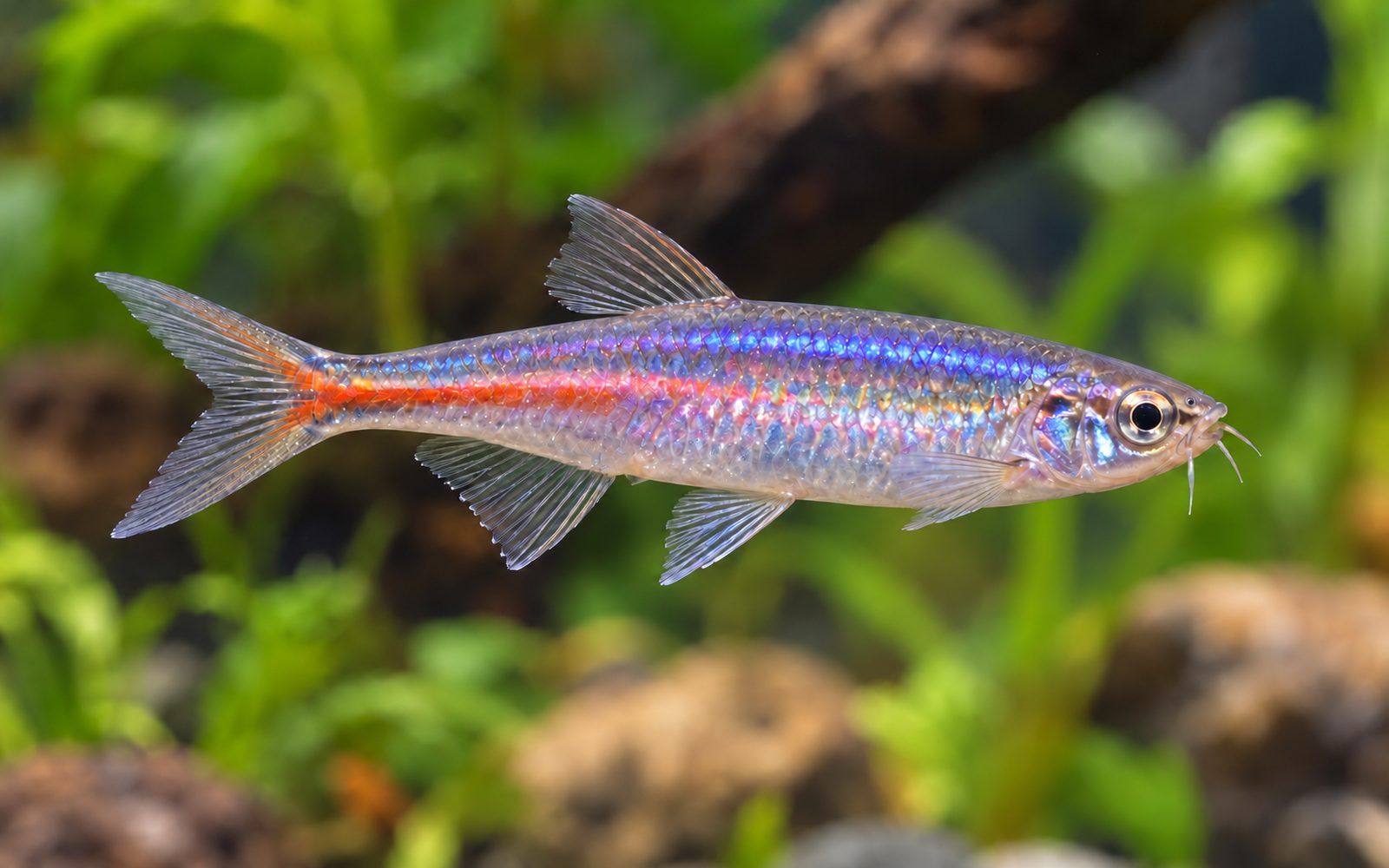
The pearl danio is a close relative of the zebra danio and just as hardy, but more elegant in appearance. Its slender, elongated body is covered with a nacreous sheen that gives off blue, purple and pink reflections depending on the angle of the light. On the rear half of the body there is a thin orange-red line running towards the tail; this line is brighter in males.
It grows to about 6 cm. It is a very fast species that is constantly on the move; since it adapts to a wide range of water values and to cool water, it is also suitable for beginners. Its shimmer is best seen in light coming from the side as the school swims.
Color and Fin Varieties
- Gold pearl danio: a cultivated form with a yellowish-gold base color and a fainter nacreous sheen; its care is the same as the wild form.
Natural Habitat
It is spread over a wide area of Southeast Asia: clear streams in hilly regions, gravelly river tributaries and lowland ponds. The water is usually flowing, rich in oxygen and close to neutral; the temperature varies markedly with the seasons.
Tank Setup
- Volume: at least 80 liters for a school of 6–8; a length of 70–80 cm or more matters more than volume.
- Water: 20–25°C, pH 6.5–7.5. In homes with a stable room temperature it can be kept without a heater.
- Flow: it likes moderate current; it swims in the filter outflow.
- Layout: plants along the sides, wide open space at the front and top.
- Lid: an excellent jumper; a lid is essential.
Diet
Omnivorous with a good appetite. Use flakes and granules as the staple; vary the diet with frozen brine shrimp, daphnia, mosquito larvae and bloodworms. In the wild it catches insects that fall onto the surface; it takes most of its food from the surface.
Behavior and Compatibility
Peaceful but very active. As a school it constantly moves through the upper layer; males chase the females and each other. Because of its speed it can bother slow and long-finned species.
Good companions: other danios, medium-sized rasboras, barbs, corydoras, loaches, kuhli loaches, rainbowfish.
Avoid: slow and shy species, fish with flowing fins such as bettas, predators large enough to swallow it.
Group and Colony Structure
At least 6, ideally 10 or more individuals. In a large school the chasing is spread among many individuals and the fish look calmer. Kept in small numbers, a dominant male can constantly wear out the others.
Breeding
It scatters its eggs among plants or gravel; there is no parental care and the eggs are eaten quickly. For breeding, an egg grid, coarse gravel or dense moss is placed on the bottom of a shallow aquarium and a well-fed group is kept there for a few days. It spawns in the early morning hours. After the adults are removed, the fry become free-swimming within a few days; they are fed infusoria and then newly hatched brine shrimp.
Health and Common Problems
Very hardy. Jumping out of a cramped tank without a lid is the most common cause of loss. Poor water quality can lead to white spot and fin rot; do 25–30% water changes weekly.
Sexing
Males are slimmer; the orange-red line on the body and the warm tones in the fins are brighter. Females have a fuller belly and are slightly paler.
Tank mates
This list is calculated automatically from the species profile and grows as new species are added to the catalog. Try it in the planner for a definite answer.
Usually compatible
 Flame Tetra
 Blackfin Corydoras
 Polystictus Corydoras
 Emerald Cory
 Emerald Dwarf Rasbora
 Porthole Catfish
 Keyhole Cichlid
 Geophagus surinamensis
 Cryptocoryne Parva
 Gold Spot Pleco (L001)
Should not be kept together






Hobbyist notes
Things you won't find in books, learned by trial and error. The most helpful ones are on top.
Change history and contributors
- Page created · October 16, 2026