
Water parameters
Overview
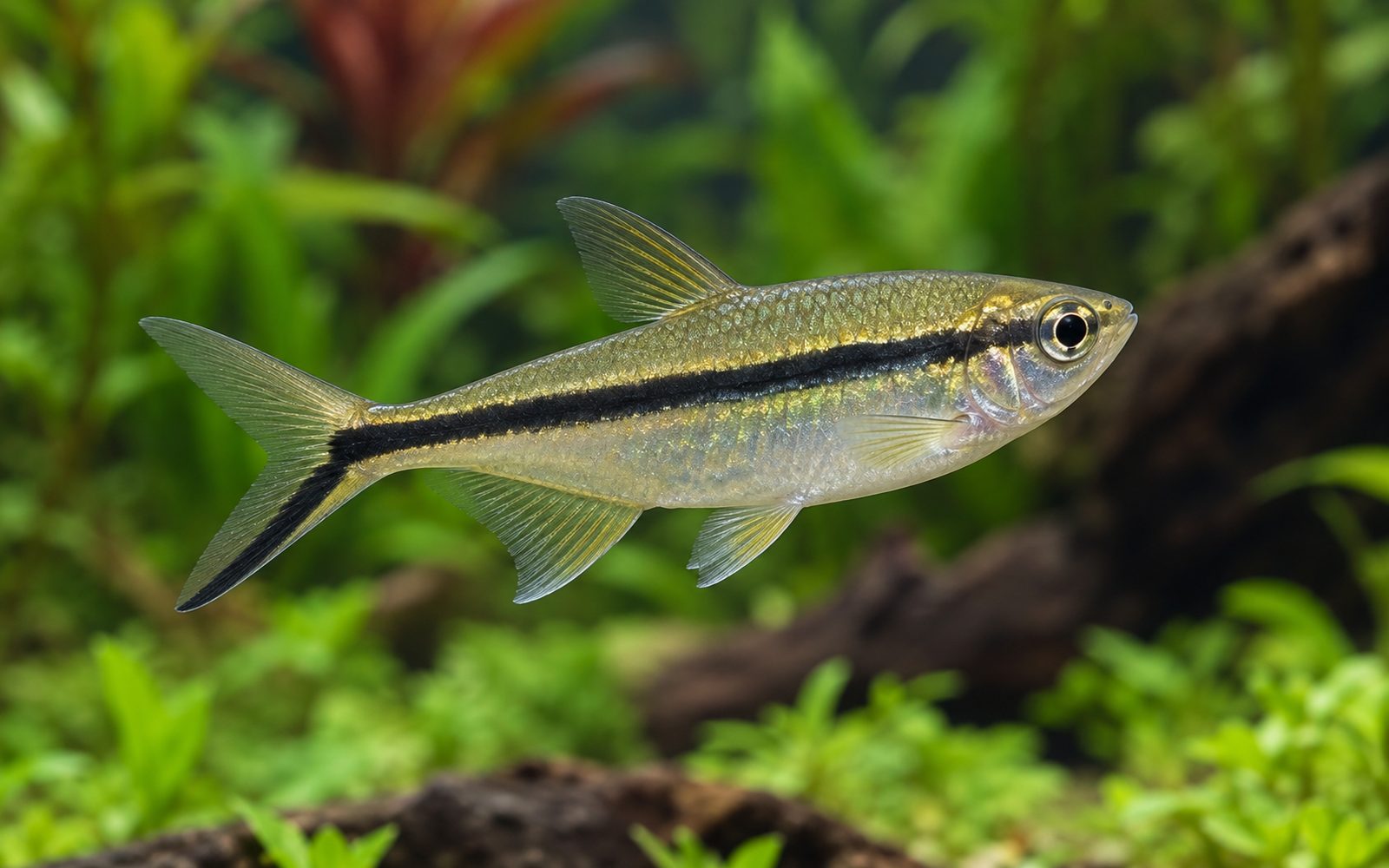
The penguin tetra is recognized by the thick black line that starts behind the gill cover, runs along the body and curves down into the lower lobe of the tail; this line resembles a hockey stick. When at rest it holds a slanted posture with its head slightly raised. Because of this posture and its black-and-silver look, it was given the name "penguin."
It is a hardy, inexpensive species; farm-bred fish are easy to find. With its active nature and its liking for swimming in open water, it brings the middle and upper layers of the aquarium to life.
Natural Habitat
It lives in slow-flowing branches and floodplains of large rivers in the Amazon basin in Peru and Brazil, usually in planted areas close to the surface.
Tank Setup
- Volume: at least 80 liters for a school of 6–10; a length of 80 cm is recommended.
- Water: 23–27°C, pH 6–7.5, soft to moderately hard water.
- Lid: it may leap out of the water when startled; a lid is essential.
- Decor: plants along the edges, floating plants on part of the surface, a large open area in the middle.
- Maintenance: a 25% water change every week; gentle to moderate flow is tolerated.
Diet
Omnivorous. It readily takes flakes and granules at the surface or in midwater. Vary it with frozen brine shrimp, bloodworms, daphnia and mysis shrimp. Feed 1–2 meals a day, only as much as is eaten within a few minutes; because it has a big appetite, avoid overfeeding.
Behavior and Compatibility
Peaceful but active; small chases are seen within the school. It usually does not harm other species, but its activity may unsettle very small and skittish species. It usually leaves adult shrimp alone.
Good companions: medium-sized tetras, rasboras, danios, corydoras, plecos, gouramis, peaceful cichlids.
Avoid: large predators that could fit it in their mouths, very small nano species, aggressive cichlids.
Group and Colony Structure
A school of at least 6, ideally 10 is recommended. In a large group the fish swim together in open water and their slanted posture becomes more noticeable. The sex ratio does not matter. When kept in small numbers the school breaks up and the fish become more skittish.
Breeding
It is an egg scatterer and quite prolific. A separate tank is prepared with soft, slightly acidic water and fine-leaved plants; the female lays a large number of eggs. The parents are removed after spawning. The fry are fed infusoria, then newly hatched brine shrimp.
Health and Common Problems
- Losses from jumping: the most common cause of death in tanks without a lid.
- White spot (ich): may appear after transport.
- General: it is hardy; with regular water changes it rarely causes problems.
Sexing
Females are larger with a plumper belly; the difference becomes clear especially when they are carrying eggs. Males are more slender.
Tank mates
This list is calculated automatically from the species profile and grows as new species are added to the catalog. Try it in the planner for a definite answer.
Usually compatible
 Flame Tetra
 Blackfin Corydoras
 Polystictus Corydoras
 Emerald Cory
 Emerald Dwarf Rasbora
 Porthole Catfish
 Keyhole Cichlid
 Cupid Cichlid
 Geophagus altifrons
 Geophagus surinamensis
Should not be kept together






Hobbyist notes
Things you won't find in books, learned by trial and error. The most helpful ones are on top.
Change history and contributors
- Page created · October 16, 2026