
Water parameters
Overview
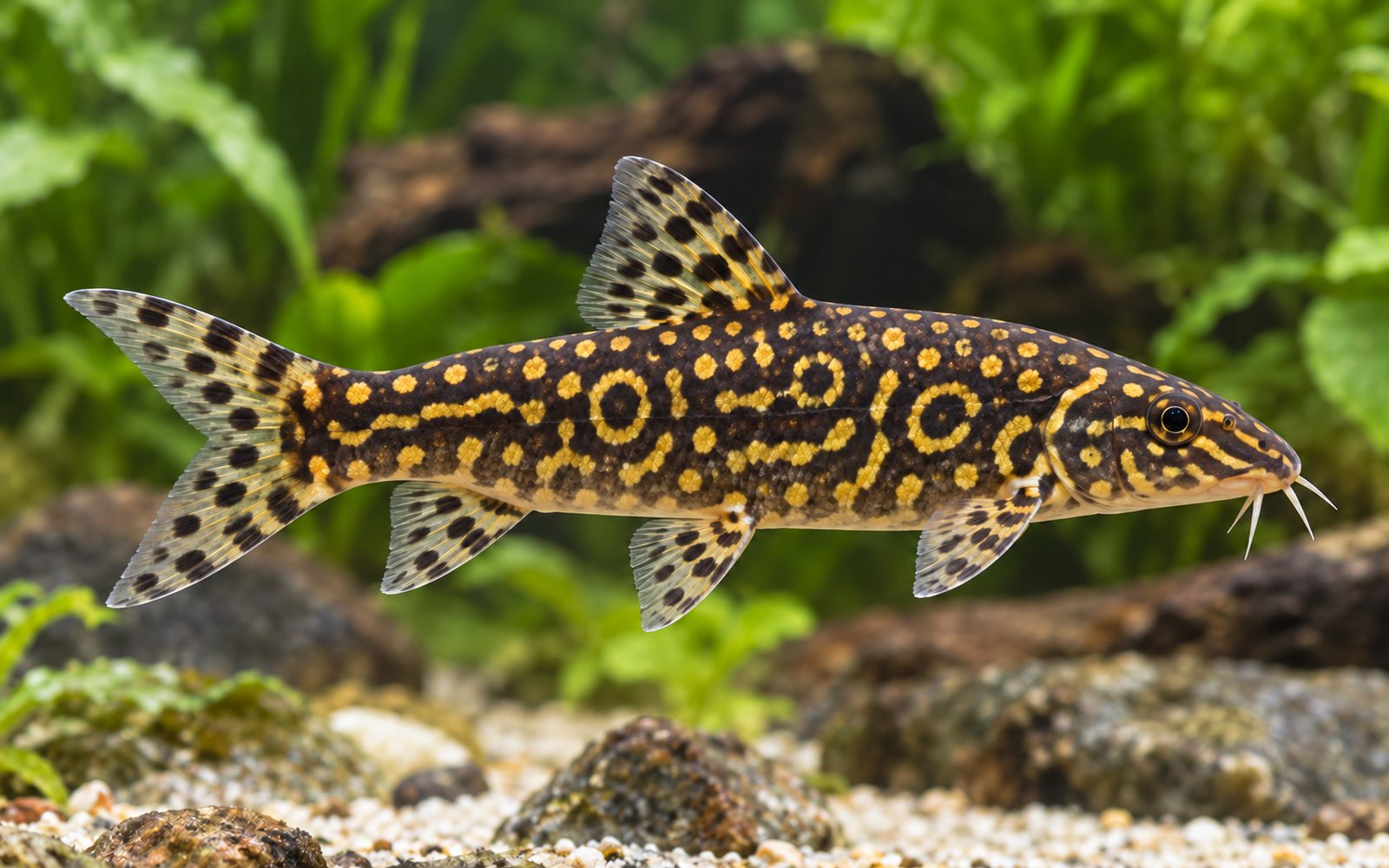
With golden yellow spots and wavy lines on a dark brown to black background, the polka-dot loach is one of the most patterned botias. It was introduced to science in 2004; before that it was sold in the trade as "Botia sp. Angelicus", and that name is still widely used.
Juveniles have dark bands on the body and are confused with the golden zebra loach at this stage. In the kubotai the bands split in two at an early age and form pointed tips; as the fish ages the dark areas widen, the yellow pattern becomes thinner and a spotted look emerges. Adults reach 13–15 cm.
Natural Habitat
It lives in flowing, clear, well-oxygenated streams in the upper tributaries of the Salween basin on the border between Myanmar and Thailand. The bottom consists of sand, gravel and large stones; the fish hide among and under the stones.
Tank Setup
- Volume: at least 240 liters and 120 cm of length for a group of 5–6; floor area matters more than depth.
- Water: 23–27°C, pH 6–7.5, soft to moderately hard. A 30% water change every week.
- Flow: Moderate to strong flow and plenty of oxygen. A powerful canister filter or an additional circulation pump is suitable.
- Decor: Rounded stones, roots and caves with narrow openings. Every individual should be able to find a shelter of its own.
- Lid: A tight lid is essential; it jumps.
Diet
An omnivore leaning toward meaty foods. Sinking granules and tablets should be the staple; frozen bloodworms, brine shrimp, mysis and tubifex should be given regularly. It also nibbles blanched zucchini, cucumber and spinach. It hunts small snails, but it should not be expected to end an infestation on its own.
Behavior and Compatibility
Peaceful but curious and active; it can disturb very small, calm fish. Jostling within the group is natural and usually harmless. In an aquarium with enough hiding places it is often seen during the day as well.
Good companions: danios, devarios, rasboras, medium-sized barbs, large tetras, other medium-sized botias.
Avoid: snails, shrimp, slow long-finned fish such as bettas and fancy goldfish, large cichlids that claim the bottom.
Group and Colony Structure
The polka-dot loach is a social schooling fish: at least 5–6, ideally 8–10 individuals. One or two individuals become stressed, hide and grow prone to disease. In a large group a pecking order forms; the fish rest together, feed together and play. It may also swim with other botia species, but enough of its own kind is still needed.
Breeding
There is no known reliable record of it being bred in the aquarium. The fish sold are collected from the wild.
Health and Common Problems
- White spot: Common in newly arrived botias; quarantine is essential.
- Medication sensitivity: Its scales are very small; start medications at half the dose and raise the temperature slowly.
- Wasting: Internal parasites are common in wild-caught fish. Do not buy a fish with a sunken belly or one that refuses food.
Sexing
Mature females have a fuller body and a rounded snout. Males have a slightly longer snout and appear to have fleshier lips. The difference can only be seen in adults and when they are compared side by side.
Tank mates
This list is calculated automatically from the species profile and grows as new species are added to the catalog. Try it in the planner for a definite answer.
Usually compatible
 Flame Tetra
Glass Tetra
Flame Tetra
Glass Tetra
 Blackfin Corydoras
 Polystictus Corydoras
 Emerald Betta
 Emerald Cory
 Porthole Catfish
 Keyhole Cichlid
 Firemouth Cichlid
 Cupid Cichlid
Should not be kept together






Hobbyist notes
Things you won't find in books, learned by trial and error. The most helpful ones are on top.
Change history and contributors
- Page created · October 16, 2026