
Water parameters
Overview
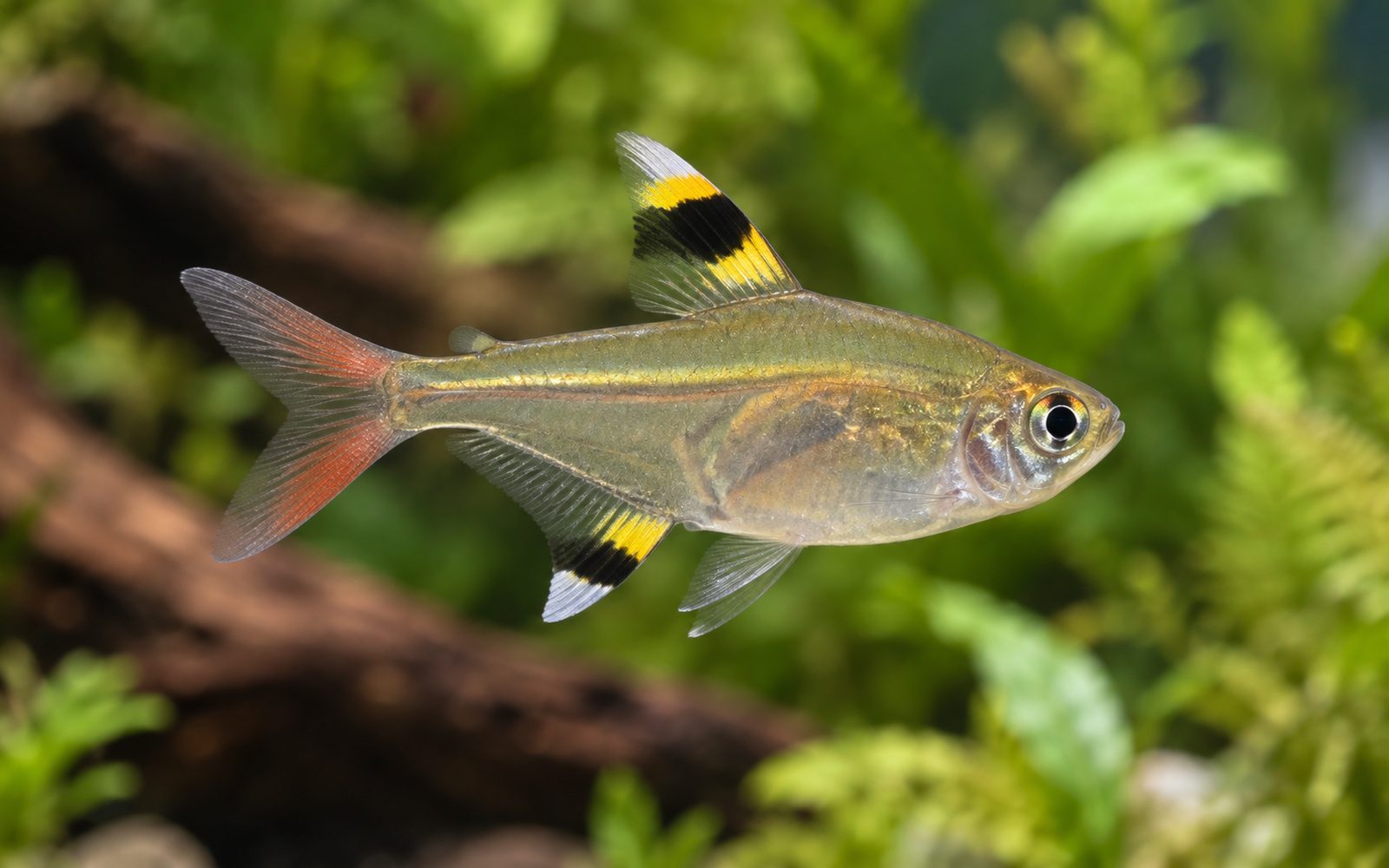
The pristella tetra is also called the "X-ray tetra" because of its semi-transparent body, through which the shadow of its internal organs can be made out when held against the light. Its main distinguishing mark is the three-layered band of yellow, black and white on each of its dorsal and anal fins; the tail fin is slightly reddish. Almost all fish sold in the trade are farm-bred; besides the wild form, there are also golden and albino varieties.
It is extremely tolerant of water values, resistant to disease and inexpensive. This makes it an even more forgiving choice than the neon tetra for people setting up their first aquarium.
Natural Habitat
Its natural range is the northeastern coastline of South America and the parts of the Orinoco and lower Amazon close to the coast. It lives both in soft, brown waters and in harder, clear streams; it has also been recorded in slightly brackish, tidal areas near the sea. It prefers shallow, planted shoreline areas and the still edges of flooded forests.
Tank Setup
- Volume: at least 60 liters for a school of 8–12; a length of 60 cm or more is important so the school can swim comfortably.
- Water: 24–26°C is the comfortable range. It lives without problems across a wide range of pH 6–8 and soft to hard water.
- Decor: dense plants along the edges, an open area in the middle. A dark substrate and background make the semi-transparent body and the fin bands stand out.
- Maintenance: a 20–25% water change every week is enough; filter flow can be moderate.
Diet
Omnivorous and not fussy about food. As the staple, give small-grained granules or crumbled flakes. Adding frozen or live brine shrimp, daphnia, cyclops and fine bloodworms a few times a week improves its colors and condition. 1–2 meals a day, only as much as is eaten within a few minutes, is enough.
Behavior and Compatibility
A peaceful and active schooling fish that cruises the middle layer of the aquarium. It has no fin-nipping habit, so it usually causes no problems with long-finned species either. It leaves adult dwarf shrimp alone but may catch newborn shrimplets.
Good companions: other small tetras, rasboras, corydoras, otocinclus, dwarf gouramis, small livebearers such as guppies and platies.
Avoid: fish large enough to fit it in their mouths (adult angelfish, large cichlids) and aggressive species that chase constantly.
Group and Colony Structure
It is a species that finds security in a school: at least 8, ideally 12 or more individuals. In a large group the fish come out into the open more boldly and change direction together; in a group of 3–4 they are shy and retreat among the plants. The sex ratio does not matter.
Breeding
It is an egg scatterer that is relatively easy to breed in the aquarium. A separate breeding tank is prepared with soft, slightly acidic water (pH 6–6.5), a temperature of 26–27°C and fine-leaved plants or a spawning mop. A well-fed pair usually scatters its eggs among the plants in the morning; because the parents eat the eggs, they should be removed right after spawning. The eggs hatch in 1–2 days, the fry become free-swimming a few days later and are fed first infusoria, then newly hatched brine shrimp.
Health and Common Problems
- White spot (ich): may appear after sudden drops in temperature; raising the temperature slowly and using a suitable medication is effective.
- General resistance: it is very resistant to disease; problems mostly come from poorly maintained water or a newly set-up aquarium.
- Quarantine: keeping newcomers separate for 2 weeks is the best precaution to avoid putting the whole school at risk.
Sexing
Males are slimmer and smaller; the colors in their fin bands are slightly more intense. Females are larger with a plumper belly. Thanks to the semi-transparent body, it is often noted that the swim bladder looks more pointed in the male and rounder in the female.
Tank mates
This list is calculated automatically from the species profile and grows as new species are added to the catalog. Try it in the planner for a definite answer.
Usually compatible
 Flame Tetra
 Blackfin Corydoras
 Polystictus Corydoras
 Emerald Cory
 Emerald Dwarf Rasbora
 Porthole Catfish
 Keyhole Cichlid
 Cupid Cichlid
 Geophagus altifrons
 Geophagus surinamensis
Should not be kept together







Hobbyist notes
Things you won't find in books, learned by trial and error. The most helpful ones are on top.
Change history and contributors
- Page created · October 16, 2026