
Water parameters
Overview
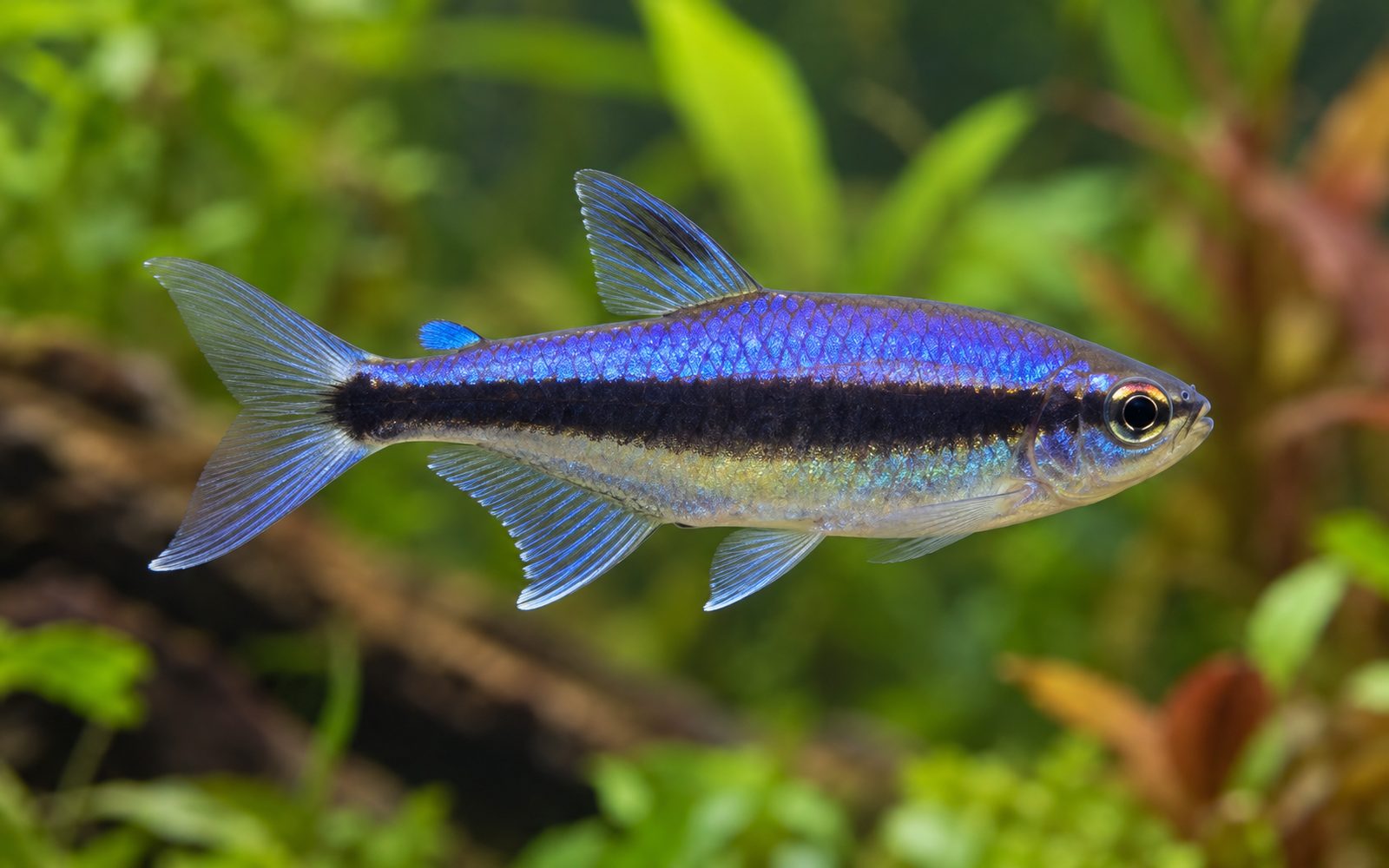
With the males' bright blue-purple body and the dark lateral band running from head to tail, the royal tetra resembles the emperor tetra; for this reason it is also sold as the "blue emperor." Females have brownish-yellow tones and only a faint blue sheen. The species was described in 1977 and is one of the relatively new tetras from the southern Amazon.
It is an easy-care, peaceful and colorful species; in planted aquariums the males' blue looks very striking.
Natural Habitat
It lives in slow-flowing tributaries of the Aripuanã River system, part of the Madeira basin, in the Brazilian state of Mato Grosso. The water is soft and slightly acidic, with dense plants and roots.
Tank Setup
- Volume: at least 60 liters for a group of 8–12.
- Water: 24–27°C, pH 6–7.5, soft to moderately hard water.
- Decor: a dark substrate, planted edges and floating plants bring out the blue color.
- Maintenance: a 20–25% water change every week; gentle flow.
- Maturity: it should not be the first fish added to a newly set-up tank; choose a tank that has finished cycling and has stable values.
Diet
Omnivorous. Alongside small granules and flakes, give frozen brine shrimp, daphnia, cyclops and fine bloodworms. A varied diet intensifies the males' colors.
Behavior and Compatibility
Peaceful. Males display to each other by spreading their fins and small chases occur, but they do no harm. It does not bother other species and leaves adult shrimp alone.
Good companions: small tetras, rasboras, pencilfish, corydoras, otocinclus, dwarf cichlids, shrimp.
Avoid: large, predatory fish, active fin-nipping species, aggressive cichlids.
Group and Colony Structure
A group of at least 8, ideally 12 is recommended. Having more than one male in the group brings out the displays and the colors. A balanced or female-heavy ratio is suitable. When kept in small numbers, the fish retreat among the plants and the males' blue fades noticeably.
Breeding
It is an egg scatterer. Breeding requires a separate tank with soft, acidic water, dim light and fine-leaved plants or a spawning mop. The parents are removed after spawning. The fry are small and are fed infusoria in the first days.
Health and Common Problems
- White spot (ich): may appear after transport; quarantine is recommended.
- Loss of color: stress and poor water quality make the males' blue fade.
- General: it is hardy in mature, clean water.
Sexing
Telling them apart is easy. Males are bright blue-purple, females brownish-yellow. Another commonly used sign is the adipose fin: it is bluish in males and red-orange in females.
Tank mates
This list is calculated automatically from the species profile and grows as new species are added to the catalog. Try it in the planner for a definite answer.
Usually compatible
 Flame Tetra
 Blackfin Corydoras
 Polystictus Corydoras
 Emerald Cory
 Porthole Catfish
 Keyhole Cichlid
 Cupid Cichlid
 Geophagus surinamensis
 Cryptocoryne Parva
 Gold Spot Pleco (L001)
Should not be kept together







Hobbyist notes
Things you won't find in books, learned by trial and error. The most helpful ones are on top.
Change history and contributors
- Page created · October 16, 2026